
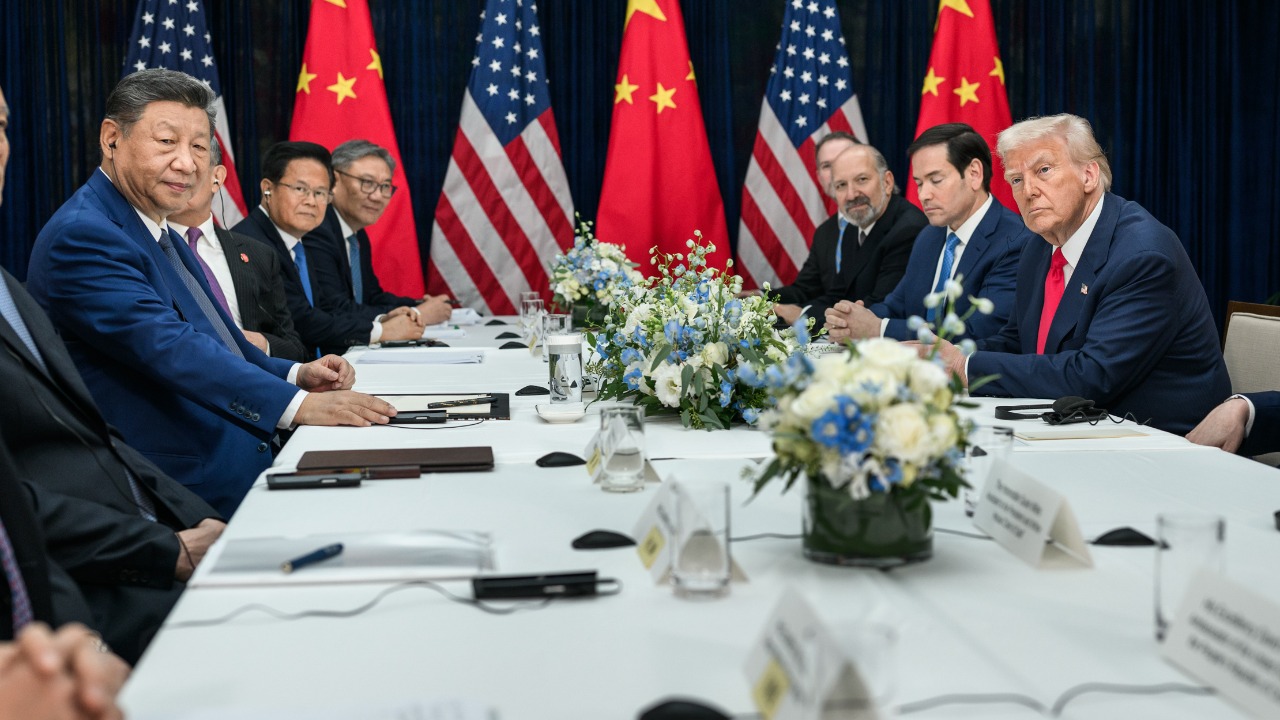
The second Trump administration’s new National Security Strategy marks a sharp pivot in how Washington talks about power. Instead of promising to stop China’s rise, it accepts that Beijing is now a near-peer competitor and shifts the contest to specific regions and sectors. At the same time, President Donald Trump is reviving a Monroe Doctrine-style vision for “our hemisphere,” betting that consolidating dominance close to home can offset a more crowded global landscape.
The result is a strategy that narrows America’s ambitions while hardening its edges, pairing a pragmatic acknowledgment of China’s global status with a more assertive posture in the Western Hemisphere. It is less about restoring a singular superpower moment than about managing rivalry, from the Caribbean to the Taiwan Strait, on terms the White House believes are more sustainable.
China moves from ‘emerging’ to entrenched rival
The new strategy starts from a premise that would have been politically unthinkable in Washington a decade ago: China is no longer treated as an “emerging” power to be socialized into existing rules, but as a fully formed competitor whose economic and technological weight must be managed rather than reversed. The document frames China as a near-peer, reflecting the reality that Beijing now shapes global trade, supply chains, and advanced industries in ways the United States can no longer ignore or easily redirect. That recognition aligns with the broader picture of China as a central node in the world economy and a leading Pacific power.
Within the strategy, China is described as the most referenced foreign state, a reflection of how deeply it is now woven into U.S. thinking about trade, technology, and security. The document reiterates a long-standing grievance of Trump’s about the trade deficit with China and stresses that China has become a World Pacific Power that can no longer be treated as a junior player. This framing does not concede ideological ground, but it does concede structural reality: the United States is planning for a world in which China is permanently embedded as a top-tier power, not a problem to be solved and set aside.
A Trump Corollary to the Monroe Doctrine
Where earlier strategies cast the United States as the anchor of a global order, the new blueprint narrows the aperture and elevates the Western Hemisphere as the primary arena of competition. President Donald Trump has wrapped this shift in the language of a “Trump Corollary” to the Monroe Doctrine, signaling that Washington will treat political, economic, and military influence in Latin America and the Caribbean as a core interest. In public remarks, Trump has spoken of “our hemisphere” and framed the policy as a 21st century makeover of the 19th century doctrine that warned European powers away from the Americas, a theme underscored when he used a proclamation to mark the Monroe Doctrine and present a revamped approach that he has branded Tru.
The strategy’s language on “Non Hemispheric competitors” is explicit about what that means in practice. It warns that Non Hemispheric competitors have made major inroads into our Hemisphere, citing Chinese investment and Russian security ties as examples of how outside powers are gaining leverage in what Washington still sees as its strategic backyard. The Trump team’s answer is to reassert U.S. primacy through trade, infrastructure, and security partnerships that crowd out rivals, while also signaling that certain forms of Chinese and Russian presence will be treated as direct challenges to American influence.
From global policeman to regional power broker
Behind the Monroe Doctrine rhetoric lies a broader recalibration of America’s role in the world. The Trump administration’s new National Security Strategy envisions a future in which the United States no longer automatically anchors every region, but instead prioritizes where it believes the stakes are highest. Analysts note that The Trump administration’s new National Security Strategy sketches a world that looks less like the unipolar moment after the Cold War and more like a competitive map of spheres of influence. In this view, the Western Hemisphere is elevated, parts of the Middle East are downgraded, and Europe is expected to shoulder more of its own defense.
This regional turn is not just geographic, it is also functional. The Trump team is explicit that it will compete with China primarily by strengthening the U.S. defense industrial base and leaning into “America First” economic policies, rather than by underwriting a sprawling multilateral order. The strategy describes a dual-track approach to China that seeks to contain Beijing’s global influence where it directly threatens U.S. interests, while accepting that some areas will be arenas of managed competition rather than outright dominance. That logic is reflected in the way The Trump administration’s strategy also outlines a dual-track approach to China, pairing efforts to “cultivate resistance” to Chinese influence in key regions with a focus on domestic economic resilience.
Indo-Pacific burden sharing and the Taiwan status quo
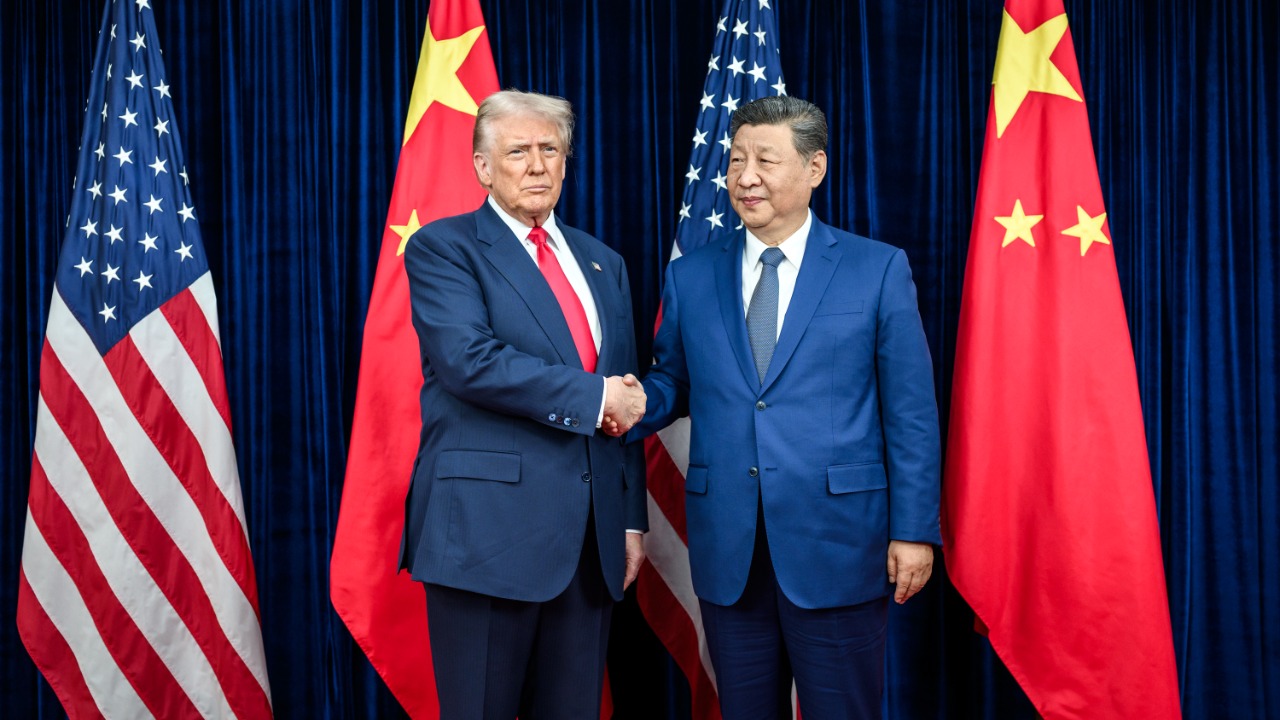
Even as the White House pulls focus toward the Western Hemisphere, the Indo-Pacific remains the central theater of military competition with Beijing. The new strategy keeps the defense of Taiwan a priority, but it does so while pressing regional partners to carry more of the load. The document maintains the long-standing “one China” policy and support for the existing status quo around Taiwan, yet it is clear that Washington expects allies like Japan and South Korea to expand their own capabilities and contributions. That expectation is reflected in the way the national security strategy released on Friday keeps Taiwan at the forefront while urging Indo Pacific allies to share more of the burden for regional security.
This approach effectively freezes the political question of Taiwan while accelerating the military and economic competition around it. By emphasizing a “free and open” Indo-Pacific and calling for more robust allied defense spending, the Trump administration is signaling that it will not seek a grand bargain with Beijing over the island, but will instead harden the status quo. At the same time, the strategy’s regional focus means that U.S. resources are not unlimited, which is why the document stresses that China is a World Pacific Power that must be balanced through coalitions and local capacity, not just American deployments.
Reasserting ‘our hemisphere’ against China and Russia
The most striking operational test of the Trump Corollary is in Latin America, where Washington is now openly framing Chinese and Russian activity as encroachments on U.S. space. The strategy warns that Non Hemispheric competitors are using infrastructure projects, technology platforms, and security partnerships to “disadvantage us economically in the present and strategically in the future.” In response, Trump has pledged to reassert the Monroe Doctrine to restore American power, casting the policy as a corrective to what he portrays as years of neglect. In one widely noted appearance, Trump pledges to reassert Monroe Doctrine to restore American power, a line that encapsulates his view that the United States must once again police the boundaries of external influence in the Americas.
Officials close to the strategy argue that this is not a call for unilateral intervention, but for a more muscular economic and diplomatic presence that gives regional governments alternatives to Chinese financing and Russian security deals. The document’s language on “our hemisphere” is paired with promises of joint development and infrastructure investment that, in theory, would make U.S. partnerships more attractive than rival offers. That logic is echoed in the way Key points from the Center highlight Chinese investment as a specific concern, underscoring that the Trump team sees economic statecraft, not just military posture, as the main tool for reasserting primacy in the region.
A narrower strategy with sharper edges
What ties these strands together is a willingness to trade breadth for intensity. The Trump administration is not trying to resurrect the postwar model in which the United States sought to shape every major region simultaneously. Instead, it is concentrating on the Western Hemisphere and the Indo-Pacific, while signaling that other theaters will receive less attention unless they intersect directly with the contest against Beijing and Moscow. That shift is evident in the way President Donald Trump talks about “our hemisphere” as the primary stage for restoring American preeminence, even as his national security team describes a more selective global role.
At the same time, the strategy leans heavily on economic and industrial tools to sustain competition. It calls for bolstering the U.S. defense industrial base, tightening supply chains, and using trade policy to favor domestic production, all framed as necessary to compete with Beijing’s state-backed model. The administration presents this as a way to help partner nations build up their own economies while deepening ties with Washington, a vision captured in the assertion that “The goal is for our partner nations to build up their domestic economies” through joint development with regional partners. In practice, that means the United States is betting that a tighter, more transactional network of regional relationships, backed by industrial strength at home, can offset the reality that China has already arrived as a global power.