
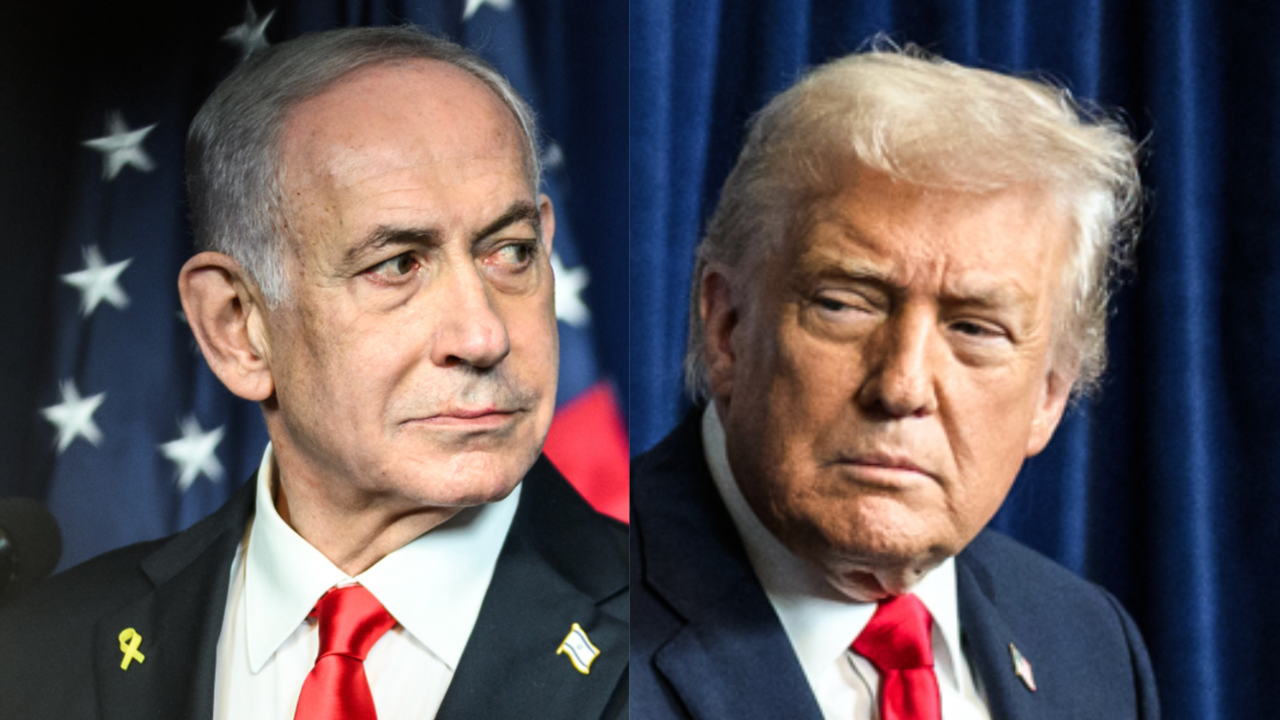
Israeli Prime Minister Benjamin Netanyahu told his cabinet on Sunday that Israel is formally rejecting U.S. President Donald Trump’s latest 15-point plan to end the war in Gaza, insisting the Israel Defense Forces will not begin any withdrawal from the territory until Hamas surrenders every weapon in its arsenal. The declaration, delivered in televised remarks at the opening of Sunday’s government meeting, sets Netanyahu on a collision course with Trump’s Board of Peace at a moment when Israel’s own military has quietly scaled back its operations in Gaza under pressure from Washington.
“Israel does not accept the 15-point document,” Netanyahu said, adding that he wanted to state it plainly after hearing complaints that he had not been direct enough earlier in the week. He said the IDF “will not carry out any withdrawal until Hamas is disarmed,” specifying that the demand covers “heavy weaponry, lighter weaponry, all weaponry,” and that Israel is seeking “genuine disarmament, not fictitious disarmament.”
A Rejection Restated for the Cameras
Netanyahu’s Sunday comments were not the first time he had voiced opposition to the plan. He made similar remarks in a social media post earlier in the week, and told reporters Tuesday that the Trump administration “sent us a draft” but that Israel “did not agree” to it. By Sunday, Israel had launched fresh strikes on Gaza over the weekend even as Netanyahu continued to reject the plan publicly. The prime minister said Sunday that Israel remains in active talks with the United States over the document, describing a mixed reception to its contents. “They (the U.S.) have ideas, some of which are acceptable to us and some of which are unacceptable to us,” he said, without specifying which provisions Israel opposes.
What Trump’s Board of Peace Actually Proposed
The 15-point roadmap at the center of the dispute was released by the Board of Peace, the body Trump chairs that was established to oversee the reconstruction and governance of postwar Gaza. Trump announced the board’s membership in January, naming Secretary of State Marco Rubio, former UK Prime Minister Tony Blair, envoy Steve Witkoff, World Bank President Ajay Banga, Trump son-in-law Jared Kushner, Apollo Global Management CEO Marc Rowan and Deputy National Security Adviser Robert Gabriel to lead the effort alongside Trump himself as chairman. The board’s mandate was to guide the second phase of Trump’s broader 20-point plan for ending the war.
The 15-point document itself was unveiled by Trump in late July, who called the breakthrough a “historic agreement” and “a monumental step toward lasting peace and security.” Its opening point commits all parties to Trump’s Comprehensive Plan for peace in Gaza, which together with United Nations Security Council Resolution 2803 forms the internationally agreed framework guiding implementation, with the stated goals of ending the destruction, securing a complete Israeli withdrawal, restoring normal life, enabling Palestinian governance, and eventually opening a political path toward self-determination. Under the plan, a National Committee for the Administration of Gaza would take over civil governance once an International Verification Committee, made up of the plan’s guarantors, the Board of Peace and the International Stabilization Force, certifies that both sides have met their obligations under each phase.
Where Israel and Hamas Split on Sequencing
The plan’s core mechanism — Israeli withdrawal running parallel to Hamas disarmament, backed by an International Stabilization Force and a newly formed Palestinian police force — has collapsed almost immediately into a dispute over sequencing. Israel has said its troops will not move until Hamas disarms first. Hamas, in turn, has insisted that Israel halt its attacks before it begins handing over weapons, effectively demanding Israel act first. Each side is waiting on the other, leaving the roadmap without the sequence of trust-building steps it was designed around.
Basem Naim, a senior Hamas official, told Reuters on Sunday that the group remains committed to the roadmap negotiated with mediators in Cairo ten days earlier, and said Hamas expects mediators and the United States to press Netanyahu’s government to follow through. “We expect the mediators and the U.S. guarantor to press Netanyahu and his government to adhere to the roadmap and not obstruct the process for internal political and electoral reasons,” Naim said, “while continuing to jeopardise the region’s security and stability.”
Hamas has also pushed back on the terminology Israel and Trump have used, avoiding the word “disarmament” altogether. The group has said it agreed instead to hand its weapons over for storage under a U.S.-backed Palestinian technocrat administration that would run Gaza’s affairs under the Board of Peace’s supervision. Hamas has said it accepted the framework to spare Gaza’s population a resumption of full-scale war, but has conditioned its own implementation on Israel meeting its withdrawal commitments first.
A Quiet Shift on the Ground, Even as Netanyahu Objects
Despite Netanyahu’s public rejection of the document, Israel’s military posture in Gaza has already shifted. Israel scaled back its attacks in the territory starting the previous Monday, following a meeting between Netanyahu and Nikolay Mladenov, the Board of Peace’s Gaza envoy. A source familiar with Israel’s position said the military had agreed to act only against what it perceives as immediate threats and to stop the near-daily targeted assassinations it had been carrying out since the ceasefire took hold. The shift followed a separate account from the Board of Peace itself, which said an Israeli withdrawal would only happen once Hamas’s disarmament was fully complete, after Mladenov’s meeting with Netanyahu.
That operational pause stands in some tension with the hardline language coming out of Jerusalem. Since the ceasefire agreement was reached in October, Israel had vowed to hunt down every militant involved in the October 7, 2023, attack that triggered the war, a campaign it only halted this past Monday. More than 1,250 people have been killed in Israeli strikes in Gaza since the ceasefire took effect, most of them civilians, according to Gaza health officials; Hamas has not released its own casualty figures for fighters killed in the same period.
Coalition Politics and a Looming Election
Netanyahu’s rejection of the plan cannot be separated from Israel’s domestic political calendar. He is campaigning for re-election ahead of a vote scheduled for October 27, and is squeezed between far-right coalition partners who see any concession in Gaza as a betrayal, and Trump, his most important military backer, who is pushing for visible progress toward ending the war.
Far-right Finance Minister Bezalel Smotrich praised Netanyahu’s stance in a statement following the cabinet meeting. “We went to war with a central goal: the destruction of Hamas,” Smotrich said, adding that the military “cannot withdraw even a millimetre from the Gaza Strip” and that reconstruction cannot begin “before the complete dismantling and demobilization of Hamas.” Smotrich’s position reflects the broader pressure Netanyahu faces from his right flank, where any hint of an Israeli pullback ahead of Hamas’s full disarmament is treated as a red line.
Netanyahu used the same cabinet session to draw a sharper line on Palestinian statehood more broadly, telling ministers that “as long as I am prime minister, no Palestinian state will arise — not in Gaza and not in Judea and Samaria,” dismissing what he called “Fatahstan” and “Hamasstan” alike. Critics of the roadmap, including some pro-Israel advocacy voices, have separately argued that the 15-point plan omits any mechanism for deradicalizing Hamas, Palestinian Islamic Jihad or the broader population in Gaza, a gap they say dooms the plan’s long-term prospects regardless of how the disarmament dispute is resolved.
Netanyahu Widens the Frame: Iran and Lebanon
Netanyahu did not confine his Sunday remarks to Gaza. He opened by pointing to Iran’s pattern of striking countries across and beyond the region while continuing to avoid direct attacks on Israel, arguing that Tehran understands the scale of retaliation it would face. He framed this as a response to what he described as a wave of rumors over the preceding two days suggesting Israeli weakness or retreat “on all fronts,” rumors he said were being pushed by the same people who had earlier urged full withdrawal from Gaza, opposed any entry into Lebanon, and opposed striking Iran directly.
On Iran, Netanyahu credited Trump personally, calling him “a great friend of ours in the White House” and praising what he called a historic partnership against Iran’s nuclear ambitions. “With an agreement or without an agreement, as long as I am prime minister, Iran will not have nuclear weapons,” he said, framing Israel’s existence as “not up for negotiation.” On Lebanon, he said Israel had acted forcefully in recent days, including operations on the Ali Taher ridge, describing an active operation he said he could not detail further.
The Toll on the Ground
Israeli forces currently occupy and have depopulated roughly two-thirds of the Gaza Strip, according to figures cited alongside the cabinet meeting, leaving nearly all of the territory’s more than two million residents confined to a narrow coastal strip still under Hamas control. Most of that population is living in makeshift tents or damaged buildings, a humanitarian backdrop against which the disarmament and withdrawal dispute is playing out.
What Comes Next
Netanyahu closed his remarks by casting Israel’s posture as continuous with past moments in the war, invoking the entry into Rafah and the Philadelphi Corridor, the operation in Lebanon that killed Hezbollah leader Hassan Nasrallah, and the two direct strikes on Iran, arguing that Israel has repeatedly done what he described as necessary for its security regardless of outside pressure — including, he said, from close allies. With talks between Israeli and American officials continuing over which elements of the 15-point plan Israel will accept, and with Hamas holding to its own sequencing demands, the roadmap Trump announced as a breakthrough last month remains unimplemented, its central disagreement over who moves first still unresolved as Israel’s October election approaches.