
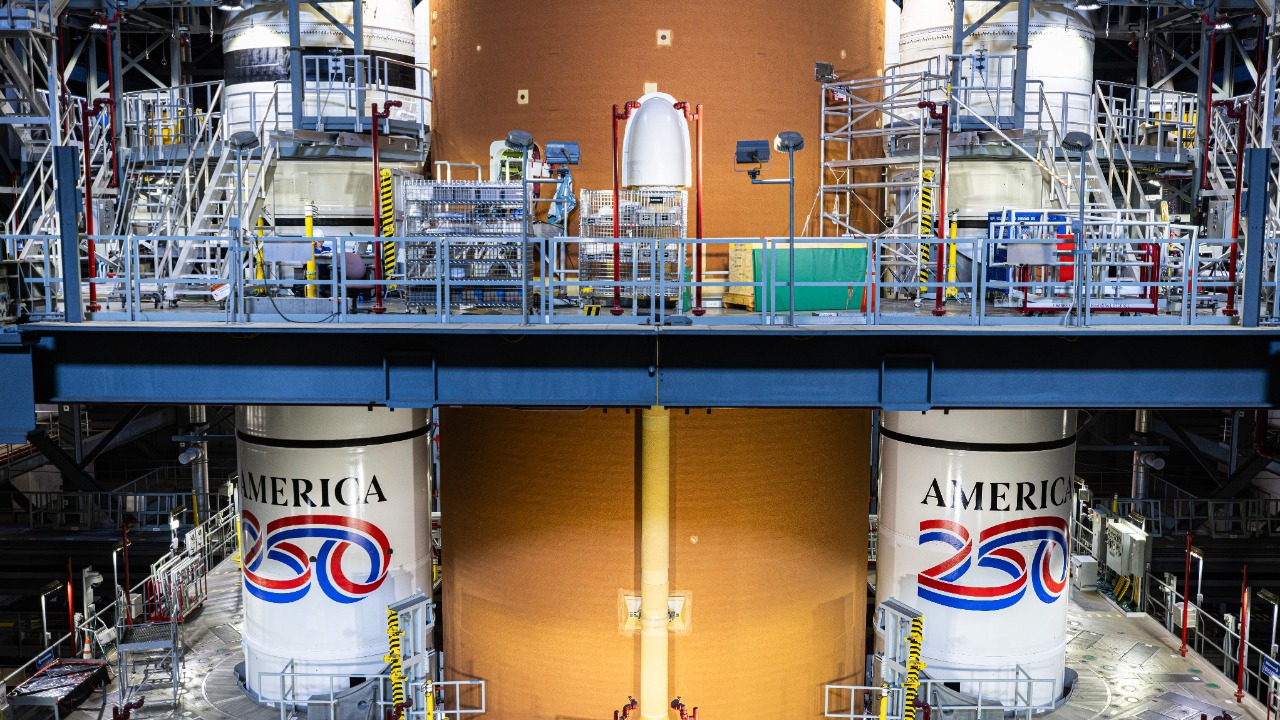
The towering Space Launch System that will send Artemis II astronauts around the moon is now carrying a bold new visual statement, with fresh “America 250” markings wrapped around its twin solid rocket boosters. The livery turns the rocket into a moving billboard for the United States’ upcoming semiquincentennial, tying a historic anniversary of American independence to the country’s most ambitious human spaceflight program in decades. By pairing a national birthday celebration with a high‑stakes lunar orbit mission, NASA is inviting the public to see the next trip around the moon as part of a longer story of American innovation and exploration.
Branding a moon rocket for a 250th birthday
I see the new artwork on the Artemis II boosters as a deliberate attempt to fuse national memory with near‑term exploration milestones. Technicians with NASA’s Exploration Ground Systems have placed an America250 emblem on the rocket’s massive white boosters, turning hardware that was already visually striking into a canvas for the country’s 250th anniversary narrative. The agency describes the emblem as a celebration of American innovation that stretches from the founding era to the technologies now pushing crews back to the moon and beyond, a message underscored by the decision to feature the America250 emblem directly on flight hardware. In official language, the campaign explicitly links Dec, Artemis II, NASA and America in a single visual frame, inviting viewers to read the rocket as both a machine and a symbol.
The design choice is not just about aesthetics, in my view, but about positioning Artemis as a national project rather than a niche technical effort. NASA public affairs writer By Elyna Niles, Carnes has framed the program as a celebration of 250 years of American ingenuity, describing how the agency intends to use the Artemis architecture to return humans to the moon and ultimately push onward to Mars. That framing is reinforced in a companion description of how NASA’s moon rocket celebrates 250 years of American innovation, which explicitly ties the Dec rollout of the branding to a broader USA narrative of scientific progress and civic ambition over exactly 250 years. By putting that number on the side of the boosters, NASA is effectively turning every launch photo into a commemorative poster for the semiquincentennial.
How “America 250” fits into the Artemis II mission
When I look past the paint, the deeper story is how this branding wraps around a very specific mission profile. Artemis II is a planned crewed flight that will send the Orion spacecraft Integrity and its European Service Module for the Artemis II on a lunar flyby, testing life support, navigation and deep space operations before any attempt to land. The mission sits at the heart of the broader Artemis program, which aims to establish a sustained human presence in cislunar space and eventually on the lunar surface, and the new livery effectively stamps that test flight as part of a national anniversary project. The official mission description for Artemis II emphasizes that this is the first crewed outing of the system, a crucial bridge between the uncrewed Artemis I and later landings.
The “America 250” graphics are timed to intersect with a broader civic campaign that is already gearing up for July 4, 2026. The America250 initiative is calling on people across the country to Volunteer, urging citizens to Help organize projects so that, Whether they are new to service or seasoned organizers, they can make 2026 a record‑setting year of volunteer service and measurable impact. That call to action, laid out on the official America250 site, sits in the same calendar window as NASA’s target for the Artemis II lunar orbit mission. By synchronizing the rocket’s branding with that civic push, the agency is effectively inviting local service projects, classroom lessons and community events to treat the crewed flight as a living centerpiece of the semiquincentennial year.
From paint job to launch pad
Visually, the new livery is hard to miss. Recent imagery shows the Artemis 2 moon rocket with a prominent “America 250” paint job on its side, a design that has already been highlighted as a striking photo of the day in the spaceflight community. The artwork runs along the boosters that will help lift the Space Launch System off the pad, with the stylized number 250 and the word America integrated into the existing orange and white palette of the stack. Coverage of the update notes that the “America 250” logo was applied in honor of the upcoming national anniversary, with Dec and Artemis explicitly referenced in descriptions of the paint job, and Space imagery helping to broadcast the look worldwide.
On the ground, the work has been hands‑on and methodical. Social media posts from the Kennedy Space Center show that Artemis II Moon Rocket Boosters Now Wearing America, with the 250th Anniversary Emblem carefully positioned by Technicians from NASA’s Explor teams inside the Vehicle Assembly Building. One widely shared update describes how crews finished installing the emblem on both sides of the solid rocket boosters, turning the stacked hardware into a symmetrical tribute to the anniversary. That same post, which tags the site as KennedySpaceCenter and uses hashtags like #FutureIsNow and #ScienceAndTech, underscores how the Anniversary Emblem is meant to resonate not only with policymakers and engineers but also with students and young technologists watching from afar. In that sense, the livery is part of a broader outreach strategy that treats the rocket as a teaching tool as much as a launch vehicle.
A symbolic mission in a pivotal year
All of this symbolism would ring hollow if Artemis II were not poised to fly in a year already being framed as a turning point for lunar exploration. Analysts have described 2026 as the year humanity will finally go back to the moon, pointing to the planned crewed loop around the lunar far side as the first human voyage beyond low Earth orbit in more than half a century. The crew, which includes astronaut Christina Koch and the other members of the Artemis II team, is expected to test how Orion handles the deep space environment and the kinds of conditions they might encounter around the moon, from radiation exposure to communication delays. That context, laid out in detailed previews of 2026 as a pivotal year, makes the “America 250” branding feel less like a marketing flourish and more like a banner marking a genuine return to deep space.
The operational timeline is tightening around that narrative. NASA is planning on rolling out the Artemis II rocket and spacecraft to the launch pad in early 2026, with agency updates describing a sequence of integrated tests that will culminate in a wet dress rehearsal and then the actual launch. One briefing from Jan notes that NASA is preparing to move the stack atop the Crawler Transporter for its WDR, a key milestone that will see the fully assembled rocket trundle slowly toward the pad on the same massive vehicle that once carried Saturn V and shuttle stacks. Another report explains that Now the agency says it could launch as early as February, with the first flight opportunity being on February 6, as teams finish rehearsals and prepare for the real event. Those details, laid out in planning notes from the Jan rollout plan and in a separate update that notes how Now NASA is eyeing early February, are echoed in policy coverage that tracks how Artemis II will roll out for its WDR atop the Crawler and Transporter before heading to the pad. In that policy analysis, the Artemis II schedule is treated as a bellwether for the entire program, especially after earlier propulsion system issues damaged the spacecraft and forced additional checks.
As I weigh all of these threads, the “America 250” livery feels like a conscious effort to knit together policy, public engagement and technical milestones into a single story. NASA’s Artemis program is already being described as the most ambitious human spaceflight effort since Apollo, with the hardware that will fly the astronauts moonward including two solid rocket boosters and a core stage that dwarf most previous launchers, and with some descriptions even noting how the mission timeline intersects with the anniversary of the Declaration of Independence. That framing, captured in detailed rundowns of how NASA is positioning Artemis, suggests that the agency sees the semiquincentennial not as a backdrop but as a stage. If the launch proceeds on the current trajectory, the sight of a “250” emblazoned rocket arcing toward the moon could become one of the defining images of the anniversary year, a reminder that the story of American independence has always been intertwined with the urge to push into new frontiers.