
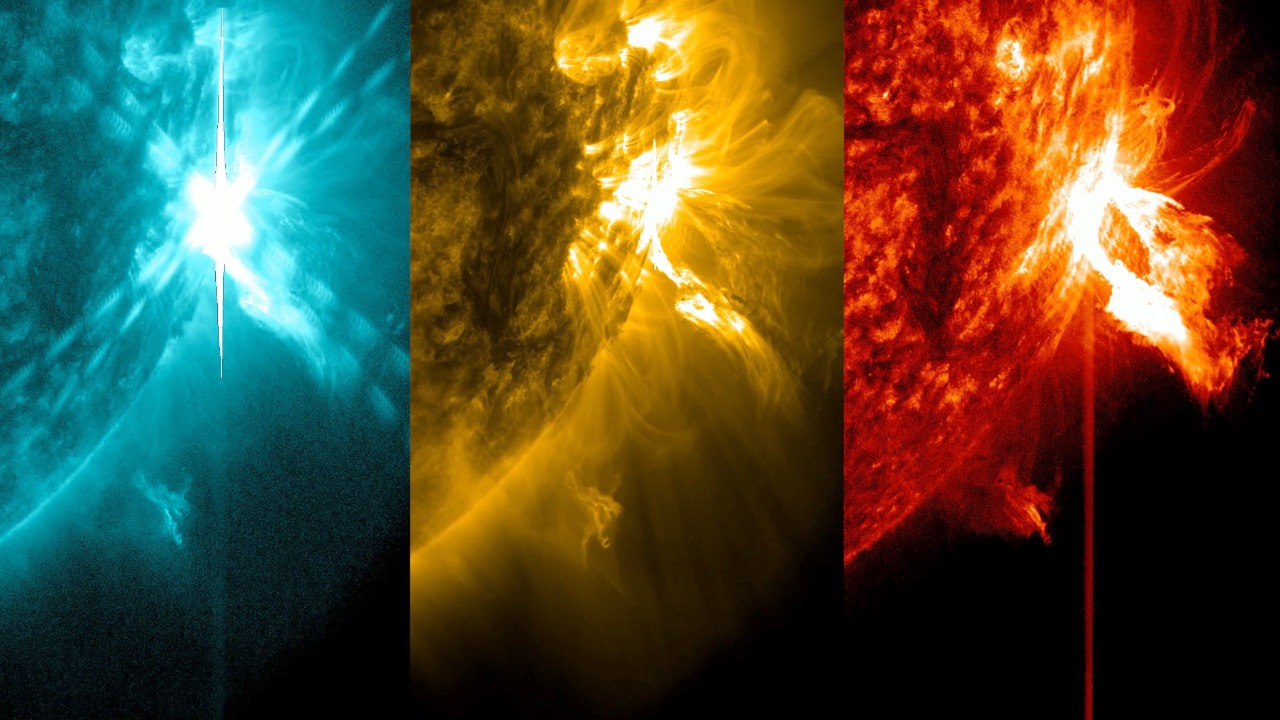
NASA has alerted governments and power grid operators worldwide after a powerful solar flare erupted from the Sun, raising the risk of temporary disruptions to communications, navigation systems, and some electrical infrastructure. The warning underscores how a single burst of solar energy can ripple through the space around Earth and into the technologies that keep modern societies running.
Scientists stress that this is not a doomsday scenario, but it is a serious space weather event that demands preparation. Recent flares have already triggered radio blackouts and vivid auroras at unusual latitudes, and researchers say the latest eruption fits a broader pattern of heightened solar activity as the current solar cycle approaches its peak.
What NASA saw when the Sun erupted
NASA reports that the Sun emitted a strong solar flare that peaked just after midnight, with the event captured in detail by the Solar Dynamics Observatory. The spacecraft, which continuously monitors the Sun, recorded intense bursts of X-ray and ultraviolet radiation streaming outward from an active region on the solar surface, a sign that magnetic energy had been abruptly released into space. According to NASA, the flare was powerful enough to significantly disturb the space environment around Earth, a key reason the agency moved quickly to alert other space weather centers and civil authorities through its solar flare update.
The latest eruption follows a series of strong events from the Sun in late November and early December, including two major flares that highlighted how unpredictable the star has become as solar maximum approaches. In one case, an X1-class flare was strong enough that scientists cautioned it could disrupt daily life on Earth, from satellite operations to radio links used by aviation and maritime traffic, as described in a recent analysis of intense solar storms. The pattern of repeated, high-energy flares is what has prompted NASA and partner agencies to frame the current event as a global concern rather than an isolated burst of space weather.
From auroras to blackouts, what is at risk
When a solar flare is accompanied by a coronal mass ejection, charged particles can slam into Earth’s magnetic field and trigger geomagnetic storms that affect both the sky and the ground. Earlier this year, a powerful eruption from the Sun produced the strongest flare of 2025 and led to widespread radio disruptions across Africa and Europe, with shortwave and high-frequency signals temporarily degraded or lost, according to detailed accounts of the radio blackouts in Africa and Europe. Another major flare in May, described as the strongest of the year at that point, disrupted global communications and highlighted how quickly aviation, shipping, and emergency services can feel the impact when high-frequency radio and some satellite links are compromised, as noted in coverage of the global communications disruption.
Not every storm is severe, and many bring more spectacle than damage. On November 11, people across the United States watched “Vibrant Lights” in the form of unusually strong auroras, while the same event produced only “Minor Disruptions” to infrastructure, according to a detailed assessment of that geomagnetic storm. Yet researchers warn that a true solar superstorm could induce powerful currents in long-distance power lines, damage transformers, and interrupt the flow of electricity over large regions. The contrast between recent minor disturbances and the potential for a much larger event is a central reason NASA’s latest alert is being treated as a prompt to harden systems rather than a cause for panic.
How global space weather agencies are responding
NASA’s warning does not stand alone. The Space Weather Prediction Center, part of the National Oceanic and Atmospheric Administration, has issued updated forecasts that track the likelihood of solar radiation storms and geomagnetic disturbances over the coming days. Its current three day outlook, labeled the “Solar Radiation Storm Forecast for Dec,” assigns only a 1 percent chance of an S1 (Minor) or greater radiation storm on each of the next three days and explains in its “Rationale” that no significant events are expected in that period, according to the agency’s three day forecast. That relatively low probability underscores how dynamic space weather can be, with intense flares sometimes followed by quieter intervals that still require close monitoring.
In Europe, the European Space Agency has been tracking what it described as “Three” significant space weather events in quick succession and has activated its network of monitoring stations and models to assess the combined impact. A recent “Summary of the” situation noted that ESA is “actively monitoring” a severe space weather episode, coordinating with satellite operators and national agencies to manage risks to spacecraft, communications, and power systems, as outlined in its space weather briefing. Together with NASA’s Solar Dynamics Observatory imagery and NOAA’s real time alerts, this international network forms the backbone of the global response to the current flare and any associated geomagnetic storm.
What disruptions people might actually notice

For most people, the first sign of a strong geomagnetic storm is not a blackout but a light show. When charged particles from the Sun interact with Earth’s atmosphere, they can push the Northern Lights far beyond their usual polar haunts. A recent forecast of a “strong geomagnetic storm” highlighted how auroras could be visible as far south as Johnston, Iowa, and other mid latitude locations, while also warning of potential “Notable” disruptions to radio communications and satellite based navigation, according to a detailed storm forecast. That mix of beauty and inconvenience is likely to define public experience of the latest flare as well, unless it is followed by an unusually intense coronal mass ejection.
More subtle, but potentially more consequential, are the impacts on systems that people rarely think about until they fail. Strong solar flares can degrade GPS accuracy and high frequency radio links used by airlines, shipping companies, and emergency responders, as seen during a major event in Oct 2024 that was described as the strongest solar flare in seven years and linked to significant interference with GPS and HF radio signals, according to a technical summary of that flare. Even when power grids remain stable, such disruptions can delay flights, complicate search and rescue operations, and force operators to switch to backup procedures that are slower and more labor intensive.
Why scientists say the stakes are rising
Researchers emphasize that the current alert is part of a broader trend of intensifying solar activity as the Sun moves through its 11 year cycle. Earlier this year, a powerful X7 class flare, described as the strongest of 2025 at the time, was cited as evidence that the solar maximum is delivering more frequent and more energetic eruptions. That event prompted warnings of possible blackouts and auroras at lower latitudes and raised concerns that, if similar conditions persist, the world could face one of the most disruptive solar storm periods of the decade, according to detailed coverage that noted how “While disruptions are expected, they may remain manageable if infrastructure is prepared,” in an analysis of the X7 class flare.
New research into geomagnetic hazards in the United States has also sharpened the focus on what a true solar superstorm could do. Scientists studying the November aurora event concluded that, while that storm produced only “Minor Disruptions,” a stronger one could induce damaging currents in long transmission lines, stress transformers, and interrupt services that depend on a stable grid, from banking networks to water treatment plants, as outlined in the USGS assessment of a solar superstorm. Against that backdrop, NASA’s latest alert is less a prediction of catastrophe than a reminder that space weather is no longer a niche scientific concern. It is a practical risk factor that governments, utilities, and technology companies must now build into their planning as the Sun continues its volatile climb through the current cycle.