
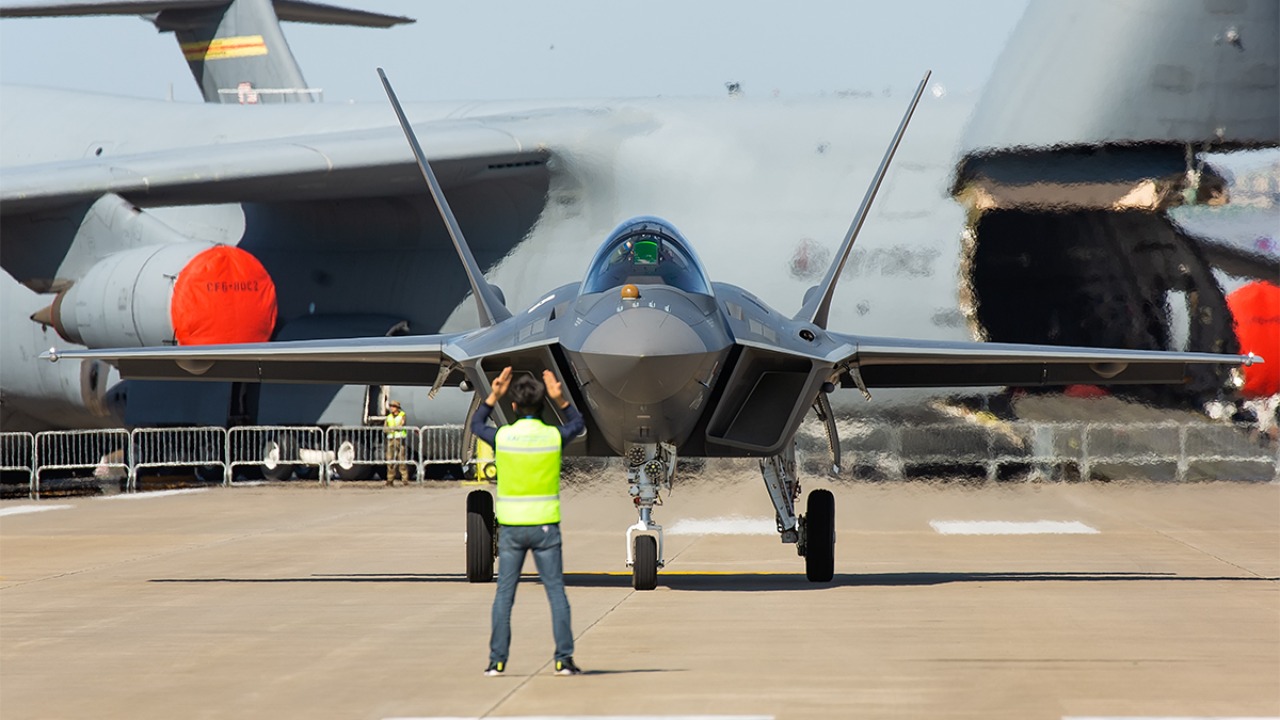
The global fighter race is no longer a two‑horse contest between China’s J‑20 and America’s F‑35. South Korea’s KF‑21 Boramae is moving from prototype to frontline asset, and its arrival will reshape airpower calculations across Northeast Asia and beyond. I see a program that blends ambition and pragmatism, pairing advanced sensors and weapons with a strategy tailored to the Republic of Korea’s specific security needs rather than chasing a perfect stealth ideal.
As the KF‑21 edges toward operational service, it also signals a deeper shift in the defense industry itself. South Korea is not just buying capability, it is building an ecosystem that can sustain and export it, challenging long‑standing assumptions about who gets to design and sell cutting‑edge combat aircraft.
From concept to frontline reality
The KF‑21 Boramae has moved with unusual speed from design board to flight line, and that pace is now converging with operational timelines. The Korean government has confirmed that The Korean authorities completed the formal flight test campaign ahead of schedule, clearing the way for production aircraft to start reaching the Republic of Korea Air Force in the second half of 2026. Korea Aerospace Industries, or KAI, now has the task of turning that test success into a reliable production rhythm, a transition that often proves harder than the first flight itself.
South Korea’s own reporting underscores how close the jet is to squadron service. Officials have stated that South Korea’s KF‑21 Boramae is set to enter service in 2026, moving from a test program into frontline duty. That timeline is reinforced by separate confirmation that Transfers This Year will see production jets handed over in the second half of the year, and by Korea Aerospace Industries’ own note that all planned test flights were wrapped up by early 2025. One enthusiast summary even highlights how Korea Aerospace Industries announced the completion of the campaign and linked it directly to deliveries in the second half of 2026, a rare alignment between official planning and public expectation.
Design choices: between 4.5‑gen and full stealth
The KF‑21 is often described as a bridge between classic fourth‑generation fighters and the most advanced stealth designs, and I find that framing useful. South Korean planners have been explicit that their goal was a 4.5-gen aircraft with a 7.7-ton payload, not a pure fifth‑generation stealth machine. That choice keeps the airframe simpler and cheaper to build and maintain, while still allowing for modern sensors, data links, and precision weapons. In performance terms, the twin‑engine layout gives the jet solid thrust and redundancy, and reporting notes that it can reach Mach 1.6 and operate at a service ceiling of roughly 50,000 feet, which places it comfortably within the envelope expected of a modern multirole fighter.
Critics are quick to point out what the KF‑21 is not, and those caveats matter. Current configurations rely on external hardpoints for weapons, which means that, as one assessment notes, Its stealth profile is compromised compared with a clean fifth‑generation design, although future Block III variants are expected to add more refined shaping and internal carriage. Another detailed breakdown stresses that General Specs and still fall short of a true fifth‑generation jet, even if the twin‑engine configuration gives the aircraft strong performance. In other words, the KF‑21 is not a clone of the F‑35, and it was never meant to be; it is a deliberate compromise between cost, capability, and industrial feasibility.
Industrial strategy and the “home‑grown” leap
Behind the airframe itself sits a larger industrial story that I see as central to understanding why the KF‑21 matters. South Korea has spent decades building up its aerospace sector, and the program is now paying off in the form of a fighter that is increasingly independent of foreign suppliers. Recent reporting notes that South Korean defense conglomerate Hanwha has begun to build new jet engines for the Boramae, a shift that moves the program toward being fully home‑grown. By relying exclusively, or almost exclusively, on domestic suppliers, Seoul is insulating itself from export controls and supply shocks that have long constrained other air forces.
This industrial push is not happening in a vacuum. Analysts have highlighted how the maturation of its own industry has permitted the ROK to develop a military strategy in which Generations and Technologies are chosen to fit national needs rather than imposed by foreign vendors. One detailed overview notes that the Republic of Korea Air Force, often abbreviated as RoKAF, sees the KF‑21 as its first domestically developed supersonic fighter, a milestone captured in the description of Republic of Korea Force’s ambitions. That shift from licensed production to indigenous design is what will allow Seoul not only to equip its own squadrons but also to compete in the global arms export market on its own terms.
How it stacks up against J‑20, J‑35A, and F‑35
Comparisons with China’s J‑20 and J‑35A and America’s F‑35 are inevitable, and I find that they reveal as much about strategy as about raw performance. One detailed matchup with China’s carrier‑capable stealth design notes that the J‑35A would likely retain an edge in low‑observable shaping and integrated sensors, but that the KF‑21’s future Block III variants are expected to close some of that gap with improved stealth and sensor superiority. Against the J‑20, the Boramae’s smaller size and twin‑engine agility could offer advantages in certain engagement envelopes, even if it lacks the deep‑penetration stealth profile that Beijing advertises for its flagship fighter.
The F‑35 remains the benchmark, and many observers frame the KF‑21 in relation to it. Some critics go as far as to label the Boramae an inferior version of the American jet, a view echoed in one online discussion where a user argues that Things get complicated as scientific progress and production facilities are monopolized by a few major programs, leaving others to play catch‑up. Yet another detailed analysis casts the KF‑21 as a “Cheap F‑35” alternative, arguing that Cheap and That Could Rewrite the Fighter Market are not contradictions but the core of its export appeal. That same assessment notes that The KF and Boramae are being positioned as a cost‑effective rival aimed directly at the F‑35, and that the number 35 has become a shorthand for the price and capability bracket Seoul is targeting.
What the KF‑21 means for regional airpower
For me, the most important question is not whether the KF‑21 can out‑stealth a J‑20 or out‑sensor an F‑35, but how it changes the balance of power and procurement in Asia. South Korea has already begun mass production, with one technical overview noting that Mass production started for South Korea’s 4.5‑gen fighter with a 7.7-ton payload and that The Republic of Korea Air Force plans to field a substantial fleet over the next 10 years and six months. As those jets fill out RoKAF squadrons, they will replace aging F‑4s and F‑5s and sit alongside imported F‑35s, giving Seoul a layered force that can handle both high‑end conflict and day‑to‑day deterrence.
That layered approach is rooted in a broader strategic vision. Analysts have described how Jan and other planners see the KF‑21 as part of a generational shift in which Forget the older dependence on foreign designs and The New KF architecture allows the Boramae Fighter Is Coming into its own, supported by domestic suppliers and a maturing aerospace base. One detailed graphic even highlights the KF‑21 Graphic with an Image Credit that underscores how carefully the program is being presented to potential buyers. As Jan and other observers have noted, South Korea is positioning itself not just as a consumer of advanced airpower but as a Company that can design, build, and export it, and the Boramae is the clearest expression yet of that ambition.