
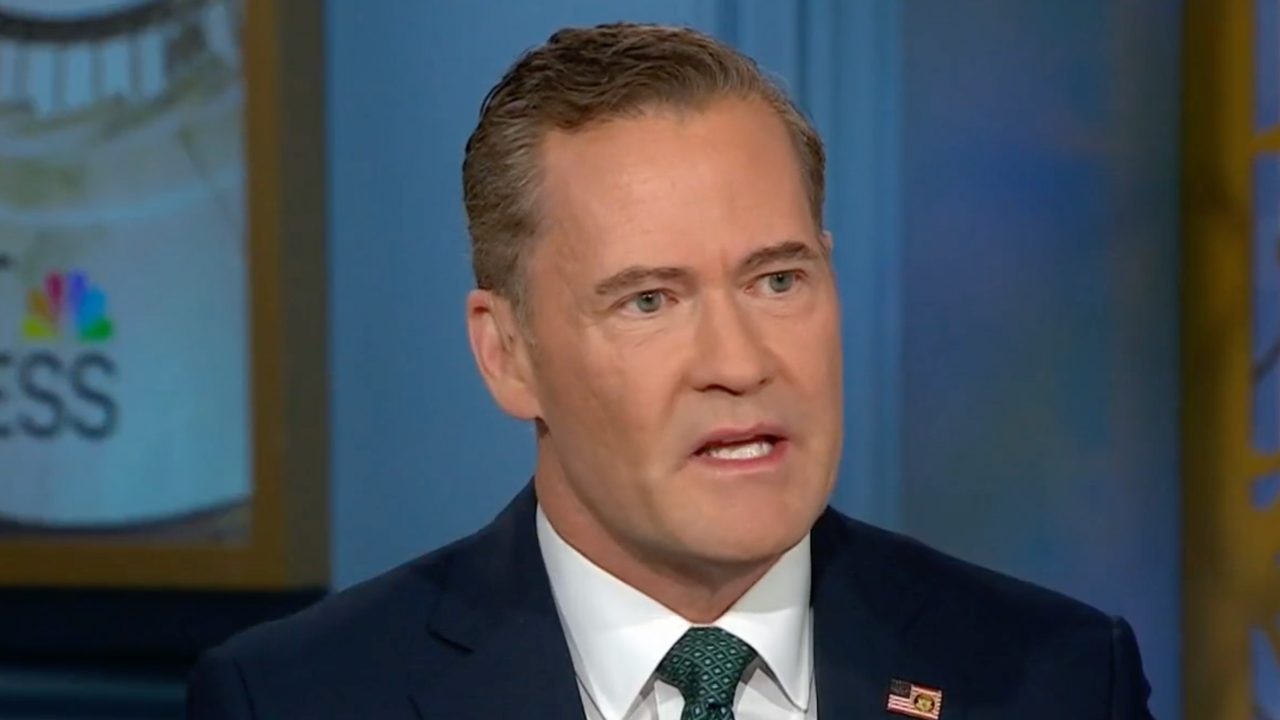
U.S. Ambassador to the United Nations Mike Waltz dismissed reporting that American weapons stockpiles have been dangerously depleted by the Iran war, and said those responsible for leaking such information to journalists should face prosecution.
“I want to be crystal clear: the U.S. military, and I’ve verified this every which way, has everything that it needs to conduct this campaign as effectively as it needs to be,” Waltz told NBC’s Kristen Welker on Meet the Press. “And I have to tell you, the people that are leaking this nonsense deserve to be in jail.”
Waltz was responding to questions about NBC News reporting that U.S. military commanders have been selectively intercepting some Iranian attacks rather than others, in an effort to conserve a diminishing supply of interceptor missiles, according to two senior U.S. officials cited in that reporting. A separate New York Times report published the same week said Trump had set aside plans to significantly expand U.S. strikes on Iran after senior military leaders, including Joint Chiefs of Staff Chairman Gen. Dan Caine, warned that a larger campaign could dangerously drain the Pentagon’s stockpile of Patriot interceptors and other air defense munitions.
Welker pressed Waltz directly on the jail comment. “Well, let me ask you, because you’re saying they deserve to be in jail. Is that something the administration’s going to pursue, putting people in jail?” Welker asked, according to a transcript of the exchange. “Well, we have a number of leak investigations going on,” Waltz replied. “I’ll defer that to the Department of Justice. But here’s the point. The point is the U.S. military has conducted a phenomenally successful campaign. We have never, as you know, I’m a veteran by background, we have never maintained this kind of air superiority, sea superiority, with unfettered access over Iran right now.”
Trump himself pushed back on the stockpile concerns in a statement to The Wall Street Journal the same day as Waltz’s interview. “We have far more munitions than anyone in the world, and far more than we need,” Trump said, directly disputing the reporting on internal administration deliberations over the risk of further depleting interceptor stocks.
Gen. Caine has offered similar reassurances in congressional testimony even as officials have acknowledged strain on the supply chain. Testifying before the House Appropriations defense subcommittee, Caine said the U.S. has “sufficient munitions for what we’re tasked to do right now,” and told reporters at a March Pentagon briefing that the military had “sufficient precision munitions for the task at hand, both on the offense and defense.” The Times reported separately that the U.S. had fired more than 1,200 Patriot interceptors during the war by late April, at a cost of more than $4 million apiece, with inventories already considered worryingly low at that point and deteriorating further since.
Waltz attributed the state of the munitions stockpile to the prior administration rather than the current war’s pace of consumption. He said the Trump administration had inherited “a depleted situation” stemming from arms shipments to Ukraine, the fight against Houthi rebels in Yemen, and broader military drawdowns under President Biden, and said the administration was moving toward new, cheaper munitions and updated defense budgets to rebuild stockpiles.
Asked whether Trump had ruled out a larger escalation against Iran, Waltz pushed back on that characterization. “I would not say that,” Waltz said, adding that “the president is keeping all options on the table” and that “talks are ongoing, they’re happening at every level.”
Welker also asked Waltz whether the war would be over by the end of the year. Waltz did not commit to a timeline, instead describing the conflict in broader historical terms.
The stockpile concerns come as Defense Secretary Pete Hegseth has sought $87.6 billion in supplemental funding from Congress, including provisions for munitions replenishment and defense industrial base expansion, which he presented to the Senate Appropriations Committee on July 21. The request comes as the fiscal year 2027 National Defense Authorization Act, which would unlock multiyear procurement contracts for THAAD, Patriot and Tomahawk production, remains stalled in the Senate following a blocked procedural vote on July 14, preventing the new contracts needed to accelerate rebuilding the stockpile. Rep. Ted Lieu has separately cited production data showing the U.S. manufactures roughly 50 Patriot interceptors and 8 THAAD interceptors per month, far below the pace at which the war has consumed the existing stockpile.
Sen. Mark Kelly, who also appeared on the same broadcast, separately questioned the military funding requests tied to the war, according to NBC’s summary of the program’s Sunday lineup.
The Pentagon has not identified any individuals facing prosecution over the reporting on stockpile levels, and Waltz did not name specific leak investigations beyond saying multiple were underway.
Waltz served as Trump’s national security adviser earlier in the administration before being confirmed as U.N. ambassador in a 47-43 Senate vote in September 2025, following his departure from the National Security Council after a journalist was mistakenly added to a private Signal chat involving sensitive military planning.
Neither the White House nor the Pentagon has issued additional public comment beyond Waltz’s remarks on the program.