

Mazda is betting that the future of performance cars is not just cleaner but actively restorative. Its new Vision X-Coupe concept is pitched as a machine that could pull more carbon dioxide out of the atmosphere than it emits, turning every spirited drive into a small act of climate repair rather than damage. The project blends experimental fuels, exhaust-side carbon capture and a revived rotary engine into a single, provocative answer to the question of whether combustion can survive in a net zero world.
Instead of abandoning pistons and fuel tanks for batteries alone, Mazda is using the Vision X-Coupe to argue that internal combustion can evolve into something radically different. The concept is designed around a carbon-negative powertrain that pairs microalgae-derived biofuel with an onboard capture device, then feeds the recovered CO₂ back into new materials and fuel production loops. It is an audacious claim, and one that puts Mazda at the center of a debate over how far technology can stretch the definition of a “clean” car.
How Mazda’s carbon-negative concept is supposed to work
The core promise of the Vision X-Coupe is simple to state and difficult to deliver: the car is intended to remove more carbon dioxide from the air than it releases over its use cycle. Mazda frames the concept as a carbon-negative evolution of its rotary heritage, with the Vision X-Coupe positioned as a muscular coupe that uses a plug-in hybrid system anchored by a new two-rotor turbocharged rotary engine. Reporting on the project describes it as a bold attempt to make the internal combustion engine not just acceptable in a decarbonizing world but actively beneficial, a claim that sits at the heart of Mazda Says Its New Concept Car Isn, Just Carbon, Neutral, Carbon, Negative, which details how the company wants the car to be carbon net-negative through its combined technologies, as outlined in Mazda Says Its New Concept Car Isn.
Underneath the design language and rotary nostalgia sits a specific technical recipe. The Vision X-Coupe is engineered to run on microalgae-derived biofuel that absorbs CO₂ as it grows, which Mazda says can cut well-to-wheel emissions by about 90 percent compared with fossil fuels. On top of that, the company integrates a Mazda Mobile Carbon Capture device into the exhaust stream, a system that is claimed to trap roughly 20 percent of the remaining CO₂ in the exhaust gases. When the near-carbon-neutral biofuel and the capture device are combined, Mazda argues that the powertrain can achieve a theoretical 10 percent net reduction of atmospheric CO₂, a framing that underpins its description of the concept as carbon-negative in the Vision X-Coupe materials and in coverage of the car’s carbon net-negative ambitions.
Inside the Mazda Mobile Carbon Capture system
The most radical piece of the Vision X-Coupe is not the rotary engine but the hardware bolted to its exhaust. Mazda’s Mazda Mobile Carbon Capture (MMCC) system is designed as a compact device that filters and stores CO₂ as the engine runs, turning the car into a rolling capture unit. The company is already testing this technology in real-world conditions on a Mazda3 race car in the Super Taikyu Series in Japan, using endurance racing as a laboratory to see how much CO₂ can be captured without crippling performance or reliability. That same MMCC hardware is envisioned as a core part of the Vision X-Coupe’s drivetrain, giving the concept its claim to clean the air as it drives.
Technical details from the Japan Mobility Show presentation describe how the MMCC unit sits downstream of the catalytic converter, where it can selectively trap carbon dioxide while letting other exhaust components pass. Mazda says the captured CO₂ can then be offloaded and reused, for example to grow more microalgae for fuel or to create high-performance carbon fiber parts, turning waste gas into feedstock. At the Japan Mobility Show, the company framed this approach under the banner The More You Drive, Cleaner the Planet, tying the MAZDA VISION X-COUPE directly to the idea that an internal combustion engine can be part of a circular carbon economy, a message that was central to the Japan Mobility Show showcase of The MAZDA VISION, COUPE and its MMCC hardware.
Microalgae fuel and the rotary engine revival
While the MMCC device grabs attention, the Vision X-Coupe’s fuel choice is just as important to its carbon math. Mazda’s engineers are betting on microalgae-derived biofuel, which pulls in CO₂ as it grows and can be refined into a liquid fuel compatible with combustion engines. Because that CO₂ was recently in the atmosphere rather than locked underground, burning the fuel and then recapturing a portion of the exhaust can, in theory, tip the balance toward net removal. Mazda positions this as a way to keep combustion relevant in a world that is tightening emissions rules, arguing that the right fuel and capture combination can make a rotary engine part of a low-carbon future instead of a relic of the past.
That rotary is not a token gesture. The Vision X-Coupe uses a new two-rotor turbocharged rotary engine as part of a plug-in hybrid system, blending electric drive with a compact, high-revving combustion unit that can run on the microalgae fuel. Mazda Motor Corp has long prided itself on engines even in the age of electrification, and in Tokyo the company used the concept to show how a rotary can be paired with carbon capture and alternative fuels to create what it calls a carbon-negative rotary powertrain. Reporting from TOKYO describes how Mazda Motor Corp is exploring this pairing as a way to counter critics who say combustion has no place in a decarbonized future, a stance detailed in coverage of how Mazda eyes carbon-capture tech for a carbon-negative rotary concept at the Japan Mobility Show, as outlined in Mazda Motor Corp.
Designing a coupe that “sucks pollution out of the air”
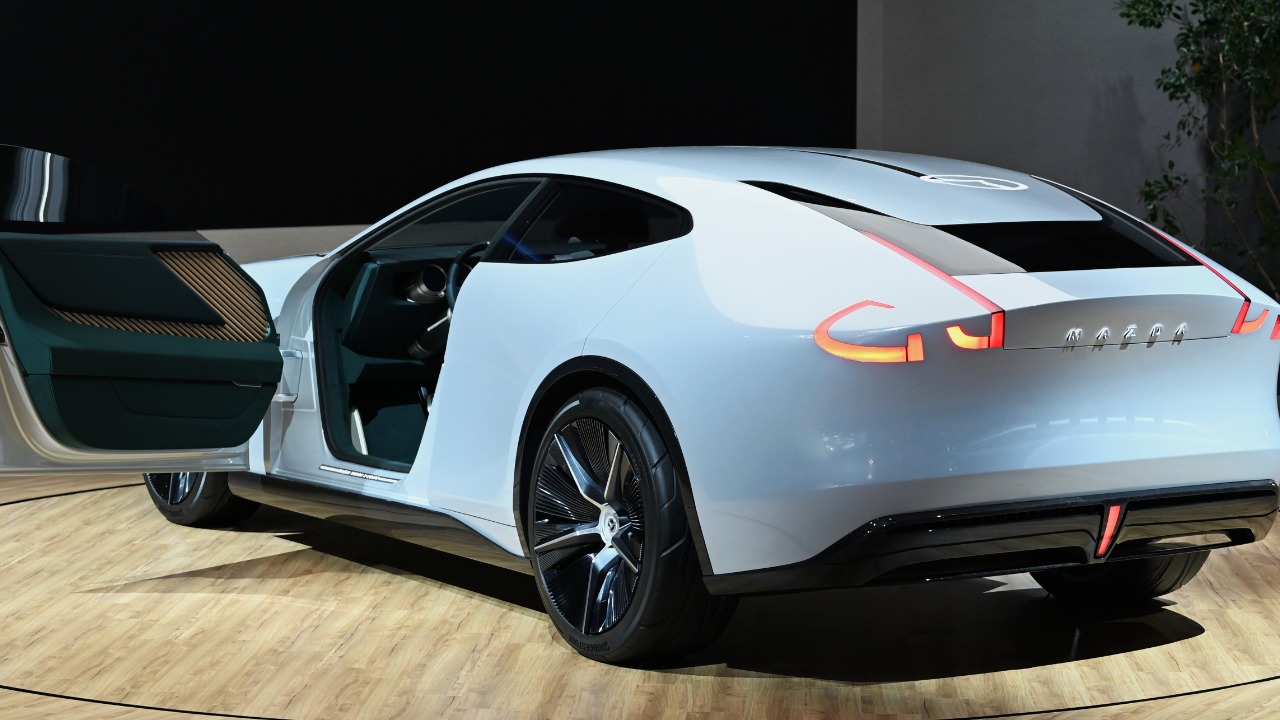
Mazda is not hiding the fact that the Vision X-Coupe is meant to be a halo car as much as a lab on wheels. The concept is described as a muscular coupe with proportions that recall classic sports cars, but its most striking design story is the way the bodywork and packaging accommodate the MMCC system and its storage tanks. The company wants drivers to see the car as a performance machine that also acts as a mobile air cleaner, a narrative that has led some coverage to describe the Mazda, Muscular Vision, Coupe Concept Could Suck Pollution Out of the Air, emphasizing how the MMCC hardware is integrated into the vehicle’s architecture, as highlighted in Mazda, Muscular Vision.
That design brief extends beyond styling flourishes. The Vision X-Coupe must manage the weight and packaging of the capture device, the storage medium for CO₂, the plug-in hybrid battery and the rotary engine, all while delivering the kind of driving dynamics Mazda is known for. Engineers are using the concept to test how these competing demands can be balanced, from cooling requirements for the MMCC unit to the structural integration of tanks that may eventually be swapped or emptied at service stations. The car’s presence at the Japan Mobility Show under the slogan The More You Drive, Cleaner the Planet signals that Mazda wants the public to associate this aggressive coupe silhouette with the idea of active environmental benefit, not just reduced harm.
From show stand to road: feasibility and stakes
For all its ambition, the Vision X-Coupe remains a concept, and Mazda is careful to frame its carbon-negative claims as theoretical rather than certified. The company is still validating how much CO₂ the MMCC system can reliably capture in varied conditions, which is why it is running demonstration experiments on a Mazda3 race car in the Super Taikyu Series. Those tests are meant to answer practical questions: how often the capture medium must be regenerated or replaced, how much weight the system adds, and how it affects fuel economy and performance over long stints. The results will determine whether a road-going version of the technology can move beyond auto shows and into production vehicles.
Industry observers note that even partial success would be significant. A carbon-negative powertrain concept unveiled at the Japan Mobility Show gives Mazda an automatic head start on reducing overall emissions compared with traditional engines, because the microalgae fuel and capture system together lower the net carbon footprint from the outset. One analysis of Mazda’s latest concept car, unveiled with a rotary engine that keeps carbon dioxide in check, argues that this approach could reshape how regulators and consumers think about combustion if it proves scalable, a point underscored in commentary on how Mazda’s latest concept car, unveiled with a rotary engine that keeps carbon dioxide in check, gives the powertrain an automatic head start on reducing overall carbon emissions, as described in Mazda’s latest concept car.
What it means for the future of combustion cars
The Vision X-Coupe is also a strategic statement about the future of internal combustion. While many automakers are racing toward all-electric lineups, Mazda is arguing that combustion engines can be saved if they are paired with the right fuels and capture technologies. One report notes that But Mazda has this week unveiled a new system that could extend the availability of the combustion engine beyond the next round of emissions rules, positioning the MMCC and microalgae fuel as tools to SAVE the combustion engine from outright bans, a framing captured in coverage that describes how But Mazda is developing new tech to SAVE the combustion engine, as detailed in But Mazda.
That stance is not without risk. Regulators may still prefer the simplicity of tailpipe-free electric vehicles, and the infrastructure required to support microalgae fuel production, CO₂ collection and reuse is far from mature. Yet Mazda’s willingness to invest in a concept that pairs a rotary engine with mobile carbon capture and advanced biofuels signals a belief that the combustion story is not finished. Analysts who have followed the project argue that the Vision X-Coupe and related research show how Oct, Mazda is trying to make the internal combustion engine cool again and possibly cleaner, using Japanese Sports Cars To Save the format by evolving it rather than abandoning it, a perspective reflected in coverage of how Oct, Mazda is exploring new cars that might clean the air, as described in Oct, Mazda.