
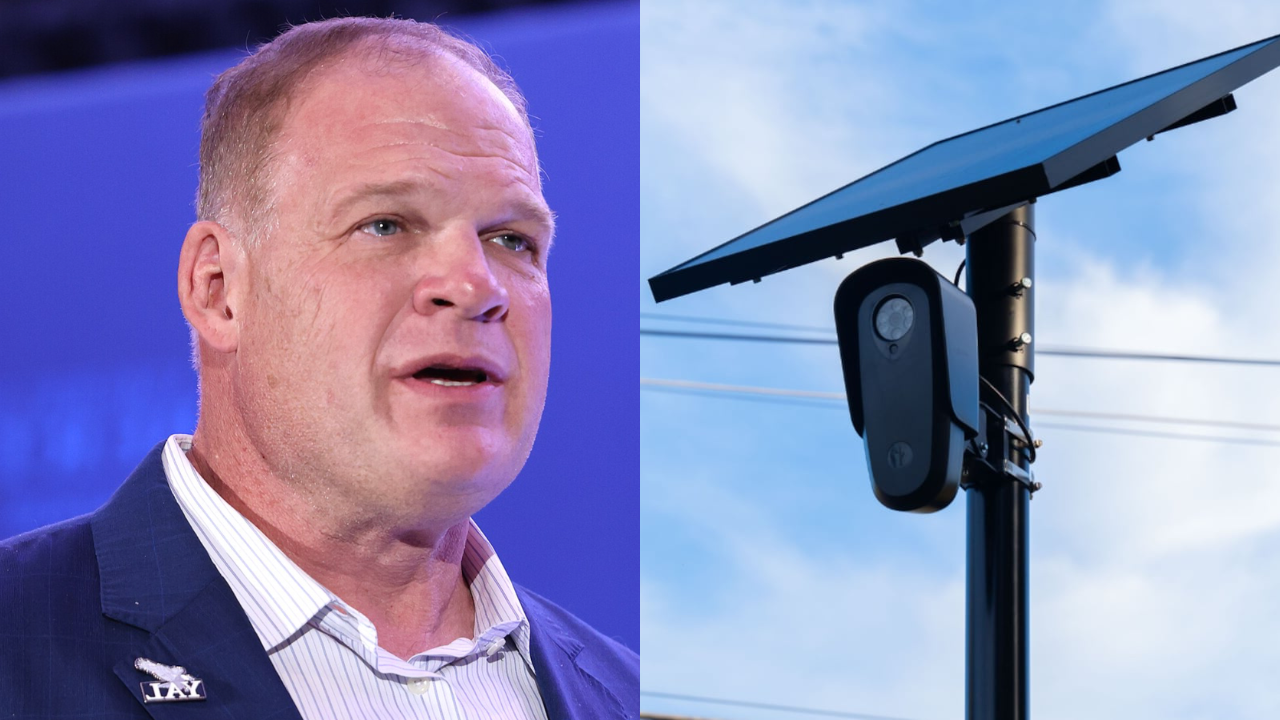
Knox County Mayor Glenn Jacobs on Monday formally urged the Knox County Commission to prohibit the use of Flock cameras and similar automated surveillance devices within the county, arguing that the technology’s expanding data-collection capabilities risk creating an unregulated mass surveillance system with no meaningful federal or state oversight. Jacobs made the appeal in a video statement posted to his official X account at 8:33 a.m. on July 27, 2026, accompanied by a press release addressing the county’s use of the devices, officially known as Automated License Plate Readers, or ALPRs.
In the video, Jacobs addressed the Commission directly, laying out both the technical function of the cameras and his concerns about how that function has evolved. The full transcript of his remarks reads as follows:
“Hello, this is Knox County Mayor Glenn Jacobs. Today, I am urging our Commission to prohibit the use of Flock cameras and similar devices in our County. For those of you who don’t know, these cameras, technically called Automated License Plate Readers, are motion activated and take a picture of every car which passes by. While License Plate Readers have been around for a while, because of AI and vastly increased networking and data retention capacities, these Flock cameras have capabilities not even imagined in the past. Older cameras only took a photo of your license plate, which was then retained for a short time. Flock cameras take a photo of your place, but also use AI to catalogue distinguishing features of your vehicle: make, color, model, even bumper stickers. That data is stored in a searchable database for sometimes up to a month or more, depending on the policies of that particular agency. When these cameras are deployed in large numbers, they create a network that can be used to track your movements. Currently, there is no federal regulatory framework governing these devices in place, and the Tennessee laws regulating them were written over a decade ago. My fear is that may be inadvertently creating a warrantless mass surveillance system and undermining the privacy and Liberty of our people. So I urge the Tennessee General Assembly and the United States Congress to look at this issue and take necessary action to safeguard our privacy and civil liberties as these new technologies continue to emerge. Thank you.”
Jacobs’s Monday statement builds on a position he first staked out publicly days earlier, when he said the cameras represent a threat to residents’ privacy and civil liberties and announced that the Commission would hold a special session to address the issue in depth.
The controversy centers on a Knox County Sheriff’s Office plan to deploy roughly 270 to 300 Flock cameras throughout the county, funded by more than $1 million — reported elsewhere as $1.5 million — in grant money originally approved by the Commission last November. According to reporting on the rollout, county officials had described the funding at the time as support for criminal justice improvements and crime-reduction efforts in high-crime areas, not as financing for a countywide automated surveillance network.
Knox County Commissioner Adam Thompson has joined Jacobs in raising objections to the rollout, releasing a joint statement with the mayor calling for a slowdown of the deployment. Thompson said he did not believe the technology currently has a place in Knox County, adding that his concern is not with law enforcement itself. “This isn’t about being against law enforcement. I support our deputies and appreciate the difficult job they do every day. It’s about making sure the public understands what information is being collected, how long it’s being kept, who has access to it, and what safeguards exist to prevent misuse,” Thompson said.
Thompson has also said he was surprised to learn that several cameras had already been installed in ZIP codes that fell outside the scope of the original grant. A special Commission workshop that had been scheduled to address public concerns over data collection, storage and privacy was canceled at the request of the Sheriff’s Office ahead of Monday’s regular Commission meeting.
Knox County Sheriff Tom Spangler responded to the mounting political pressure on Monday, releasing a statement confirming that while his office will continue to operate its existing cameras, installation of the remaining devices in the planned expansion “has been PAUSED.” The pause follows weeks of scrutiny of the program, which the Sheriff’s Office has said retains vehicle data for 30 days unless it becomes evidence in an active investigation, and does not track vehicle speed or issue citations.
Jacobs’s position has found an ally in Washington. U.S. Rep. Tim Burchett, R-Tenn., said he has been coordinating directly with the mayor on the issue. “I’ve been speaking with Mayor Jacobs about this, working with coordination with him on this thing, so hopefully, we’ll get some movement out of this,” Burchett said, adding, “We gotta ban these dadgum things.” He also cited documented cases elsewhere in the country of officers misusing Flock camera data, saying, “I’ve consistently opposed these warrantless surveillances and policies that weaken our privacy rights like crazy. We’ve already seen incidents where cops have used these things to pursue ladies for dating purposes.”
Burchett has translated that position into federal legislation. On July 21, 2026, he introduced H.R. 9800, the Protection Against Mass Surveillance Act, which would bar federal agencies from purchasing, deploying, operating, accessing or contracting for Flock Safety’s automated license plate reader cameras and similar technologies, which he has described as unconstitutional. The bill would also prohibit federal funding for automated license plate recognition systems and biometric identification technologies, including those relying on fingerprint, iris, retinal, voice or gait data, and would require federal agencies that do obtain such data to delete it within 30 days. Data collected through prohibited systems could not be admitted as evidence in court or administrative proceedings under the bill. It has been referred to the House Committee on Oversight and Government Reform.
Burchett is not alone in pursuing federal action against the technology. Rep. Thomas Massie, R-Ky., has said he intends to introduce separate legislation that would withhold federal funding from municipalities and police departments that deploy Flock or similarly styled surveillance cameras against law-abiding citizens, a strategy aimed squarely at Flock Safety’s local government customer base, which spans roughly 6,000 communities nationwide. Both the Burchett and Massie proposals follow a separate amendment on the issue from Rep. Scott Perry that failed to advance out of committee, underscoring the difficulty such measures have faced in Congress to date.
The scale of the network Jacobs is objecting to has grown rapidly since Flock Safety’s founding in 2017. As of mid-2026, the company’s cameras have surpassed 100,000 units operating in more than 5,000 communities across all 50 states, with independent tracking projects placing the figure closer to 96,000. Company and media estimates indicate the network scans more than 150 million vehicles daily, amounting to roughly 20 billion plate reads per month. Flock Safety spent $920,000 on federal lobbying in 2025 and another $230,000 in the first quarter of 2026, while Motorola Solutions, a competing surveillance technology provider, spent more than $2 million over the same period.
Flock Safety has defended its product, saying its network helps solve approximately 700,000 crimes annually and pointing to cases such as its role in tracking a shooting suspect connected to Brown University in December. The company has also said new municipal contracts have continued to outpace cancellations, with nearly 800 new city agreements signed in 2026. In January, the company added a “Federal Sharing” setting allowing agencies to disable data access by federal authorities, a feature critics have characterized as an acknowledgment that such sharing had previously occurred by default.
The opposition to ALPR networks has drawn support from across the political spectrum, a dynamic reporting has described as one of the few issues on which a divided electorate has found common ground: liberal critics have focused on concerns that local camera networks give federal immigration authorities access to location data, while conservative critics, including Jacobs, Burchett and Massie, have centered their objections on Fourth Amendment protections against warrantless, suspicionless tracking of law-abiding drivers.
Jacobs, a former WWE performer known by the ring name “Kane” who has branded himself a libertarian since taking office, won a second term as Knox County mayor with roughly 55 percent of the vote. His administration has previously drawn attention for opposing pandemic-era mask mandates, and his handling of the Flock camera dispute continues a pattern of positioning himself against expansions of government authority he views as encroaching on individual liberty.
With the Sheriff’s Office installation pause now in effect and Burchett’s federal legislation pending before the House Oversight Committee, the question of whether Knox County moves to a permanent ban now rests with the Commission, which Jacobs has asked to act while state and federal lawmakers weigh broader reforms to a regulatory framework he says has not kept pace with the technology.