
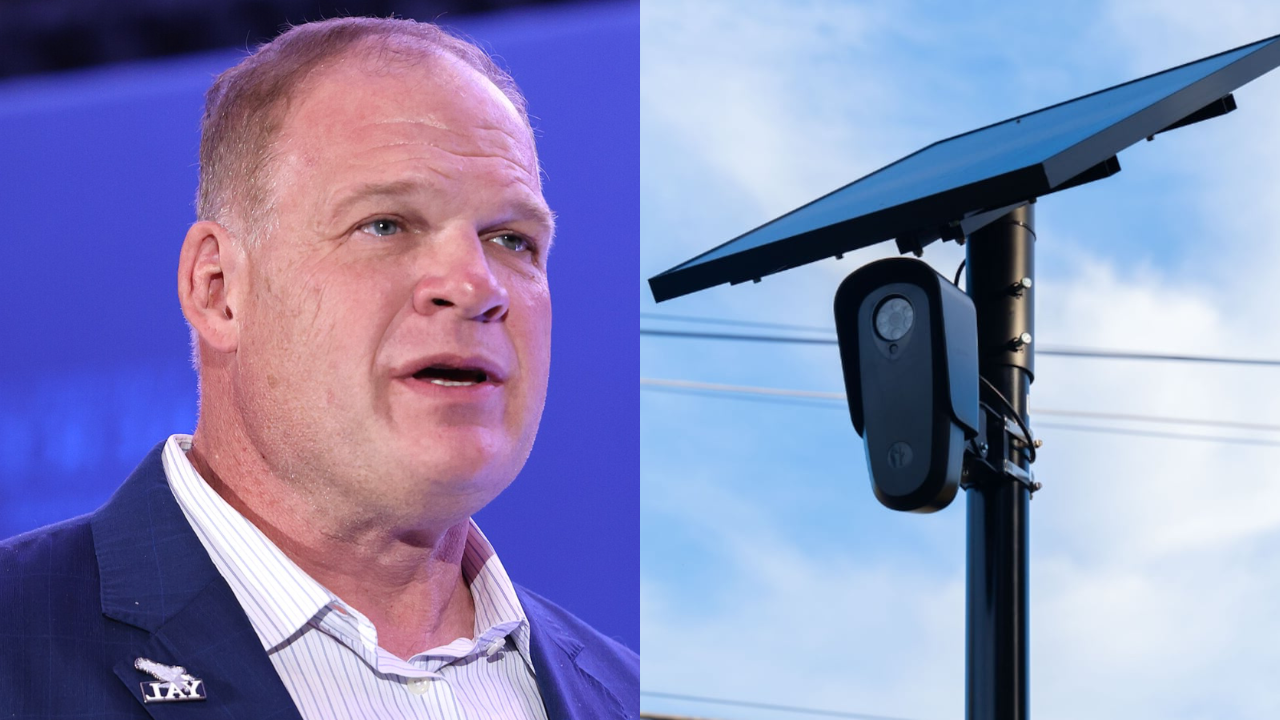
Knox County Mayor Glenn Jacobs publicly broke with the county’s sheriff’s office on July 22, 2026, declaring that the rollout of Flock Safety license plate cameras across the East Tennessee county represents a direct threat to the constitutional rights of the people he governs. In a post published to X at 5:54 a.m., Jacobs wrote: “I have serious concerns about the rollout of Flock cameras in Knox County. I believe they are a threat to our privacy and civil liberties. Commission is holding a special session prior to their regular meeting Monday to discuss this issue, and I will have more to say as well.”
The statement thrust Knox County into a national debate over automated license plate readers (ALPRs) that has been building in cities and counties across the country. Flock Safety, the private company behind the technology, has installed devices in more than 5,000 communities nationwide and says its network performs upward of 20 billion vehicle scans every month. Knox County’s own proposed expansion would add nearly 300 of the cameras, funded through a $1.5 million grant secured by the Knox County Sheriff’s Office (KCSO) to build out an Advanced Research and Communications Center.
Jacobs, a self-described small-government libertarian who was first elected Knox County mayor in 2018 after a career as WWE wrestler “Kane,” has built much of his political identity around limiting government reach into residents’ lives. His objection to the Flock rollout fits squarely within that framework: cameras that continuously photograph, log and store the license plates, and in many cases the physical descriptions, of vehicles traveling on public roads, regardless of whether the driver is suspected of any crime.
That “no suspicion required” feature of ALPR technology is precisely what has drawn scrutiny under the Fourth Amendment, which protects Americans against unreasonable searches and seizures by the government. Civil liberties groups, including the American Civil Liberties Union, have argued that dense networks of always-on cameras capable of reconstructing a person’s daily movements over weeks or months amount to a form of warrantless, continuous surveillance the Constitution’s framers could not have anticipated but would likely have recognized as the kind of general, suspicionless search they sought to prevent. Courts have not settled the question nationally, and Flock cameras themselves are generally installed on public rights-of-way, where individuals have historically had a reduced expectation of privacy for any single trip. Critics counter that the issue is not any one photograph but the aggregation of millions of them into a searchable, retrospective map of where a person has been.
Jacobs’s post did not elaborate on the constitutional argument in detail, but his framing — describing the cameras as a threat to “privacy and civil liberties” rather than simply an operational or budgetary concern — aligned him with that broader Fourth Amendment critique rather than with law enforcement’s public-safety framing of the technology.
The mayor’s statement came after weeks of rising tension inside Knox County government over how the camera program had been approved in the first place. Knox County Commissioner Adam Thompson told local media that the original funding resolution approved by the commission in November did not mention “cameras” or “surveillance” at all, and that he had fielded a wave of calls and emails from constituents who said they were blindsided by the scope of the plan once it became public. “I’ve received multiple emails and phone calls, and had face-to-face conversations with residents who are confused, unaware, ill-informed,” Thompson said, describing the reaction from his largely rural Eighth District.
The commission had been scheduled to hold a special session and workshop ahead of its regular July 27 meeting to question KCSO officials and Flock Safety representatives about data retention, information sharing with outside agencies, and oversight of the system. That meeting was abruptly canceled on July 24 at KCSO’s request, with the sheriff’s office citing scheduling conflicts and a need for more preparation time — a delay that left residents and commissioners alike still waiting for answers as of publication.
Jacobs is not alone among Knox County and Tennessee officials pressing the issue. U.S. Representative Tim Burchett, who represents the district that includes Knox County, escalated the fight to the federal level on July 21, 2026, introducing legislation dubbed the “Protection Against Mass Surveillance Act” to bar federal grant dollars from being used to fund surveillance camera networks like Flock’s. “I heard about it when they first started going and at first I thought, ‘That can’t be right,'” Burchett told reporters, adding bluntly, “We gotta ban these dadgum things.” The bill has been referred to the House Committee on Oversight and Government Reform.
The local backlash has not been limited to elected officials. Knox County resident Patrick Tresnan, who lives near one of the existing cameras, described the feeling of constant monitoring in stark terms: “The simple fact that I have the right to my own privacy and I have someone else that I don’t know, wherever they are, constantly watching everything I do, say, come and go, whoever I see, talk to. It’s just, to me, it’s a complete invasion of privacy.” Not every resident shares that assessment; new mother Qurstin Massengill told reporters the cameras make her feel safer given ongoing concerns about kidnappings and trafficking, illustrating the divide the Knox County Commission will have to navigate.
Adding another layer to the dispute, a former Oak Ridge Police Department officer was fired and later indicted last year for misusing surveillance technology, including Flock cameras, for personal purposes — a case East Tennessee officials have cited as evidence of the accountability gaps critics say the systems create when oversight is inadequate.
Facing that pressure, Knox County Sheriff Tom Spangler and Jacobs reached an agreement on July 21 to hold off on operating the cameras or the Advanced Research and Communications Center until after both officials’ terms end on September 1, effectively punting the operational decision to their successors. KCSO has maintained that the cameras are intended for high-crime public areas and private properties with owner consent, and that the system is a valuable tool for solving crimes and locating missing people.
Knox County is not an outlier. Flock’s rapid national expansion — its cameras are now installed in communities across 49 states — has prompted parallel fights in cities including Denver and Oxnard, California, where local audits found that federal agencies including Immigration and Customs Enforcement, Customs and Border Protection and the FBI had queried locally-owned Flock data, in some cases without a stated case number or warrant. Flock Safety has said it does not maintain a direct contract with ICE and that federal access occurs only when local law enforcement agencies choose to run searches on the federal government’s behalf, a distinction that has done little to satisfy critics who argue the practical effect is the same.
As Knox County waits for the commission to reschedule its workshop, Jacobs’s promise that he “will have more to say” leaves open the question of what, if any, formal action he or the commission will take. For now, his public break with the sheriff’s office marks one of the more prominent instances of a sitting Republican county executive explicitly framing a law-enforcement surveillance program as a civil liberties threat rather than defending it on public-safety grounds — a stance that has made Knox County an early flashpoint in the national reckoning over Flock’s reach.