
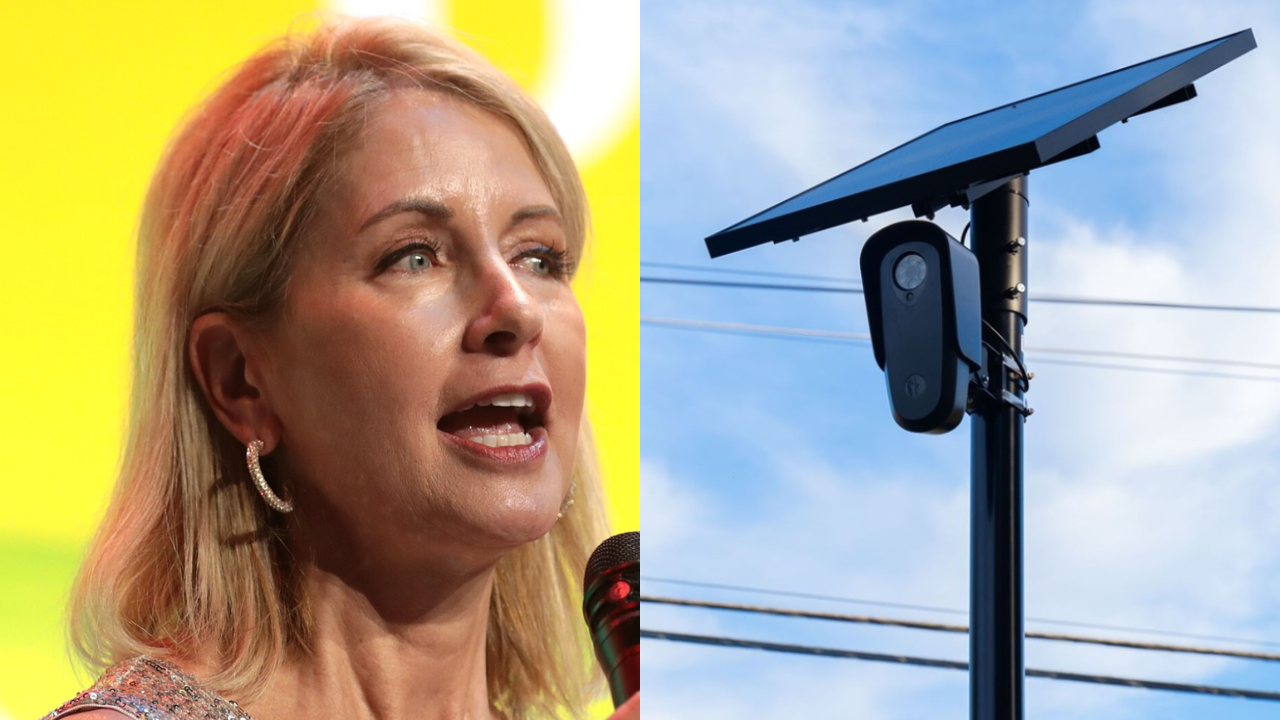
U.S. Representative Mary Miller (R-IL) warned on Tuesday, July 28, 2026, that the rapid nationwide expansion of Flock Safety’s automated license plate reader cameras amounts to the construction of a government surveillance database tracking the daily movements of ordinary Americans, arguing the technology threatens constitutional protections against unreasonable searches.
In a post on X published at 10:03 a.m. on July 28, Miller wrote: “The government shouldn’t be able to build a database of your daily movements. Flock cameras are a threat to our constitutional rights. Mass surveillance is not the American way.”
Miller’s statement did not name a specific city, contract, or piece of legislation, but it arrives amid a rapidly intensifying national debate over Flock Safety, the Atlanta-based company whose camera network has become the dominant automated license plate recognition (ALPR) system used by American law enforcement. The company says its cameras are now deployed in thousands of communities across 49 states, with more than 120,000 devices feeding a searchable, cloud-based database accessible to thousands of police departments.
Flock’s cameras photograph every passing vehicle, log its plate, and build what the company calls a “Vehicle Fingerprint” — recording details like make, color, and even bumper stickers — that can be searched later without a warrant in many jurisdictions. Civil liberties groups, including the American Civil Liberties Union, the Electronic Frontier Foundation, and the Cato Institute, have argued that stringing together months of this data effectively creates a permanent record of where a person goes: work, church, a doctor’s office, or a political rally.
Miller’s post reflects a broader position she has staked out during her time in Congress on government data collection and warrantless surveillance. In April 2024, Miller voted against reauthorizing Section 702 of the Foreign Intelligence Surveillance Act after the House rejected an amendment that would have required the government to obtain a warrant before searching Americans’ communications. “I voted against reauthorizing FISA without serious reforms to protect American citizens because FISA was abused during the Obama Administration to spy on the Trump campaign and spying authority has been abused by the Biden Administration to spy on Tucker Carlson for criticizing Biden’s policies,” Miller said at the time.
The Flock camera debate has escalated sharply in recent months as reports of misuse have surfaced across the country. CNN reported that a Milwaukee police detective was criminally charged after using the Flock network to track a woman’s location without a legitimate law enforcement purpose, prompting the department to introduce mandatory case-number logging and monthly audits of camera searches. The Milwaukee case is among a growing list of incidents cited by critics as evidence that access to the database is difficult to police once it exists.
Wrongful stops tied to camera misreads have also drawn scrutiny. In Española, New Mexico, a license plate reader mistook the number “2” on a driver’s plate for a “7,” falsely flagging the car as stolen and leading officers to handcuff the driver and her 12-year-old sister during a traffic stop.
The legal fight over the cameras’ constitutionality is already working its way through federal court. In Norfolk, Virginia, residents Lee Schmidt and Crystal Arrington sued the city after roughly 175 to 200 Flock camera clusters were installed, arguing that the network’s 21-day rolling data retention window and its ability to build detailed “Vehicle Fingerprints” amounted to a warrantless search under the Supreme Court’s Carpenter v. United States precedent. A federal district judge rejected that argument in January 2026, ruling the current scope of Norfolk’s camera network did not meet the threshold for “long-term location tracking” established in Carpenter, though the judge cautioned that ALPR surveillance “could become too intrusive” as the technology expands. Civil liberties groups have appealed the ruling to the Fourth Circuit.
Local pushback has also played out in city halls. In Denver, hundreds of residents packed a town hall after Mayor Mike Johnston extended the city’s contract with Flock, with organizers accusing officials of expanding “a technology that threatens all of our constitutional rights” behind closed doors. City officials said the extension included new safeguards intended to prevent the camera network from being accessed by federal immigration agents or law enforcement from other jurisdictions.
Flock Safety has defended its technology, telling reporters and lawmakers that its license plate readers maintain a high rate of accuracy and are built around limited data retention, encryption, and audit logging designed to flag misuse. The company’s founder and chief executive, Garrett Langley, has said publicly that safety and privacy are not mutually exclusive goals, telling reporters “we can have safety and privacy — let’s do both,” and calling for communities to be given tools to select their own safeguards.
Supporters of the technology point to its use in solving crimes, including tracking down the suspect in a mass shooting at Brown University, and cite a rise in vehicle theft nationally — the National Insurance Crime Bureau reported nearly 660,000 vehicles stolen across the country in 2025, an average of one every 48 seconds — as justification for expanded license plate monitoring.
Miller’s Tuesday post places her among a bipartisan group of lawmakers and privacy advocates who have raised concerns about the scale of the Flock network even as law enforcement agencies continue expanding their use of it. The ACLU has continued to press Congress to pass the Fourth Amendment Is Not For Sale Act, which would prohibit government agencies from purchasing location and other private data as a workaround to the warrant requirement.
As of publication, Miller’s office had not released a formal press statement or introduced legislation specifically targeting Flock Safety or ALPR networks, and her X post stands as her most recent public comment on the issue. The debate over the cameras is expected to continue playing out in courtrooms, city councils, and Congress as the network — already the largest of its kind in the country — continues to grow.