
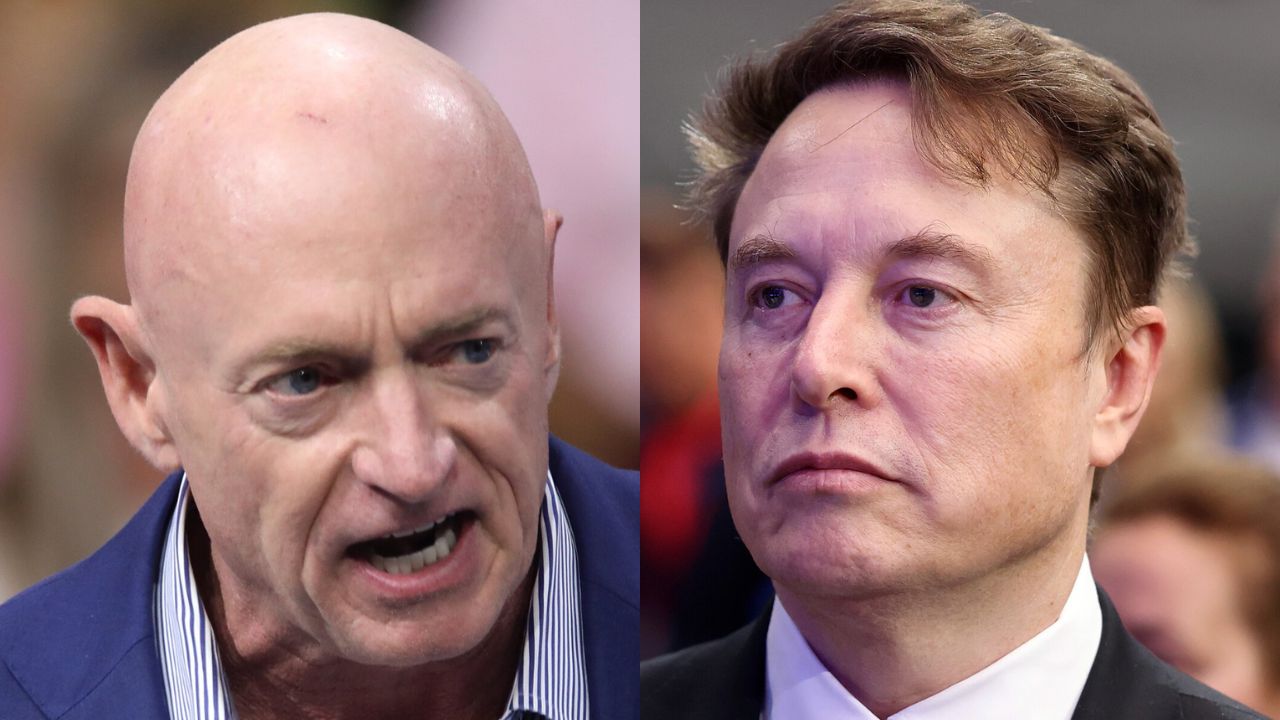
U.S. Sen. Mark Kelly, a retired Navy captain and former astronaut, said on Monday that no single individual should hold the level of influence over American elections now on display in the 2026 midterms. He called for a “serious effort” at campaign finance reform and for the Supreme Court’s Citizens United decision to be overturned. The Arizona Democrat posted the message to X as new figures showed Elon Musk, the world’s richest person, has poured more than a quarter-billion dollars into Republican efforts this cycle.
What Kelly Said
Kelly posted the statement at 12:00 p.m. on Oct. 12, 2026, from his verified account, @CaptMarkKelly. The post read in full:
“Any single individual having this amount of influence in our elections does not lead to a healthy democracy. It doesn’t matter if they are supporting Democrats or Republicans. We need a serious effort at campaign finance reform and have to overturn the Citizens United decision.”
The post did not name any individual. Kelly attached a New York Times report published the same day, “Inside Elon Musk’s $276 Million Midterm Rescue Mission for Republicans,” which described Musk as the largest known donor of the midterm cycle. Kelly’s wording also stresses that the concern is not partisan, since the influence he describes is a problem “if they are supporting Democrats or Republicans.”
The Spending Behind the Statement
The report said Musk has given more than $276 million to Republican groups and his own super PAC since the start of July. Representatives for Musk supplied the previously unreported figures ahead of a federal filing deadline on Thursday. Of that total, $158 million went to the Senate Leadership Fund, the main super PAC backing Republican Senate candidates. The report described it as one of the largest political donations in American history and more than the group’s Democratic rival raised from all donors in that quarter.
Musk also gave more than $76 million over the summer to America PAC, the super PAC he founded in 2024, which spent that amount on a canvassing program to turn out hard-to-reach Republican voters. The group is active in seven Senate battlegrounds and nearly three dozen House races. Musk’s representatives said he also gave $20 million to the Congressional Leadership Fund, $10 million to Lone Star Liberty PAC, which supports Texas Senate nominee Ken Paxton, $10 million to the Republican Governors Association, and $2 million to the Republican Attorneys General Association.
Musk has now given about $366 million to federal committees in the 2025-26 cycle, more than the roughly $290 million he spent in 2024 to help return President Donald Trump and Republicans to power. At least $119 million of that 2024 spending had been reported by the final week before that election. People briefed on the giving say he has also made undisclosed donations in both cycles. The $276 million figure covers only what is publicly known.
A Heavy Focus on Texas
America PAC deployed nearly 3,000 paid canvassers last week and says it has knocked on about 6.5 million doors nationwide. The group has put more than a third of its disclosed spending into the Texas Senate race, where Paxton faces Democratic nominee James Talarico. The $158 million Musk gave the Senate Leadership Fund came before the group’s late-August decision to begin a $149 million ad campaign supporting Paxton.
The spending also marks a reversal. In May 2025, Musk said he was “going to do a lot less” political spending in the future. His relationship with Trump then collapsed in a public break last year, but the two have since reconciled and appeared together at three events in the past two weeks. America PAC has also confirmed for the first time that it intends to stay active in the 2028 presidential election.
Kelly’s Record on Money in Politics
Kelly’s call to overturn Citizens United continues a position he stated on the Senate floor earlier this year. In January 2026, he led a series of floor speeches marking 16 years since the ruling. “In 2010, the Supreme Court handed down a decision that put a ‘for sale’ sign on our democracy,” Kelly said. He added that the ruling “opened the door for corporations and billionaires to spend unlimited amounts of money to influence our elections, often without the public ever knowing who’s behind it.”
Kelly was joined in those remarks by Democratic colleagues including Sens. Sheldon Whitehouse of Rhode Island and Alex Padilla of California. Padilla said he would keep pushing for legislation to overturn Citizens United so elections reflect “the will of the people” rather than corporations and the highest bidder. Whitehouse has long led the effort in the Senate on the DISCLOSE Act, which would require groups spending in elections to reveal their donors.
Kelly’s Previous Clashes With Musk
The senator’s history with Musk predates the midterms. In March 2025, while Musk led the administration’s Department of Government Efficiency, Kelly posted that he had returned from Ukraine, where he visited a military hospital and met wounded soldiers. Musk replied on X: “You are a traitor.” Kelly answered in a television interview the next day, saying Musk’s “slash-and-burn of the federal government” was meant to make room for large tax cuts for wealthy Americans.
Kelly also took the dispute into his Senate work. In a statement posted on his official website in March 2025, he said he would vote against a partisan funding bill, citing what he called attacks by Musk and Trump on veterans’ care, Social Security and other services. “I cannot vote for the Republican plan to give unchecked power to Donald Trump and Elon Musk,” Kelly said.
That month, Kelly also posted a video announcing he was giving up his Tesla. “Every time I get in this car in the last 60 days or so, it reminds me of just how much damage Elon Musk and Donald Trump are doing to our country,” he said, adding a vulgar insult aimed at Musk. Kelly’s earlier criticism centered on government cuts and Musk’s federal role. Monday’s post is his most direct public statement on the scale of Musk’s political donations.
Why Citizens United Is at the Center
The Supreme Court decided Citizens United v. FEC on Jan. 21, 2010, in a 5-4 ruling. It held that the government cannot restrict independent political spending by corporations and unions. Combined with a lower-court ruling the same year, the decision cleared the way for super PACs, the vehicles through which Musk’s largest donations have flowed. Campaign finance experts have described the 2024 election as one shaped by the decision.
Overturning the ruling would require either a future Supreme Court reversal or a constitutional amendment. Democrats in the Senate, including Sen. Maggie Hassan of New Hampshire, have backed the Democracy for All Amendment for that purpose. None of those efforts has advanced past the Republican-controlled Senate.
What It Means as the Midterms Approach
Kelly’s post lands three weeks before the Nov. 3 midterm elections, with Republicans defending their Senate majority and the Senate Leadership Fund backed by Musk’s $158 million. The report Kelly linked noted that Musk’s businesses have benefited from large federal contracts, and that he is now positioned as a potential player in 2028. That gives Kelly’s argument a second angle: the scale of one donor’s giving, and how it overlaps with a business empire that works closely with the federal government.
Kelly, a retired Navy captain who flew combat missions in the Gulf War and four NASA space shuttle missions, has served in the Senate since December 2020 and was re-elected in 2022. His post leaves open whether the push to overturn Citizens United gains traction, but it frames the issue in nonpartisan terms. “It doesn’t matter if they are supporting Democrats or Republicans,” Kelly wrote, putting the focus on how much influence any one individual can hold over American elections.