
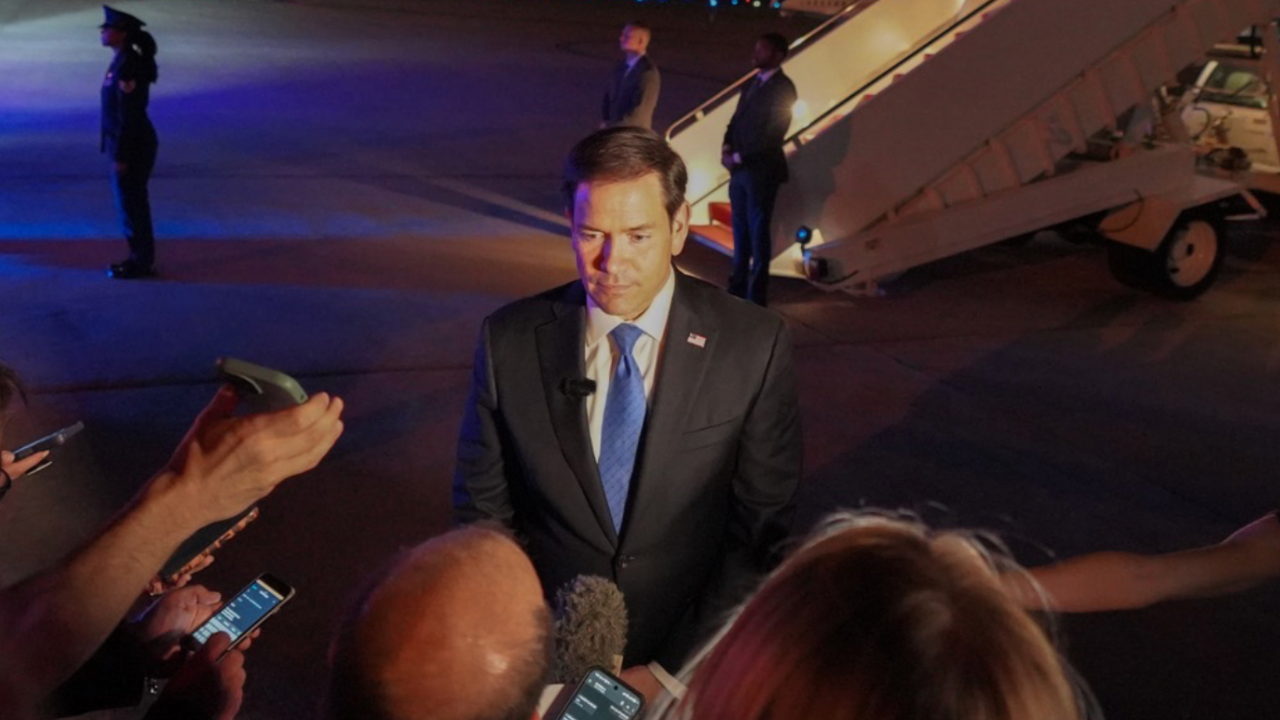
Secretary of State Marco Rubio addressed the deaths of American service members in Jordan and Iraq over the weekend, calling them heroes who paid “the ultimate price” in the service of the country.
“We lost people in Jordan after there was a strike,” Rubio told reporters, according to an official State Department transcript. “A missile got through. We shot down almost all the missiles. One leaked through, hit the wrong place, and tragically, and it’s heartbreaking, and our hearts go out to these families. These are heroes that pay the ultimate price.”
Rubio also addressed a separate death in Iraq. “We also lost a service member in Iraq unrelated to combat,” Rubio said. “They were decommissioning ammunition, and an accident happened in that process, and they were harmed.”
Rubio placed the losses in the broader context of military service. “Nothing the military does is safe,” he said. “It’s all inherently dangerous, and we’re just grateful to have such heroic Americans in uniform in the service of our country. And obviously, it goes without saying, we’re praying for their families and praying for their souls, and we are grateful that we have people like that serving us, both those who we have lost and those who at this very moment are on the watch and defending our interests around the world.”
Rubio’s remarks followed an official CENTCOM statement confirming that two U.S. service members were killed in action in Jordan on July 17 as CENTCOM and partner forces defended against Iranian ballistic missile and drone attacks, with a third listed as missing and four others medically evacuated to Jordanian hospitals before being discharged, according to the command’s public release.
CENTCOM issued a follow-up statement saying personnel had located unidentified remains at the site of the Jordan attack after “a thorough search” for the missing service member, with an identification examination still underway, and separately confirmed that a service member in northern Iraq was killed July 18 during a controlled detonation of unexploded ordnance from a downed Iranian one-way attack drone, according to the command’s updated release.
The U.S. military has identified two of the fallen as 1st Lt. Tyler James Feehan, 25, of Ewa Beach, Hawaii, and Army Pvt. Isabella Gonzales, 19, of Carrollton, Texas, both of whom were stationed at Muwaffaq Salti Air Base in Jordan, where the attack occurred.
Defense Secretary Pete Hegseth wrote on X that “their sacrifice only stiffens our resolve,” while President Trump wrote on Truth Social that he had directed military leadership to ensure Iran “pays for that killing many times over” for every American service member it kills. White House press secretary Karoline Leavitt announced that Trump would attend the dignified transfer of the fallen service members at Dover Air Force Base.
The deaths bring the total number of U.S. service members killed since the war with Iran began Feb. 28 to 17, according to Pentagon figures, following six deaths in an Iranian attack on a base in Kuwait in March, six deaths when a refueling plane crashed in Iraq that same month, one death in a strike on Prince Sultan Air Base in Saudi Arabia, and one Navy pilot who died in a helicopter’s emergency landing at sea last month.
The U.S. military has continued strikes on Iran since the Jordan and Iraq deaths, with CENTCOM saying its operations are designed to “further degrade Iranian military capabilities used to attack commercial shipping in the Strait of Hormuz.”
In the same set of remarks, Rubio addressed whether the memorandum of understanding reached between the U.S. and Iran in June remained in effect. “The straits are supposed to be open, free of tolls, free of attacks, free of all the things they’re doing against these ships,” Rubio said, according to the State Department transcript. “You can’t have an MOU that’s alive if they’re violating the terms of it.”
Rubio said Iran had been expected to halt its attacks on shipping roughly a week earlier but instead struck three vessels. “Their behavior has to change in order for ours to change,” Rubio said, adding that “the United States always remains open to a diplomatic solution, and we’ve tried multiple times with Iran, and we’ll continue to try. If that door opens, we’ll be happy to see it open.”
Asked what signals Iran had sent indicating interest in negotiating, Rubio said those signals had come “directly and through multiple channels with other countries as well.” He added that any renewed diplomatic effort “has to be real” and “a deal that they’re willing to live by.”