
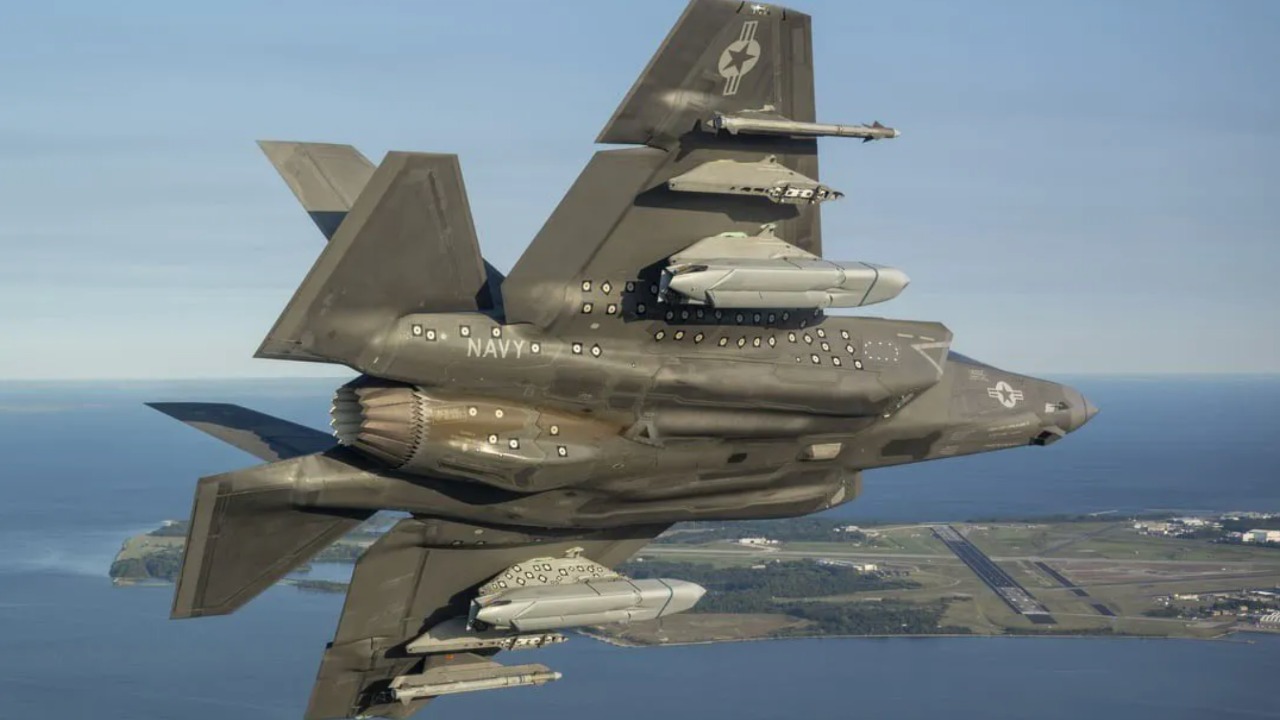
The Pentagon is pouring money into Lockheed Martin’s Long Range Anti-Ship Missile at a pace that would have been unthinkable five years ago. A new Air Force contract aims to double the LRASM stockpile from roughly 500 to 1,000 rounds, while a separate $53 million investment will overhaul the production line itself. Together, the moves signal that Washington now treats massed anti-ship firepower not as a niche capability but as a cornerstone of how it plans to fight at sea.
What LRASM is and why it matters
LRASM is a stealthy, precision-guided cruise missile designed to find and destroy enemy warships at ranges well beyond 200 nautical miles. Built by Lockheed Martin Missiles and Fire Control, it uses onboard sensors and autonomous targeting to operate in GPS-denied environments, a feature that sets it apart from older anti-ship weapons that depend on external guidance updates throughout their flight.
The Air Force currently launches LRASM from the B-1B Lancer bomber, and the Navy fires it from F/A-18E/F Super Hornets and surface warships equipped with the Mk 41 Vertical Launch System. That cross-service, multi-platform footprint is one reason the weapon has attracted such broad funding: every additional LRASM produced feeds magazines across two services and multiple combatant commands.
Air Force contract targets 1,000 missiles
In early March 2026, the Air Force awarded Lockheed Martin a contract modification designed to lift the LRASM inventory to approximately 1,000 rounds, according to a report by The Defense Post. The deal is structured as an add-on to an existing agreement, which lets the government increase quantities and authorize industrial upgrades without a lengthy new competition.
Setting a specific numeric target is unusual and deliberate. By publicly committing to 1,000 missiles, the Air Force is sending a message to Pacific-focused war planners and to Beijing: the United States intends to have enough anti-ship weapons to sustain a prolonged campaign across vast ocean distances, not just fire an opening salvo.
$53 million to retool the production line
Missiles alone do not solve the problem if factories cannot build them fast enough. In a separate contract action disclosed in March 2026, the Department of Defense authorized a $53 million upgrade to the LRASM production line, covering new tooling, test equipment, and assembly-line modernization, according to Defence Blog.
That same contracting notice extended funding through February 29, 2028, giving Lockheed and its suppliers a multi-year planning window. For a defense manufacturer, that kind of runway matters: it allows long-lead orders for components like seekers and turbofan engines, and it justifies hiring and training new workers rather than relying on overtime from existing staff.
The $9.5 billion JASSM-LRASM mega-deal
The latest contracts sit on top of a much larger foundation. In August 2025, Lockheed Martin won a $9.5 billion multi-lot contract covering both LRASM and the Joint Air-to-Surface Standoff Missile (JASSM), its land-attack sibling, as reported by Overt Defense. That deal was structured to push both missile families to higher annual output across several fiscal years.
JASSM and LRASM share airframe and propulsion components, so scaling one helps scale the other. Lockheed entered the Pentagon’s Large Lot Procurement pilot program for both weapons in 2024, a mechanism that lets the government commit to bigger quantities across multiple budget cycles while the contractor locks in better pricing from subcontractors. Lockheed has said the approach allows both missiles to be ramped more quickly than traditional year-by-year purchasing would permit.
Much of the physical expansion is centered at Lockheed Martin Pike County Operations in Troy, Alabama, which builds both JASSM and LRASM. The facility has been adding equipment and shifts to keep pace with demand, and a recent Lockheed news release highlighted ongoing configuration work for higher-rate production at the site.
Why the rush: China’s navy and the Taiwan scenario
The spending spree is not happening in a vacuum. China’s People’s Liberation Army Navy now operates the world’s largest fleet by hull count, with more than 370 battle force ships as of early 2026, according to the Pentagon’s most recent annual report on Chinese military power. Many of those vessels carry advanced air-defense systems that would force U.S. aircraft to launch weapons from standoff range rather than closing to shorter distances.
In a Taiwan contingency or a broader Western Pacific conflict, U.S. war planners expect to need hundreds of anti-ship missiles in the opening days alone to suppress Chinese naval task groups and amphibious formations. Wargames conducted by the Center for Strategic and International Studies in 2023 found that the United States expended its entire inventory of long-range anti-ship missiles within the first week of a simulated conflict over Taiwan. That finding helped catalyze the push to double LRASM stocks.
Australia has already committed to buying LRASM for its F/A-18F Super Hornets and future platforms, and Japan has expressed interest in the weapon for its own anti-ship needs. Allied purchases add production volume that benefits U.S. unit costs, but they also draw from the same factory capacity that the Pentagon is now racing to expand.
Precision Strike Missile: the land-based parallel
The LRASM buildup is part of a broader pattern. In late March 2026, the Department of Defense announced a new agreement with Lockheed Martin to accelerate production of the Precision Strike Missile (PrSM), a long-range surface-to-surface weapon for the U.S. Army, according to DefenseScoop. Lockheed said it is moving swiftly to accelerate development, testing, and production under the new deal, which builds on a multi-year contract awarded by the Army in 2025.
PrSM is designed to strike targets at ranges beyond 500 kilometers, giving ground-based units the ability to threaten ships and land targets that were previously reachable only by aircraft or submarines. Pairing PrSM expansion with the LRASM surge gives the U.S. military overlapping anti-ship coverage from air, sea, and land, a layered approach that complicates an adversary’s defensive planning.
| Program | Funding / Contract Value | Key Detail |
|---|---|---|
| LRASM inventory expansion (USAF) | Contract modification (value not disclosed) | Target: ~1,000 missiles, up from ~500 |
| LRASM production-line upgrade | $53 million | Tooling, test equipment, assembly modernization through Feb. 2028 |
| JASSM + LRASM multi-lot (2025) | $9.5 billion | Covers multiple production lots for both missile families |
| Precision Strike Missile (PrSM) | New agreement (value not disclosed) | Accelerated production for U.S. Army ground-launched variant |
Industrial and workforce pressures
Doubling output of a complex cruise missile is not simply a matter of writing bigger checks. LRASM’s seeker, datalinks, and autonomous guidance software require specialized components that have limited supplier bases. Lockheed’s Missiles and Fire Control division has used back-to-back contract awards to lock in long-lead materials and secure commitments from subcontractors, according to a financial analysis by Ad Hoc News, which noted that the latest modification follows a similar $130 million award that had already boosted production earlier.
On the workforce side, Lockheed has been advertising dozens of new roles at its missile plants, from production technicians to systems engineers, listings visible on the company’s careers portal. For communities like Troy, Alabama, where Pike County Operations is a major employer, the LRASM ramp translates directly into jobs and local economic activity.
The challenge is speed. Defense industrial base constraints, from microelectronics shortages to a tight labor market for cleared technicians, have slowed other munitions programs in recent years. Whether Lockheed can hit the 1,000-missile target on schedule will depend as much on supply-chain execution as on the size of the contracts themselves.
What comes next
The LRASM production surge is now one of the Pentagon’s most visible bets on standoff lethality. If the factories deliver, the U.S. military will enter the late 2020s with a substantially deeper magazine of stealthy anti-ship missiles spread across bombers, fighters, and surface combatants. If bottlenecks slow the ramp, the gap between strategy and inventory will persist at exactly the moment planners say they can least afford it.
Either way, the direction is clear. Washington has decided that the era of buying long-range anti-ship missiles in small batches is over.