
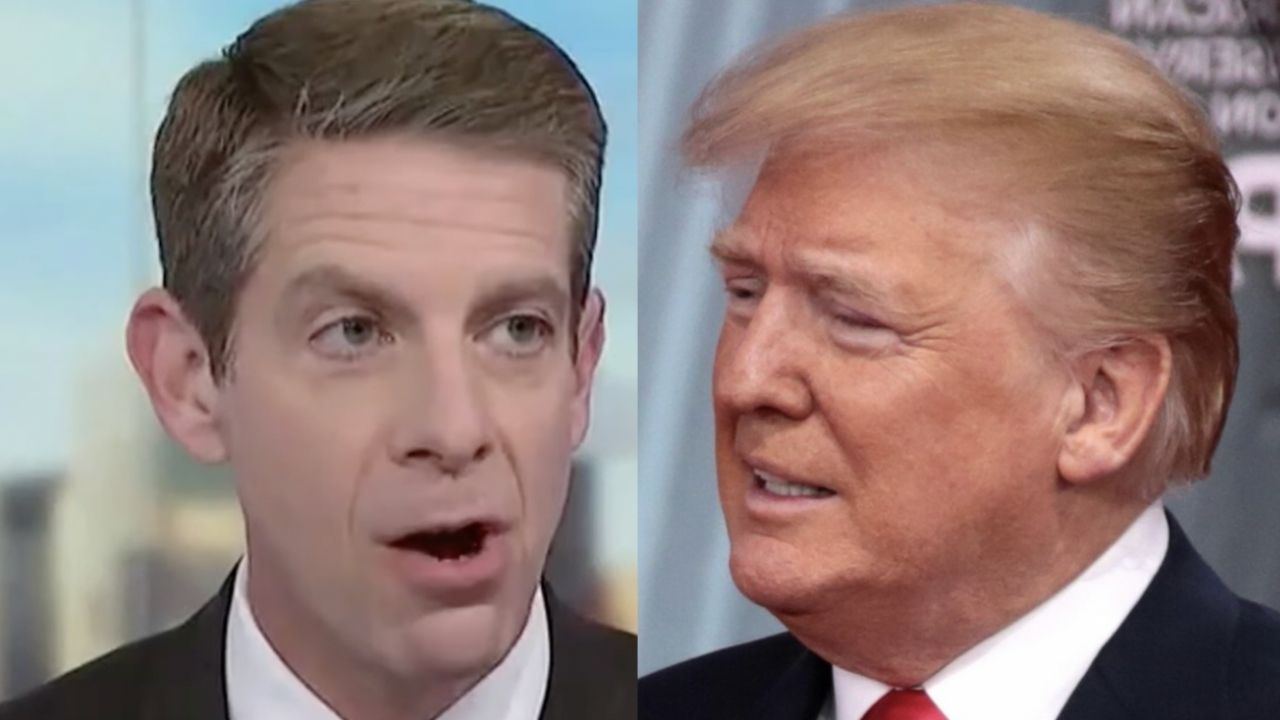
WASHINGTON — Rep. Mike Levin said Sunday that President Donald Trump and Republican leaders in Congress are spending “billions of your tax dollars on military operations against Iran that Congress never authorized,” expanding what he called “Stephen Miller’s mass deportation agenda,” and funding “the president’s own vanity projects,” “while doing nothing to lower your grocery bill.”
Levin, a California Democrat from the 49th District and a member of the House Appropriations Committee, posted the statement on X at 10:21 a.m. Eastern on Sept. 20. He said voters could “help put an end to it” in November.
Daily reminder that Trump and Republican leadership are spending billions of your tax dollars on military operations against Iran that Congress never authorized, expanding Stephen Miller’s mass deportation agenda, and funding the president’s own vanity projects, while doing nothing to lower your grocery bill or make your life more affordable.
This November, you can help put an end to it.
Iran operations and the authorization record
U.S. Central Command stated that it commenced Operation Epic Fury against Iran at 1:15 a.m. on Feb. 28, 2026, “at the direction of the President,” according to a CENTCOM fact sheet dated April 6. Congress has not enacted a declaration of war or a specific authorization for use of military force against Iran. That statement appears as a finding in H.J. Res. 156 and in the text of H. Con. Res. 93.
On Sept. 15 the House agreed to H. Con. Res. 93, sponsored by Rep. Seth Moulton, on Roll Call 307, 220–204. The Clerk’s party tally was 213 Democrats and 7 Republicans voting yes, 203 Republicans and one independent voting no, and 9 not voting. The resolution directs the president, under section 5(c) of the War Powers Resolution (50 U.S.C. 1544(c)), to remove U.S. Armed Forces from hostilities against Iran unless Congress enacts a declaration of war or a specific authorization. The Senate received the measure on Sept. 16 and referred it to Foreign Relations. Concurrent resolutions do not become law.
H. Con. Res. 86 passed the House on June 3 and the Senate on June 23 with the same core direction. Levin voted for an earlier war-powers measure on March 5 and said in a House statement that Trump had launched “major combat operations” on Feb. 28 “without a declaration of war, without an authorization from Congress.” House Foreign Affairs Ranking Member Gregory Meeks said on the floor Sept. 15, “This Congress has not authorized a war with Iran,” in remarks released by the committee minority.
The Lead Inspector General for Operation Epic Fury, in a report to Congress covering April 1–June 30, said the Department of War estimated the cost of the operation at $33.4 billion as of June 29. That estimate included $7.4 billion in incremental obligations, $22.3 billion in expended munitions, and $3.7 billion in equipment losses. It did not include infrastructure repairs. From Feb. 28 through June 30 the same report recorded seven U.S. service members killed in action, seven killed in non-hostile events, and 417 wounded in action, with four additional deaths in action in July.
On June 24, OMB Director Russell Vought transmitted a request for $87.6 billion in supplemental appropriations. His letter to Speaker Mike Johnson said most of the request addressed “urgent needs related to Operation Epic Fury.” The accompanying estimate listed $67.146 billion for Department of War military programs, including $21 billion for munitions, $17.3 billion for operational costs, $12.1 billion for classified programs, $1.5 billion for fuel, and $1.2 billion for “Administration priorities.” Congress has not enacted that supplemental as a standalone public law.
Immigration enforcement funding
Miller’s title on the White House annual staff report and on his OGE financial-disclosure filing is Assistant to the President and Deputy Chief of Staff for Policy and Homeland Security Advisor. On June 10 the president signed the Secure America Act, Public Law 119-98. The Congressional Research Service summary of the enacted bill states that it provides $70 billion to the Department of Homeland Security, Customs and Border Protection, and Immigration and Customs Enforcement through fiscal 2029 for immigration enforcement, border security, and related activities. The House passed the bill 214–212 on June 9. That package sits on top of immigration-enforcement appropriations in the July 4, 2025, reconciliation law, Public Law 119-21, which CRS has described as including tens of billions of dollars for ICE detention and hiring through fiscal 2029.
The DHS Annual Performance Report for FY 2025–2027 states that ICE returned or removed 442,637 people in fiscal 2025, against a target of 175,000, and that the department set a target of 1,000,000 returns and removals for fiscal 2026 and 2027. Levin did not attach a dollar figure to Miller’s name in the Sunday post. The statute funds the agencies, not an individual aide.
Prices and the “vanity projects” phrase
The Bureau of Labor Statistics reported on Sept. 11 that the Consumer Price Index for all items rose 3.4 percent in the 12 months through August. The food-at-home index, BLS’s grocery measure, rose 2.2 percent over that year and was unchanged from July to August, per the August CPI release. Energy rose 16.3 percent. Gasoline rose 27.4 percent. Food away from home rose 3.4 percent. Dairy fell 0.3 percent. BLS does not publish an “affordability” index. Levin’s statement that leaders have done “nothing” to lower grocery prices is his characterization of that record.
“Vanity projects” is Levin’s language. The June 24 OMB letter requested $500 million “to support ongoing efforts to complete restoration and construction projects in and around Washington, D.C.,” and specified coordination on the Seawall and the World War II Memorial. The same letter requested $600 million for the General Services Administration. It did not mention a White House ballroom. Separate news organizations have reported disputed estimates for ballroom and security work; those figures are not in the OMB letter.
The midterm general election is Nov. 3. House control, Senate control, and Levin’s seat are on the ballot.