
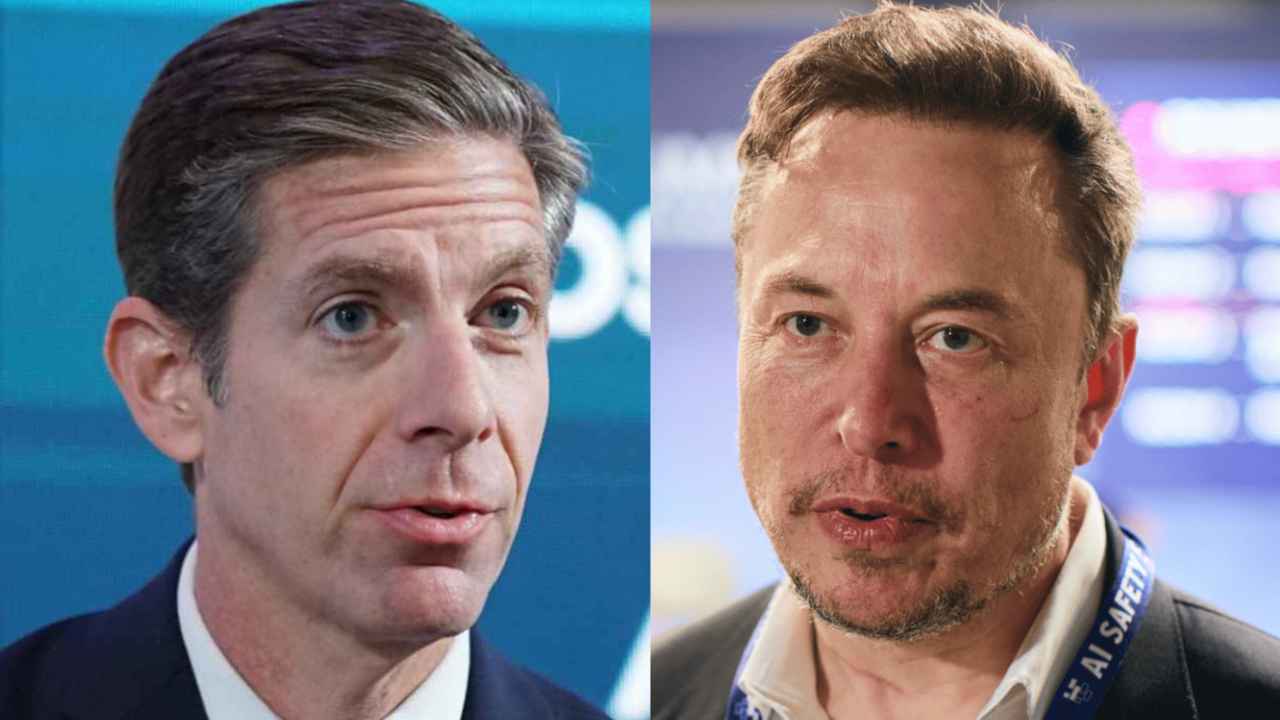
Rep. Mike Levin of California said Congress must “ensure that an unelected billionaire doesn’t have the power to single-handedly manipulate our nation’s foreign policy,” urging lawmakers to use the National Defense Authorization Act and defense appropriations to rein in Elon Musk’s SpaceX and Starlink after Ukraine reported renewed disruptions to the military-grade Starshield network on Nov. 12.
“So we have to crack down on the SpaceX relationship with the federal government generally and the Starlink connection specifically and ensure that no one person or one company has that much power over our national security and our foreign policy. It is unacceptable, unacceptable,” Levin said in remarks he shared Friday in a post on X.
In the post, the California Democrat wrote: “Our growing dependence on Elon Musk’s SpaceX and Starlink has concentrated far too much power over critical national security decisions in the hands of one individual and his companies. Congress must take action to rein in this relationship.” On how, he wrote: “We have tools at our disposal, including the National Defense Authorization Act and defense appropriations, and we need to use them.”
Levin’s remarks came the same day Senate Foreign Relations Committee Ranking Member Jeanne Shaheen and Sen. Chris Coons sent Musk a letter demanding SpaceX preserve records on Ukraine’s access to the two networks. “Between October 13 and October 24, 2026, restrictions on Starlink and Starshield disrupted communications services used by Ukrainian forces, including for interceptor drones defending civilian population centers against Russian missiles and drones,” the senators wrote. “On November 12, 2026, President Zelenskyy and the Ukrainian military reported renewed disruptions to Starshield across the entire front line and Russian-occupied parts of Ukraine.”
Zelenskyy announced the renewed problems himself on Nov. 12. “Unfortunately, our units have been recording significant disruptions to Starshield’s operations over the territory of Ukraine for several days now – along the entire front line and in the temporarily occupied territories of Ukraine. Specifically, systematic speed restrictions are being imposed on Starshield, limiting it to 161 kilometers per hour (100 miles per hour),” he wrote on X after briefings from Defense Minister Yevhenii Khmara and Commander-in-Chief Mykhailo Drapatyi. “For us, this primarily means a significant complication in intercepting Russian jet-powered drones. Unfortunately, there have already been strikes that got through because our interception systems cannot reach sufficient speeds and are unable to intercept in time.” He added, “We are trying to establish all the circumstances with the American side.”
The letter said the October disruption “coincided with reports that American diplomatic, military and security personnel in Kyiv struggled to reach designated shelters during Russian air raids,” and that “Congressional staff in Ukraine at the time witnessed and experienced the effects of the throttling firsthand.” It asked Musk to confirm by Nov. 30 that records are being preserved and to say “whether anyone outside of SpaceX authorized or directed those actions.”
Who ordered the October restrictions remains disputed in the public record. On Oct. 14, Musk wrote on X: “Starshield systems are owned and controlled by the US government. Any limits on speed or usage are decided by the US military and ultimately POTUS. Starlink is a commercial service owned and controlled by SpaceX. Usage of Starlink is limited to civilian or defensive activities and cannot be used for offensive military action, as doing so would be inappropriate for a commercial company.”
Secretary of War Pete Hegseth placed the decision with the company. “We haven’t pulled anything back. There are terms of service that ultimately need to be complied to. And that’s where Starlink has the option to make those decisions, but nothing’s changed from our view. We haven’t made any directives or anything like that,” Hegseth told reporters on Oct. 20, according to CBS News.
Musk later offered a different account of the Starlink limits. “Ukraine military violated Starlink terms of service and used it for offensive drone strikes to kill people. That loophole was closed last week,” he wrote Oct. 24, adding that “Starshield, a different system, is controlled by the US government. What they decide to do is up to them.” In the same post he wrote, “Starlink remains critical to the defense of Ukraine, as it is the only system that cannot be jammed or blown up, at least for now. Were Starlink to be turned off, the Ukrainian front line would collapse immediately. This is NOT a threat, it is simply a statement of fact.”
Levin has pressed the question for weeks. “Either Donald Trump is lying or Elon Musk is lying. Maybe both,” he posted Oct. 26. “The American people deserve to know who made the decision to turn off Ukraine’s access to Starlink, leaving them more vulnerable to Russian attacks. Congress needs answers, and I’m going to keep asking until we get them.”
He has also tied the episode to Russia. “Trump eases sanctions on Russia and begins buying Russian diesel. Days later, Musk restricts Starlink service in Ukraine, disrupting its military operations and its ability to defend itself,” Levin wrote in a Nov. 1 post. “And now we’re learning directly from Putin that Russia has been in contact with Musk.” He added: “I want to know what Musk has been discussing with Russian officials, whether those conversations had anything to do with the Starlink disruptions, and what the Trump Administration knew.”
He has also raised SpaceX’s federal contracts. “First, the White House told us Elon Musk’s Starlink service was a FREE gift. Now, federal contracting records reveal nearly $1.2 MILLION in taxpayer-funded contracts awarded to SpaceX for Starlink services at the White House,” Levin wrote Nov. 11, citing a Washington Post report. “The Trump Administration has refused to explain whether these contracts cover the same services it previously described as a donation.”
The Pentagon’s reliance on SpaceX extends well beyond Ukraine. In April 2025, the Space Force’s Space Systems Command awarded National Security Space Launch contracts with an anticipated value of $5,923,580,297 for SpaceX, $5,366,439,406 for United Launch Services and $2,386,234,812 for Blue Origin. The command said SpaceX “is anticipated to be awarded 28 missions or about 60%” of the program’s Lane 2 missions from fiscal 2025 through 2029, which it described as covering “our most demanding, least risk-tolerant payloads.” Space Force Chief of Space Operations Gen. Chance Saltzman said at the time, “National Security Space Launch isn’t just a program; it’s a strategic necessity that delivers the critical space capabilities our warfighters depend on to fight and win.”
The senators’ letter framed Starshield itself as a response to earlier concerns. “Previous restrictions affecting operations near Crimea demonstrated the risks of relying on commercial infrastructure whose availability could be determined by a single corporate executive,” Shaheen and Coons wrote. “The development and procurement of Starshield were intended, in part, to address the military’s need for more reliable and government-controlled communications.”
Levin’s statements that SpaceX holds too much power, that “an unelected billionaire” can “single-handedly manipulate” foreign policy and that either Trump or Musk is lying are his own assessments, while Musk’s statements that Ukraine’s military broke Starlink’s terms and that Starshield limits are set by the government are Musk’s. The record shows restrictions disrupted Ukrainian forces’ Starlink and Starshield service from Oct. 13 to Oct. 24, according to the senators’ letter; Zelenskyy reported renewed Starshield speed restrictions on Nov. 12; Hegseth said the Pentagon issued no directives; and SpaceX holds a Space Force launch contract with an anticipated value of about $5.9 billion.