
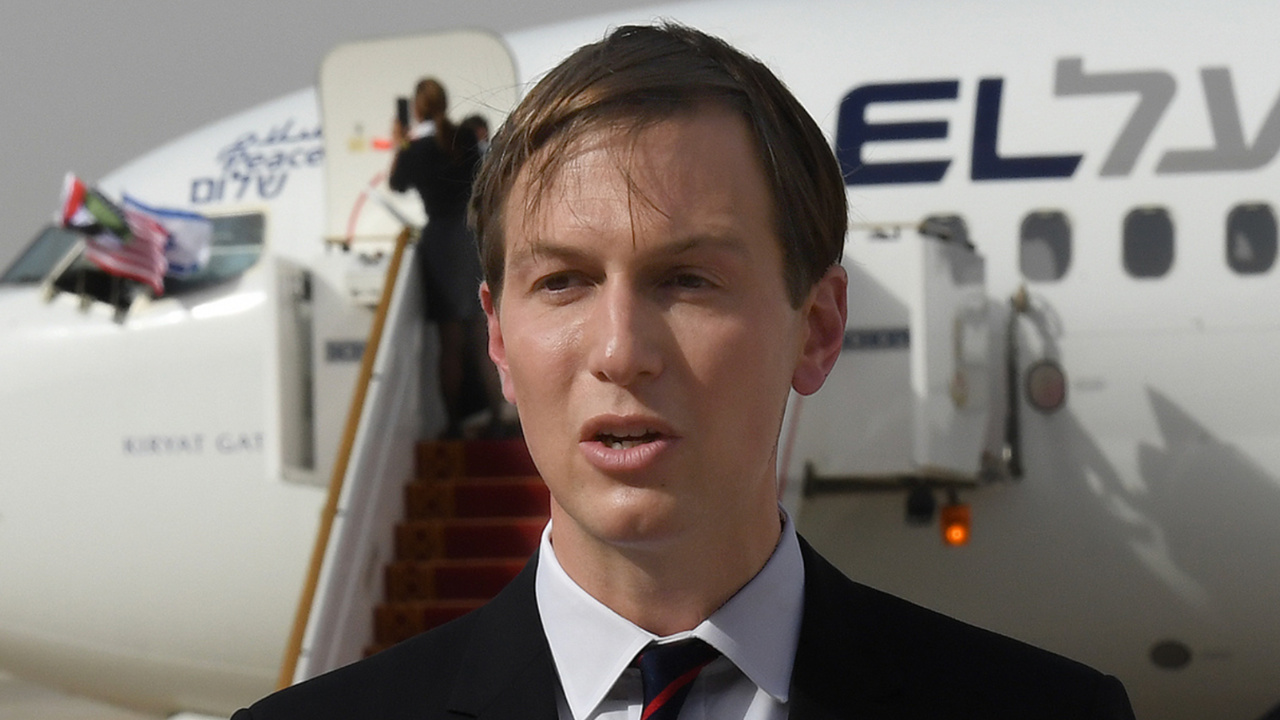
Jared Kushner marked the sixth anniversary of the Abraham Accords Thursday with a message arguing the framework’s approach remains relevant to unresolved regional challenges. “Six years ago, President Trump launched the Abraham Accords and opened a new chapter of peace, partnership, and prosperity in the Middle East,” Kushner wrote on X. “Many said it was impossible. But with courageous leadership, persistence, and a small group of people willing to challenge old assumptions, we proved that the impossible could be achieved.”
The Rest of Kushner’s Message
Kushner argued the underlying model — replacing conflict management with shared economic and security interests — remains applicable today. “The Middle East is once again at an inflection point. There are breakthrough opportunities today that many will say are impossible,” he wrote. “The Abraham Accords showed that a different path is possible. Now we have an opportunity to build an even broader movement around cooperation, shared prosperity and security… We surprised the world once. With the right leadership, focus, patience and courage, I believe we can do it again.”
What the Abraham Accords Actually Established
The Accords originated as a series of normalization agreements the first Trump administration brokered in 2020, with the core agreements signed at the White House on September 15 of that year, establishing full diplomatic relations between Israel and the United Arab Emirates, and separately between Israel and Bahrain. Morocco and Sudan later joined the broader framework, though Sudan’s continued instability has delayed it from finalizing a full bilateral agreement. Kushner, then a senior White House adviser, was a principal architect and negotiator of the original deals.
Who Has Actually Joined Since 2020
The Accords’ membership has grown modestly since the original signings. According to Britannica’s tracking, Kazakhstan announced its accession to the framework in November 2025, becoming the most recent country to formally join. Saudi Arabia and Syria have both shown what outside analysts describe as serious interest, but neither has reached an agreement to actually join.
Why Saudi Arabia Specifically Remains Outside the Framework
Saudi Arabia’s absence carries particular significance given its regional weight, and the reasons for it are well documented. According to reporting on the kingdom’s position, Trump stated in July 2026 that a proposed civilian nuclear cooperation agreement with Saudi Arabia would be tied to the kingdom joining the Accords and normalizing relations with Israel — but Saudi officials have continued to insist that normalization depends on credible progress toward an independent Palestinian state, a position the kingdom has maintained consistently rather than shifted in response to the nuclear-deal linkage.
How the Framework Has Been Strained Since 2023
Independent regional analysts have documented genuine strain on the Accords since Kushner’s team first brokered them. According to the Middle East Institute, the shared Israeli-Gulf perception of the Iranian threat that partly underpinned the original agreements “has increasingly come under stress,” particularly following Israel’s post-October 7, 2023, campaigns against Hamas and Hezbollah and the broader Israeli-Iranian conflict that began in 2025. The same analysis noted that Israel has pursued “a maximalist military approach toward Iran and its allies,” while Gulf states have generally prioritized regional stability and, in some cases, sought to lower tensions with Tehran directly — a strategic divergence the analysis said could determine whether the Accords ultimately expand or stagnate.
What Outside Analysts Say Has Held the Framework Together
Despite that strain, the Washington Institute’s five-year assessment found the core signatories have remained committed on paper even through serious regional turmoil. “In the five years since the Abraham Accords were launched in 2020, economic and security coordination between the signatories has grown substantially,” the assessment found, noting that while the Gaza war “ushered in major regional instability that has soured public sentiment across the region and paused further efforts toward normalization, most notably with Saudi Arabia,” none of the original signatories has suspended or formally withdrawn from the agreements.
The Documented Trade Growth Kushner Referenced
Kushner’s claim of “billions in trade” has some independent support, though with an important caveat. According to a May 2025 report from the Dubai-based Observer Research Foundation Middle East cited by the Mises Institute, trade between the four original Accords nations grew substantially in the years following the agreements, with commercial airline service, university and technology exchanges, and new import-export relationships developing across the bloc — though the same report found total trade dipped in 2023, an impact widely attributed to the disruption following Hamas’s October 7 attack on Israel that year.
A Note on the Anniversary Date Itself
Kushner’s post marking “six years” arrived on August 13, though the Accords’ actual signing ceremony took place September 15, 2020 — meaning Thursday’s post came roughly a month ahead of the precise six-year anniversary date, framing the message more as a general reflection on the framework’s legacy and future than a strictly dated commemoration.
A Parallel Statement From Israel’s President
Kushner’s remarks came alongside separate comments from Israeli President Isaac Herzog, who also publicly marked the milestone around the same period, describing the agreements as an important achievement for the region — a parallel acknowledgment from Israel’s own head of state that underscored the anniversary’s significance beyond Kushner’s individual reflection.
Kushner’s Consistent Advocacy Since Leaving Government
Thursday’s post continues a pattern Kushner has maintained since leaving formal government service, regularly marking Accords anniversaries and defending the underlying model in public statements. He has consistently framed the approach as a rejection of “conventional conflict management” in favor of tangible economic and security benefits — the same core argument repeated in Thursday’s post.
What “Do It Again” Likely Refers To
Kushner did not name a specific country or deal in his post, but his call to “build an even broader movement” tracks closely with two active, unresolved efforts the administration has pursued in recent months. Trump has repeatedly urged Syria’s post-Assad interim president, Ahmed al-Sharaa, to sign onto the Accords, pairing that push with the lifting of U.S. sanctions on Syria as a goodwill gesture; Special Envoy Steve Witkoff told CNBC in a separate interview that the administration expected “pretty big announcements on countries that are coming into the Abraham Accords,” while Israeli National Security Adviser Tzachi Hanegbi has separately identified Syria and Lebanon as the two most likely near-term candidates. Trump has also continued pressing Saudi Arabia to join, at one point tying a proposed U.S.-Saudi civilian nuclear cooperation agreement to normalization with Israel — an offer Saudi officials have not accepted, maintaining instead that normalization remains contingent on credible progress toward Palestinian statehood.
Where This Leaves Things
As of Kushner’s Thursday post, the Abraham Accords’ formal membership remained limited to the UAE, Bahrain, Morocco, Sudan, and Kazakhstan, with Saudi Arabia — widely viewed as the framework’s most consequential potential addition — still withholding normalization pending progress on Palestinian statehood that has not materialized. Kushner’s call to “build an even broader movement” describes an aspiration rather than a confirmed diplomatic breakthrough, with the framework’s near-term expansion remaining, by outside analysts’ own assessment, contingent on resolving the same regional tensions that have strained it since 2023.