
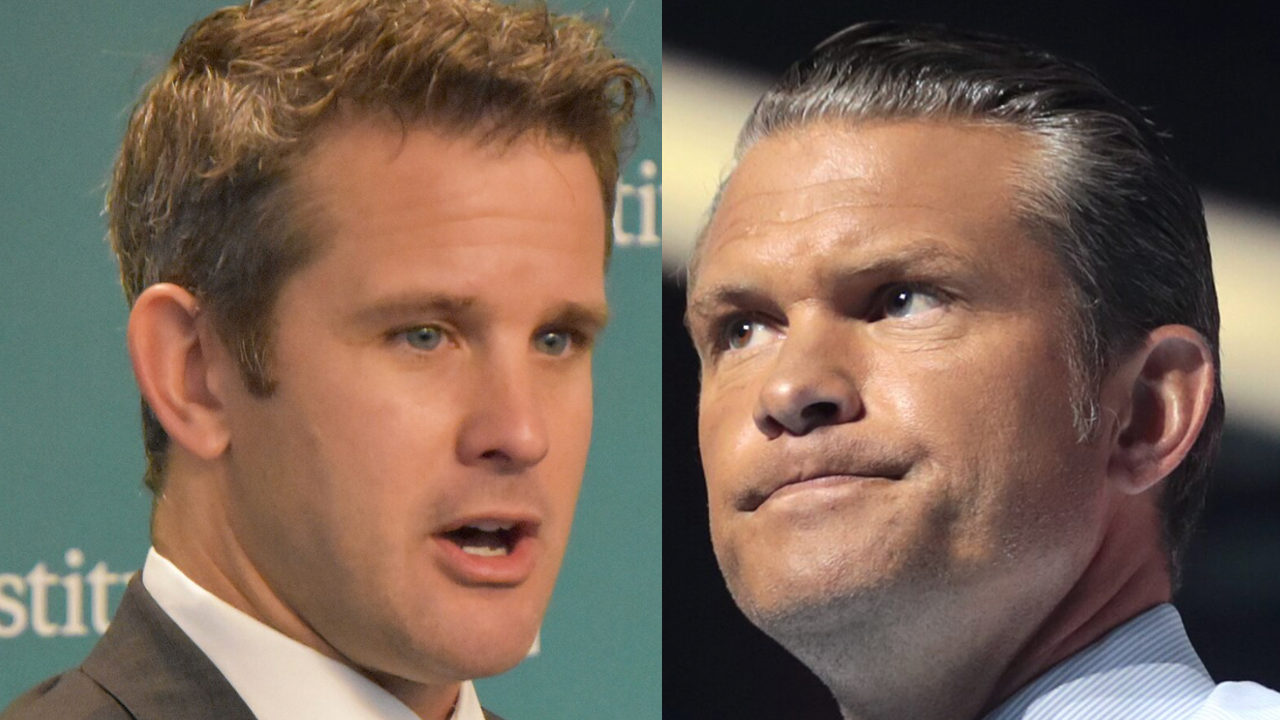
Former Republican Congressman and Air National Guard Lt. Col. Adam Kinzinger said this week that Defense Secretary Pete Hegseth has lost the respect of the military men and women he leads, adding his voice to a growing bipartisan chorus of lawmakers, veterans and Pentagon insiders who have raised alarm over Hegseth’s management of the nation’s armed forces.
“The problem is no longer any individual fiasco,” Kinzinger wrote on X. “The problem is the man who keeps creating them.” The post sparked a polarized debate among veterans and military families, with replies split between those defending Hegseth’s reforms and those echoing Kinzinger’s concerns.
Kinzinger, an Illinois Republican who broke with Trump over the January 6th Capitol attack and has since become one of his most prominent Republican critics, has spent much of 2026 documenting what he describes as a pattern of self-inflicted damage at the Pentagon. In a detailed June post on his Substack, he wrote that Hegseth “seems to think the Pentagon is a television studio with a bigger budget.”
The Signal Scandal
The episode that drew the most sustained damage to Hegseth’s credibility was his use of the Signal messaging app to share sensitive military operational details. In March 2025, The Atlantic revealed that National Security Advisor Mike Waltz had accidentally added the magazine’s editor-in-chief, Jeffrey Goldberg, to a Signal group chat in which Hegseth and other top officials discussed an imminent military strike on Houthi targets in Yemen. Hegseth wrote in the chat, “THIS IS WHEN THE FIRST BOMBS WILL DEFINITELY DROP,” referencing the military time of 1415.
A second Signal chat then emerged in which Hegseth had shared essentially the same attack information with his wife, his brother Phil Hegseth — whom he had hired at the Pentagon as a DHS liaison — and his personal lawyer. NBC News reported that the airstrike information had been pulled directly from a classified U.S. Central Command document marked “Secret/NOFORN,” meaning no foreign nationals were permitted to view it.
The Pentagon Inspector General concluded in a classified report to Congress that had the information been intercepted by a foreign adversary, it would have endangered both U.S. service members and the mission. The IG found Hegseth violated Pentagon protocols governing the use of personal devices for official business. Hegseth refused to be interviewed by the inspector general during the probe, submitting his arguments in writing instead. He has insisted no classified information was shared, declaring on X, “Total exoneration. Case closed.” The White House backed him, and Trump said he stood by Hegseth.
The General Purge
Since taking office in January 2025, Hegseth has overseen the removal, firing or forced departure of more than a dozen of the military’s most senior officers, a pace and scale that has drawn bipartisan alarm on Capitol Hill. Among those fired were Joint Chiefs Chairman Gen. CQ Brown Jr., Chief of Naval Operations Adm. Lisa Franchetti, Air Force Chief of Staff Gen. James Slife, Director of the Defense Intelligence Agency Lt. Gen. Jeffrey Kruse, and Gen. Christopher Donahue, the commander of U.S. Army Europe and Africa.
The dismissal that drew the sharpest Republican reaction was that of Army Chief of Staff Gen. Randy George — a decorated officer credited with pulling the Army out of its 2024 recruiting crisis and pushing for drone-based technology adoption — who had clashed with Hegseth over the secretary’s attempts to block the promotion of four Army officers, two of whom are Black and two of whom are women. George was replaced by Hegseth’s former personal assistant at the Pentagon.
Sen. Thom Tillis — a Republican who voted to confirm Hegseth — said publicly that Hegseth had “a failing grade” on technical and managerial skills. “He’s making some less-than-ideal personnel decisions,” Tillis said. An anonymous Republican senator told The Hill that confidence in Hegseth among Senate Republicans had dropped sharply, adding that “the hollowing out of incredible leadership at the Pentagon has been a big concern.”
A Culture of Suspicion Inside the Pentagon
Pentagon insiders told CNN that Hegseth has operated with deep distrust of officials around him — civilian and military alike — almost from the start of his tenure. “A year-plus later, there is a lack of clear internal processes within the Pentagon, caused by mass paranoia,” one Pentagon official told CNN. “Everything is a case-by-case basis because there’s no delegation, there’s no trust. And if there’s no delegation or trust, policy decisions can’t be made.”
Retired Army Major General Randy Manner warned in April that removing senior officers without clear justification could make others less willing to provide candid advice during wartime, creating a dynamic that “does not help at all in terms of giving confidence to the American fighting man,” per Newsweek. Former spokesman John Ullyot — who was asked to resign — published an op-ed in Politico calling the situation “a near collapse in the Pentagon’s top ranks” and describing “a strange and baffling purge.”
The Flu Outbreak and Pattern of Reversals
Kinzinger devoted significant attention in his June Substack post to an episode involving the flu vaccine. After Hegseth eliminated the military’s flu vaccine requirement as part of a broader rollback of what he described as “woke” health mandates, at least 275 Air Force recruits at Joint Base San Antonio-Lackland fell ill with influenza in the spring, some requiring hospitalization, and training was disrupted. The Pentagon quietly reinstated the flu vaccine requirement weeks later, according to Kinzinger’s post. He described it as emblematic of Hegseth’s approach: “A decision designed to generate headlines, provoke applause, or advance a culture-war narrative. Experts warn about the consequences. The warnings are ignored. Then predictable consequences followed.”
Hegseth’s Defense
Hegseth and his supporters argue that the Pentagon required a fundamental culture shift away from what they describe as decades of “managed decline” and overemphasis on diversity over lethality. In congressional testimony in April, Hegseth told lawmakers that “for decades, our military has been stagnant” and that the Trump administration was “reversing those trends” with a $1.5 trillion national security budget and what he described as a once-in-a-generation revival of American industry and defense investment.
Hegseth has pointed to the Navy’s record recruiting numbers — hitting 45,000 sailors three months ahead of schedule — and surging enlistment figures across all branches as evidence that his approach is working. Trump has repeatedly backed him. “I think he’s a great choice,” Trump said at an April press conference, adding that Hegseth had been “treated very unfairly” by the Senate. As long as that support holds, analysts say Hegseth’s position is secure. “In a better world, the Senate would assert itself and rein in his chaotic tenure,” one defense analyst told Salon. “As long as the president is happy with him, he’s not going anywhere.”