
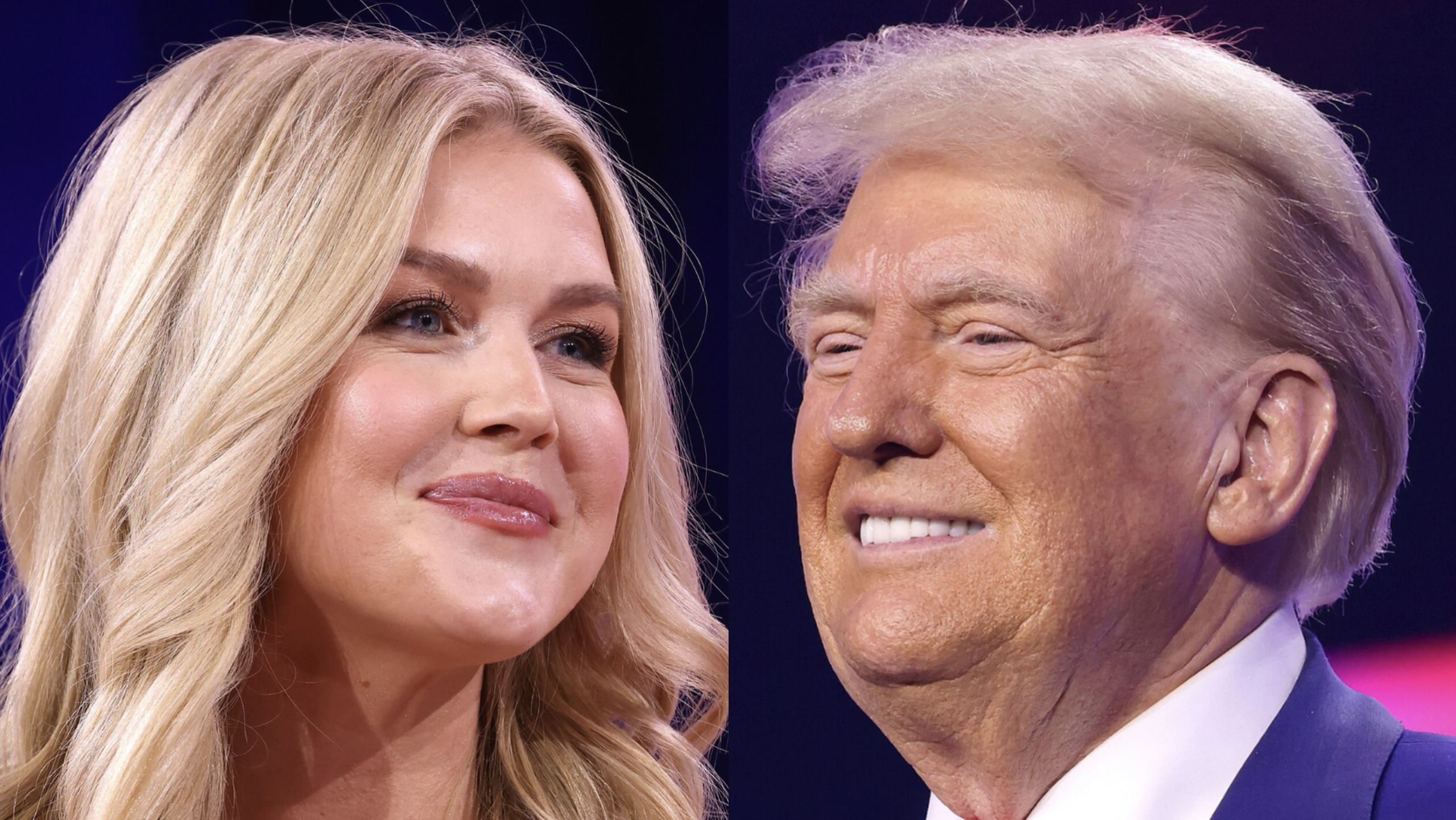
President Donald Trump on Wednesday unveiled a $22.5 billion plan to rebuild Washington Dulles International Airport, and the announcement quickly drew public praise from White House Press Secretary Karoline Leavitt, who framed the project as part of the president’s broader push to modernize the nation’s infrastructure.
“America should have the best airports and infrastructure in the world. President Trump is making that happen,” Leavitt wrote in a post on X shortly after the announcement.
Leavitt’s post came as Trump presented the renovation plan from the Oval Office, using a laser pointer to walk through renderings laid out on his desk. He was joined by Transportation Secretary Sean Duffy, United Airlines CEO Scott Kirby, and Metropolitan Washington Airports Authority CEO Jack Potter for the presentation.
The centerpiece of the plan is the elimination of Dulles’s mobile lounges — the slow-moving “people movers” that have shuttled passengers between the main terminal and outlying gates since the airport opened in 1962. Trump has repeatedly described the facility as one of the worst airports in the world despite praising the design of its landmark main terminal.
“It’s considered one of the worst airports anywhere in the world, we’re going to make it maybe the best with some hard work,” Trump said, adding that it was time “for a major and long overdue renovation and reconstruction of Washington’s really horribly-thought of Dulles.”
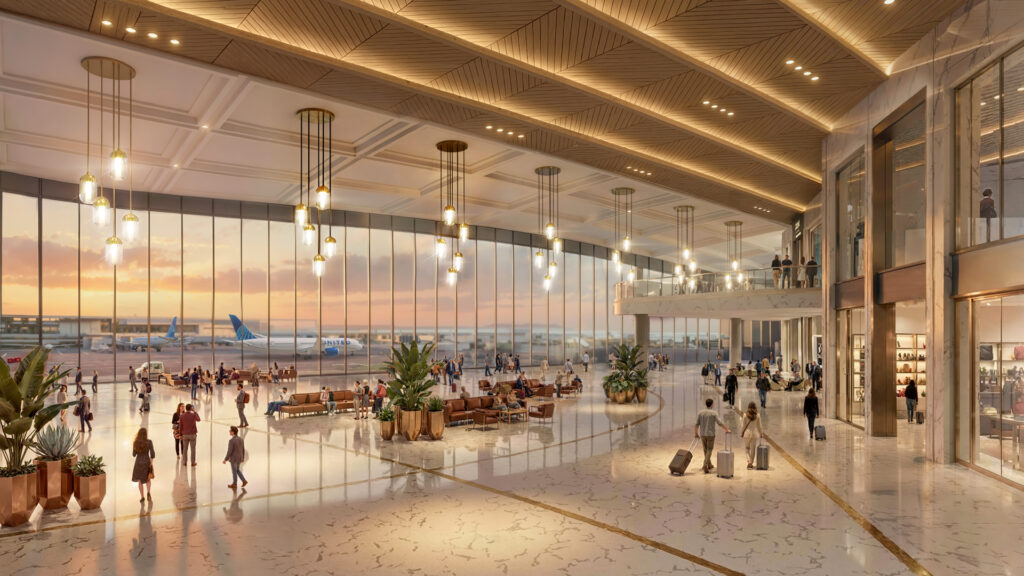
The overhaul calls for more than 5 million square feet of new or renovated airport space, including four new linear concourses to replace the current A, B, C and D gate areas. In place of the mobile lounges, the airport will get a new underground, U-shaped aerotrain, a central walking tunnel, and additional moving sidewalks. The existing aerotrain currently serves only the A, B and C concourses, leaving out the D concourse where United’s gates are located.

An above-ground parking garage with space for roughly 32,000 vehicles will also be built closer to the main terminal, along with glass-enclosed bridges connecting to the building, a new hotel, and additional restaurants and shops, according to renderings presented at the event.
Trump was careful to separate his criticism of the airport’s layout from the terminal building itself, crediting Eero Saarinen, the Finnish-American architect who designed Dulles’s distinctive main terminal with its sweeping, upward-curving roofline. That structure will be preserved under the plan.
“We’re going to turn that around and we’re going to make Dulles airport — serving Washington and Virginia, Maryland, etc. — we’re gonna make that into something really spectacular,” Trump said in December, when he first previewed his intent to redesign the airport. “We have an amazing plan for it.”
Leavitt’s endorsement of the project reflects the administration’s broader messaging strategy around Trump’s infrastructure initiatives in the capital region. As press secretary, Leavitt has regularly used her public platforms to amplify the president’s announcements, framing large-scale construction projects as evidence of tangible progress delivered during his second term.
The Dulles overhaul is the latest addition to a growing list of large-scale construction efforts Trump has pursued in and around Washington. Since returning to office, he has pushed forward a new White House ballroom, a planned renovation of the Kennedy Center, and a towering triumphal arch near the Lincoln Memorial.
“This transformation is another step in our ongoing efforts to make Washington, D.C., safe and beautiful again,” Trump said at the announcement. “It’s time to ensure that the United States has the greatest airports anywhere in the world. And we’re starting right here with the capital city.”
Funding for the project will come primarily through municipal bonds issued by the Metropolitan Washington Airports Authority, working in coordination with the airlines that serve Dulles, with additional portions of the development potentially structured as public-private partnerships. Trump said United Airlines would help fund part of the project, though the carrier did not immediately respond to a request for comment on the funding arrangement. The airport authority had already approved a separate $7 billion capital plan for Dulles in 2025.
Dulles is operated by the Metropolitan Washington Airports Authority under a 50-year lease approved by Congress, and Trump indicated that some level of congressional approval would still be required to move the project forward. Duffy said the administration’s goal is to begin construction next spring, with the broader project expected to unfold over roughly two years.
Despite the criticism directed at the airport’s layout, Dulles has remained a growth story. It was the fastest-growing large U.S. airport by passenger traffic last year, handling a record 29 million total passengers in 2025, up 6.4%. This fall it is scheduled to open a new 435,000-square-foot, 14-gate concourse serving United customers, which currently handles roughly 70% of the airport’s traffic out of a cramped terminal built in 1985 as a temporary facility.
The mobile lounges being phased out under the plan have long been a point of friction for travelers. Built by Chrysler Corporation, the vehicles were originally marketed as a convenience when Dulles opened, allowing passengers to walk only 200 feet from the terminal before boarding a lounge for a short ride to their aircraft. The airport currently operates a fleet of 19 mobile lounges, each capable of carrying up to 102 passengers. Safety concerns have also factored into the debate: one of the mobile lounges crashed in November, sending 18 people to the hospital.
Leavitt’s post, published on X at 2:15 p.m. on July 29, 2026, was among the first official White House reactions to circulate publicly following the announcement, positioning the Dulles project as part of a larger narrative the administration has built around infrastructure investment in the capital region.