

In the choking jungle around Henderson Field on Guadalcanal, one Marine with one heavy machine gun turned a collapsing line into an immovable wall. Sergeant John Basilone’s stand in October 1942, at the head of a handful of exhausted gunners, became one of the defining actions of the Pacific war and a benchmark of Marine Corps grit. His Medal of Honor citation would later describe extraordinary heroism, but the reality on the ground was even starker: if his guns failed, the Marines’ last line of defense could have snapped.
Basilone’s story at Guadalcanal is not just a tale of marksmanship or toughness, it is a case study in how training, improvisation, and sheer will can change the course of a battle. With Browning M1917 heavy machine guns overheating, crews cut down, and ammunition nearly gone, he kept the weapons in the fight and the enemy at bay. That night, one Marine and one machine gun section helped decide whether the United States would hold its first hard‑won foothold in the Pacific.
The Marine behind the legend
John Basilone entered the Second World War as a professional soldier already hardened by experience. According to his official Marine Corps biography, he had served in the United States Army before enlisting in the United States Marine Corps, bringing with him a familiarity with weapons and field conditions that would prove crucial on Guadalcanal. By the time he reached the island, he was a sergeant in charge of two sections of heavy machine guns, a role that demanded both technical mastery and the ability to keep men steady under fire, as reflected in his profile from the Marine Corps History Division on Medal of Honor recipients.
Those who fought with him remembered not a distant hero but a working NCO who stayed on the line. One account preserved by the Marine Corps History Division quotes Private First Class Phillips recalling that “Basilone had a machine gun on the go for three days and nights without sleep, rest or food,” a description that captures both the physical strain and the relentless tempo of the Guadalcanal fighting. Biographical summaries note that he would later be promoted to platoon sergeant and become known as “Manila John,” but the foundation of that reputation was laid in the mud and darkness around Henderson Field, where his leadership was measured in yards of ground held and guns kept firing rather than in rank or decorations, as outlined in the detailed entry on John Basilone.
Henderson Field and the stakes on Guadalcanal
By the time Basilone’s machine guns were dug in near Henderson Field, the Battle of Guadalcanal had already become a grinding contest of attrition. Control of the airfield meant control of the skies over the surrounding seas, and with it the ability to reinforce or starve the island’s garrisons. Reports on the campaign describe the epic six‑month struggle in the jungle, with Japanese forces launching repeated night assaults in an effort to break through the Marine perimeter and overrun the airstrip, a pattern summarized in coverage of the Battle of Guadalcanal.
Basilone’s sector covered a narrow approach that funneled attacking troops toward the Marine lines, a place where a single failure could open a path straight to the airfield. His Medal of Honor citation, reproduced by Arlington National Cemetery, notes that “while the enemy was hammering at the Marines’ defensive positions,” he was in charge of two sections of heavy machine guns guarding a vital pass on Guadalcanal in the Solomon Islands. The citation emphasizes that the Japanese attack came in waves and that the defensive positions were under “brutal fighting with heavy casualties,” underscoring how thin the margin was between holding and losing Henderson Field, as detailed in the official Medal of Honor text.
One Marine, one machine gun line
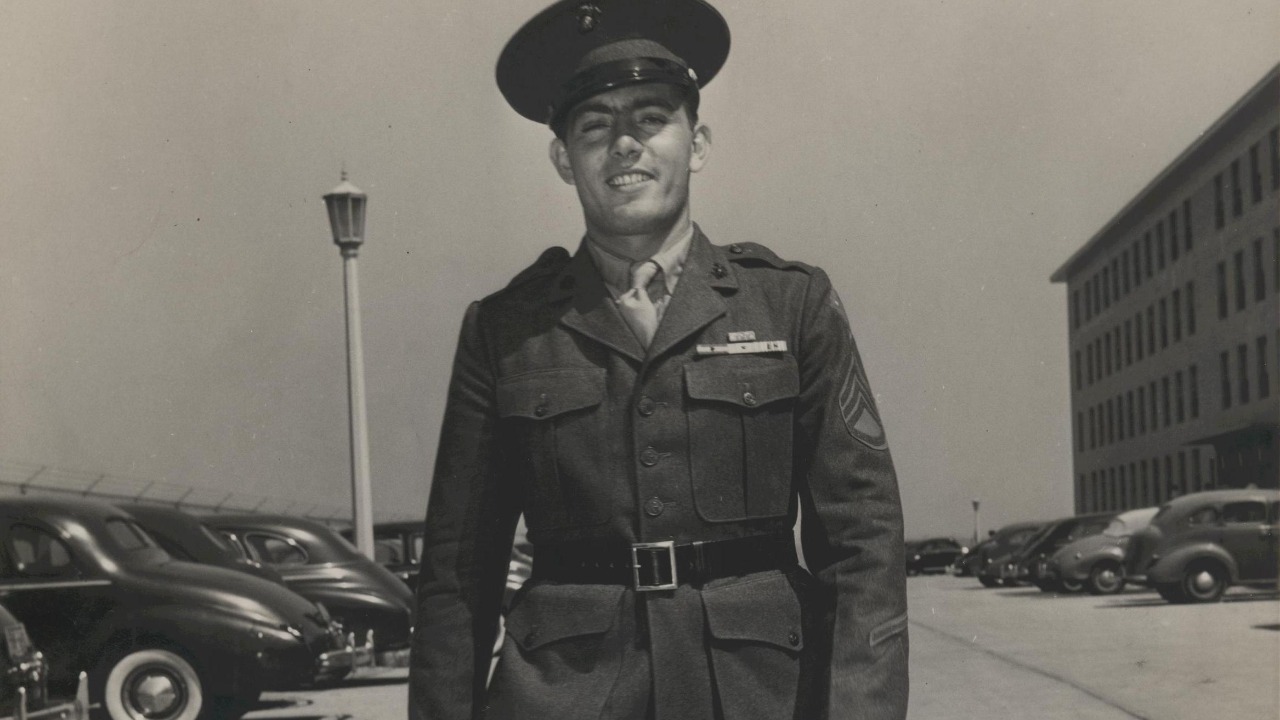
When the Japanese assault crashed into Basilone’s sector in late October 1942, his machine gun crews were quickly hit by mortar and grenade fire. Accounts compiled by Marine historians describe how his two sections of heavy .30‑caliber guns, positioned near the Tenaru River and along the approaches to Henderson Field, were chewed up until only a handful of Marines remained at their posts. With enemy soldiers infiltrating close to the wire and casualties mounting, Basilone shifted an extra gun into position and personally kept it firing, even as he moved between emplacements to clear jams and direct fire, a sequence described in narrative form in the Marine Corps article on the legend of Gunnery Sgt. Basilone.
As the night wore on, ammunition became as dangerous a constraint as enemy fire. When belts for the heavy guns ran low, Basilone did not wait for resupply. He fought his way through Japanese lines to bring up more ammunition to his gunners, then returned to the positions and continued to man the weapons himself. One detailed combat narrative notes that when some guns were knocked out, he crawled to the damaged positions under fire, inspected the weapons, and managed to get at least one back into action, all while bullets “whizzed” around him, as recounted in the story of John at his gun pits.
The Browning M1917 and a brutal close fight
The weapon at the center of Basilone’s stand was the Browning M1917, a .30‑caliber, water‑cooled heavy machine gun that had first seen service in the First World War. The M1917 and its later M1917A1 variant were designed by John Browning and adopted by the United States armed forces as a crew‑served weapon capable of sustained fire when properly cooled and supplied with ammunition. Reference material on the weapon notes that it was used extensively in the Guadalcanal campaign and that it was most famously associated with John Basilone’s Medal of Honor action, as described in entries on the Browning M1917 and the M1917A1 machine gun.
In practice, that meant Basilone was fighting with a weapon that could dominate a narrow field of fire but demanded constant attention. He had to manage water levels in the cooling jackets, clear stoppages, and keep ammunition belts feeding smoothly, often with only a few surviving crewmen to help. When the guns did fall silent, accounts of the battle state that he resorted to his pistol and even a machete to repel attackers who had closed to within yards of the positions, contributing to what one combat history describes as the virtual destruction of a Japanese regiment in front of his sector. A detailed campaign study notes that he killed at least 38 enemy soldiers, not only with the machine guns but also with his sidearm, a figure cited in an analysis of Marine hero of Guadalcanal and Iwo Jima.
Medal of Honor, national fame, and unfinished business
The official recognition of Basilone’s actions came in the form of the Medal of Honor, awarded for his conduct on Guadalcanal on 24 and 25 October 1942. The citation emphasizes that, while the enemy was hammering at the Marines’ defensive positions, Sergeant Basilone “fought valiantly to check the savage and determined assault” and “continued to direct the fire of his gunners” despite heavy casualties and the loss of most of his men. It credits his leadership and personal courage with contributing in large measure to the virtual annihilation of the attacking force and to the security of the vital airfield, as documented in the official text preserved by Medal of Honor narratives and the Arlington National Cemetery profile.
The award turned Basilone into a national figure, and he was brought back to the United States to help sell war bonds, a role that placed the former machine gunner on parade routes and stages far from the mud of Guadalcanal. Yet biographical accounts agree that he was uncomfortable away from the front and repeatedly asked to return to combat duty with his unit. One detailed profile notes that he eventually got his wish and went back overseas, where he was later killed in action on Iwo Jima and awarded the Navy Cross posthumously, a trajectory outlined in the comprehensive entry on Gunnery Sergeant John Basilone and in broader biographical summaries of his life.