
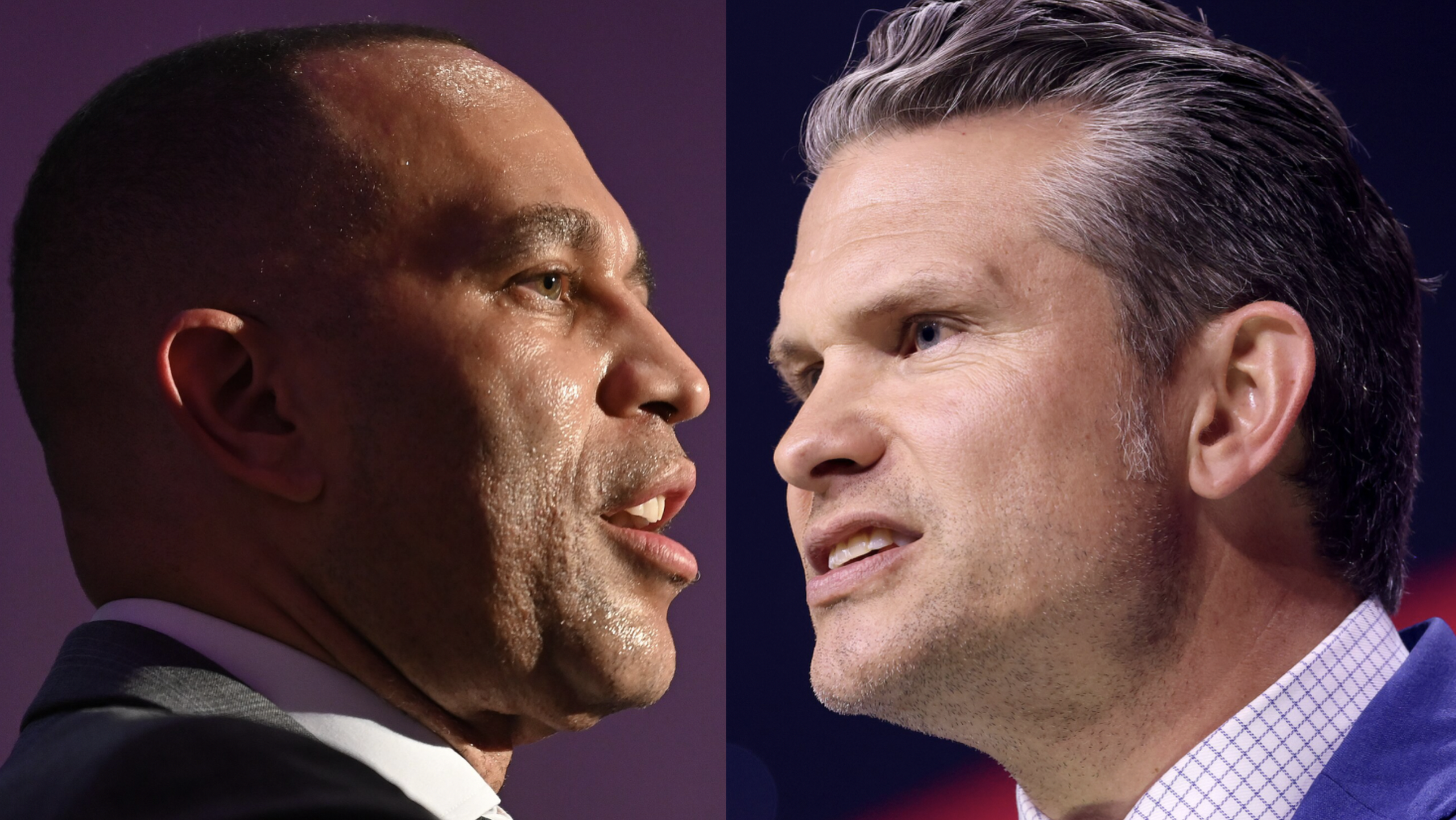
House Minority Leader Hakeem Jeffries used a single, blistering social media post on Tuesday to reject the Pentagon’s latest request for war funding and to deliver one of his sharpest one-line rebukes yet of the Trump administration’s handling of the conflict with Iran. Posting on X at 10:22 a.m. on June 23, 2026, the New York Democrat wrote: “Pete Hegseth wants an additional $80 billion in taxpayer money to pay for Operation Epic Failure in Iran. Get lost.”
The two-sentence statement landed as Defense Secretary Pete Hegseth has spent recent days lobbying lawmakers on Capitol Hill for a massive new infusion of cash to cover the costs of the military campaign against Iran, which the Pentagon has internally referred to as Operation Epic Fury. Jeffries’ phrasing — “Operation Epic Failure” — is a direct inversion of that official military designation, transforming the administration’s own branding of the operation into a one-line verdict on its outcome.
The $80 billion figure Jeffries referenced traces back to a Wall Street Journal report published June 18, which Reuters covered the same week. According to that reporting, Deputy Defense Secretary Stephen Feinberg told lawmakers in phone calls that the Department of Defense needs roughly $80 billion to cover costs tied to the Iran war along with other, non-war-related Pentagon bills. A full U.S. supplemental request, expected to include funding for the Pentagon as well as non-defense priorities such as farm and disaster relief, was reported to be headed to Capitol Hill within days of that disclosure. The Pentagon declined to comment on the figure when contacted by Reuters, and the request had not been formally transmitted to Congress as of the time of that report.
The $80 billion ask represents a dramatic escalation from earlier official estimates. A Pentagon official told Reuters in April that the Iran war had cost approximately $25 billion to that point — the first official figure provided for the conflict’s price tag. Hegseth himself had told Congress during testimony the previous month that war-related costs stood closer to $29 billion, a figure that covered munitions replacement and equipment repairs but did not account for damage to U.S. military sites in the region. The jump from that estimate to the new $80 billion figure reflects, according to reporting on the matter, both the mounting costs of sustained operations and bills that had not previously been disclosed to lawmakers.
The funding request comes against the backdrop of a broader and far larger defense spending fight already underway in Washington. White House budget director Russell Vought told the House Budget Committee in April that he could not provide an estimate for the total cost of the Iran war as he defended President Trump’s request for a $1.5 trillion annual military budget — a roughly 50 percent increase over current-year funding levels. Republicans have separately said they hope to secure approximately $1.1 trillion through the regular appropriations process and an additional $350 billion through a mostly party-line vote later this summer, on top of whatever sum is ultimately approved for Iran war costs specifically.
Jeffries’ Tuesday post is consistent with a position he has held since the earliest days of the conflict, which began when President Trump ordered strikes against Iran on February 28, 2026. In a statement issued that day, Jeffries said the Trump administration “must explain itself to the American people and Congress immediately, provide an ironclad justification for this act of war, clearly define the national security objective and articulate a plan to avoid another costly, prolonged military quagmire in the Middle East.”
The minority leader repeated and sharpened that critique throughout the early weeks of the war. Appearing on NPR’s Morning Edition on February 28, Jeffries said the proposed War Powers Resolution “would require that Donald Trump immediately terminate the use of any U.S. armed forces from any hostilities against Iran or any part of its government or military, unless that is explicitly authorized by a declaration of war that comes from the United States Congress.” He added that the administration’s approach to Iran risked “another failed forever foreign war,” invoking the precedents of Iraq, Libya and Afghanistan. The full transcript of those remarks is posted on Jeffries’ official House website.
On March 2, in an appearance on CNN’s News Central, Jeffries argued that “the American people want us to focus on making their life better, making their life more affordable, not getting involved in another endless war in the Middle East that is going to end in failure,” adding that the administration had “found billions of dollars for bombs” while declining to address the cost of living. That interview transcript is also published on Jeffries’ official House website.
By April 16, with the House debating the Khanna-Massie War Powers Resolution on the floor, Jeffries told colleagues that Republicans could not “defend the fact that billions of dollars are being spent every day to drop bombs in the Middle East” while resisting efforts to extend Affordable Care Act tax credits or otherwise lower costs for American families. He further argued that “as a result of what Donald Trump and Republicans have done over in the Middle East, Iran, in some instances, is stronger now than they were before.” Those floor remarks are archived on Jeffries’ official House website.
The Pentagon’s new funding request also arrives in the immediate aftermath of a major diplomatic development. The White House officially transmitted the text of a 14-point memorandum of understanding between the United States and Iran to Congress on Thursday, June 18 — the so-called Islamabad Memorandum of Understanding. The text, read aloud to reporters on a conference call by a senior U.S. official speaking on condition of anonymity, lays out a framework for the “immediate and permanent termination of military operations on all fronts,” a phased removal of the U.S. naval blockade within 30 days, safe passage arrangements for commercial vessels through the Strait of Hormuz, a minimum $300 billion reconstruction and economic development plan for Iran backed by regional partners, a schedule for terminating U.S. and United Nations sanctions, and a 60-day window to negotiate a final deal that would be endorsed by a binding U.N. Security Council resolution.
That MOU also includes Iran’s reaffirmation that it will not pursue nuclear weapons, alongside a mechanism to resolve the disposition of its stockpiled enriched material under International Atomic Energy Agency supervision. Both governments agreed to maintain the status quo on the nuclear program and on U.S. troop deployments while the 60-day negotiating window for a final deal plays out. Jeffries has voiced skepticism about the durability of any such arrangement, telling NBC’s Meet the Press that President Trump had claimed the U.S. and Iran were close to a deal “38 or 39 different times” over the course of the conflict, and that no agreement had previously materialized.
Tuesday’s post is the latest example of Jeffries pairing skepticism about the war’s diplomatic trajectory with sustained criticism of its financial cost. He has consistently argued that the same dollars being funneled into the Iran campaign could otherwise be directed toward lowering grocery prices, health care costs and other affordability concerns for American families — a framing he has repeated in nearly every public statement on the conflict since February. His “Get lost” response to Hegseth’s latest request signals that, with the war’s price tag now reported at $80 billion and climbing, that argument shows no sign of softening.