
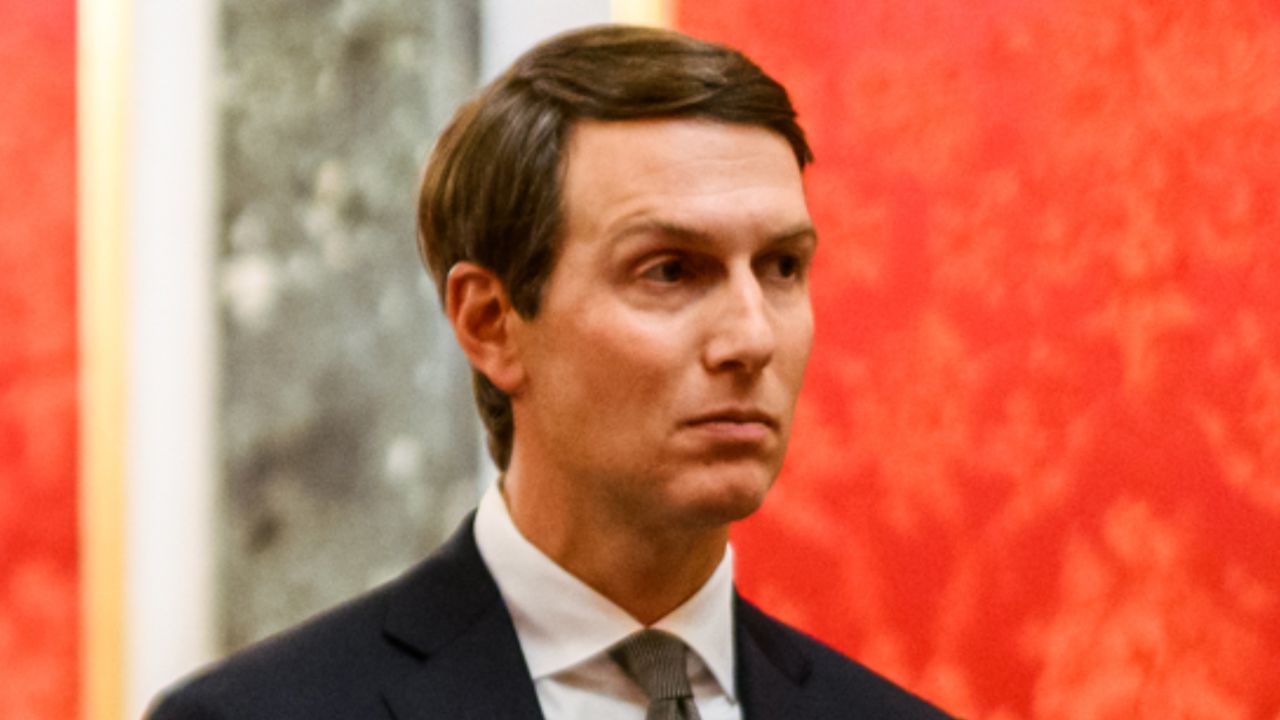
While Jared Kushner has been flying between capitals to negotiate an end to the war in Gaza, his private equity firm has held the largest stake in an Israeli financial group that has put hundreds of millions of dollars into the companies supplying Israel’s military campaign, a CNN investigation published Thursday found. The report describes an unusual arrangement in which one of the Trump administration’s most prominent Middle East negotiators remains the sole owner of a firm that stands to profit from the sector at the center of the conflict.
CNN found no indication that Kushner’s diplomacy directly affected the investments it reviewed. Kushner’s attorney says he had no role in choosing them.
How Kushner Built Affinity
Kushner incorporated the company that became Affinity Partners on January 21, 2021, one day after Donald Trump’s first term ended. Within six months, Saudi Arabia’s Public Investment Fund committed $2 billion to the new firm. The fund is led by Crown Prince Mohammed bin Salman, with whom Kushner built a close relationship during his years as a White House adviser. The New York Times reported at the time that the fund’s board overruled advisers who had cited the inexperience of Affinity’s management. Capital from Qatar and the United Arab Emirates followed.
According to an April letter from House Judiciary Committee Democrats, Affinity now manages about $6.16 billion in assets, with 99 percent of its funding coming from foreign nationals, including sovereign wealth funds in Saudi Arabia, the UAE, and Qatar.
The Phoenix Investment
Affinity made its first Israeli investment in 2023, paying $150 million for a 15 percent stake in the Shlomo Group’s car rental and credit business. In July 2024 it bought 4.95 percent of Phoenix Financial, one of Israel’s largest financial groups, for $128.5 million. Phoenix offers insurance, pension, and asset management services. Five days before Trump returned to office in January 2025, Affinity roughly doubled that position, making it Phoenix’s largest shareholder. Kushner told Bloomberg the decision was rooted in his belief in Israel’s resiliency.
The purchases came as Israel’s war in Gaza, launched after the October 7, 2023 Hamas attacks that killed more than 1,200 people, was escalating. Palestinian health ministry figures put the death toll from Israel’s campaign above 74,000. An independent United Nations inquiry concluded that Israel’s military actions amounted to genocide, a characterization Israel has repeatedly rejected.
Kushner’s Unofficial Diplomatic Role
Unlike his first term, when he served as a senior White House adviser, Kushner took no formal government post this time. Beginning in May 2025 he served as an unofficial adviser to his father-in-law, first helping special envoy Steve Witkoff and then taking on a larger operational role as the Gaza war intensified. Regional officials who spoke with CNN welcomed his involvement, citing a relationship with Prime Minister Benjamin Netanyahu that dates to Kushner’s teenage years.
By staying outside the government payroll, Kushner avoided financial disclosure requirements that would apply to an official position. As a private firm, Affinity is also not required under U.S. law to publicly list its holdings. Kushner disclosed in March only that it had made 28 investments.
The Ceasefire and the Board of Peace
In October 2025, Trump sent Kushner to Sharm el-Sheikh, Egypt, to finalize a Gaza ceasefire, telling reporters to find anybody more capable. Days later Kushner celebrated the deal in Tel Aviv’s Hostages Square. The agreement took effect on October 10, 2025. In January 2026, Kushner presented a reconstruction masterplan at the World Economic Forum in Davos, featuring a coastal tourism zone and a new airport, and urged private companies to pursue what he called “amazing investment opportunities” in Gaza.
At the first meeting of Trump’s Board of Peace in February, Kushner, an executive board member, said of the participants: “People are not personally profiting from this.”
What the Israeli Filings Show
Because Phoenix is publicly listed, it must file quarterly reports with Israeli regulators. CNN used those records to identify nine military-linked companies in its holdings, which two forensic accountants in Israel separately reviewed and confirmed. The filings cover only part of Phoenix’s portfolio and exclude retirement accounts and stakes held through mutual funds and bonds. By one account of the report, Phoenix’s investment in the nine companies totals at least $456 million. Affinity holds no direct stake in any of them but benefits when Phoenix profits. All nine saw their share prices rise last year, and several cited the Gaza war as a driver of demand.
Elbit Systems and the Defense Holdings
The largest holding, worth at least $265 million, is in Elbit Systems, Israel’s biggest arms manufacturer. Israel accounted for 32 percent of Elbit’s 2025 revenue, and the company has won contracts including about $200 million for airborne munitions, $48 million for 155mm artillery shells, and $210 million for tank upgrades. Its stock has risen more than 165 percent since the war began, and CNN and rights groups have traced its tank shells and 500-pound bombs to strikes that killed civilians.
Phoenix also holds more than $68 million in Next Vision, a maker of drone cameras, and at least $40 million in Reshef Technologies, which makes artillery fuzes and reports $165 million in Defense Ministry orders since the war began. It owns more than 10 percent of Ashot Ashkelon, which supplies tank and armored vehicle components, and a $524,524 stake in Israel Shipyards, whose fast attack boats the Israel Defense Forces say have launched missiles into Gaza. Smaller positions in Boeing ($4 million) and Caterpillar ($2.5 million) round out the list. The UN has urged Caterpillar to cease business with Israel over bulldozer use in Gaza and Lebanon.
Kushner’s Own Words on Business and Peace
Kushner has been open about the link between commerce and diplomacy. In a September 2025 appearance on the “No Priors” podcast, he said that Middle Eastern investors were asking whether “maybe there’s a benefit to having these wars done.” He also said that when Arabs and Israelis discuss a business opportunity, they tend to forget everything else. He described a debate inside Affinity’s investment committee about Phoenix, with Gulf backers questioning an investment in a country on the brink of war, and said he told them it was no bad thing to have them more invested in Israel’s economy.
He has described Phoenix as Affinity’s “best investment,” and in a 60 Minutes interview he dismissed concerns about overlaps, saying that what critics call conflicts of interest, he and Witkoff call “experience and trusted relationships.”
The Financial Return
Affinity sold about a quarter of its Phoenix stake in July for more than $340 million, over five times its initial purchase price. It remains the largest shareholder with a 7.4 percent stake worth more than $1 billion. Some Phoenix defense holdings predate Affinity’s rise to top shareholder, while others, including the electronic fuzes used in shells fired in Gaza and parts for Israeli tanks, came after.
Responses From Kushner, Phoenix, and the White House
An attorney for Kushner told CNN that he “never participated in or directed Phoenix’s decisions” on where to invest, was not involved in buying or selling any of the nine companies, and has never served on Phoenix’s board. Kushner said in 2025 that he met with Phoenix leadership every few weeks. His attorney confirmed that and said contact had fallen sharply as he took on more volunteer diplomatic work. Phoenix did not address CNN’s findings, though a spokesperson said the company is regulated.
White House principal deputy press secretary Anna Kelly dismissed the conflict concerns as a “tired narrative” pushed by Democrats against the president’s family, and said Kushner’s business activity has nothing to do with his volunteer diplomacy. She cited his role in the Abraham Accords. Cynthia Brown of Citizens for Responsibility and Ethics in Washington said that “the people profiting should not be the people making the decisions.”
Congressional Scrutiny
House Judiciary Committee ranking member Jamie Raskin opened an investigation in April, calling Kushner’s dual roles “completely irreconcilable and unethical.” The letter demanded records by April 30. In an August 25 statement, Raskin said Kushner never responded and that Affinity ignored a follow-up from committee staff. He then expanded the inquiry to include a $120 million Albanian land purchase and possible Foreign Corrupt Practices Act issues.
Democrats lack the majority to compel compliance. This could change if they win control of the House in the November midterms, which would bring subpoena power.
Where the Gaza Process Stands
The ceasefire that Kushner helped broker remains fragile. On September 23, the Board of Peace unveiled a $2.45 billion, six-month, 66-project recovery plan at the UN General Assembly. Kushner told the meeting that a year earlier none of the Board’s structures existed. The Board estimates physical reconstruction at about $35.2 billion in the medium term and $71.4 billion over a decade. Implementation depends on Hamas disarming, a phased Israeli withdrawal, and a transfer of governing authority to a Palestinian technocratic committee.
Israel has continued strikes in Gaza that it says target Hamas operatives and ceasefire violations. Axios reported that the Board hopes the process can begin after Israeli elections on October 27.
Why It Matters
The report arrives as the Board of Peace seeks private capital for a reconstruction effort that Kushner has promoted, and as Democrats push for oversight in the midterms. The central dispute is structural rather than a finding of misconduct. Kushner holds no government job requiring disclosure, yet his role gives him significant influence over a conflict from which firms in his Phoenix holding stand to gain. CNN found no evidence of a direct link between his diplomacy and the investments, and his representatives deny any influence. Whether Congress or the administration moves to examine the arrangement further is unresolved.