

Japan has quietly crossed a technological threshold at sea, installing a 100 kilowatt class laser weapon on the JS Asuka to shoot down drones and other small aerial threats. The ship-mounted system, now moving from land trials to sea testing, signals a shift in naval defense toward directed energy, where electricity replaces explosives and magazine depth is limited mainly by power generation.
By concentrating ten 10 kilowatt fiber lasers into a single beam, the weapon is designed to slice through metal in midair, burning through quadcopters, loitering munitions, and even mortar rounds before they can reach a ship. For a navy facing the spread of cheap, expendable drones, the promise is simple and disruptive: high precision, rapid engagement, and a cost per shot measured in kilowatt hours instead of hundreds of thousands of dollars.
How Japan’s 100 kW naval laser actually works
The new system on JS Asuka is built around a 100 kilowatt fiber laser that combines ten individual 10 kilowatt emitters into a single, tightly focused beam. Fiber lasers route light through doped optical fibers rather than bulky gas or solid-state cavities, which allows the weapon to remain compact enough for shipboard use while still delivering industrial scale power. Reporting on the ground tests describes the beam cutting through metal plates and shredding small drones in flight, a level of performance consistent with other high energy laser demonstrators in this power class, as detailed in technical coverage of Japan’s 100 kilowatt trials.
On JS Asuka, the laser is integrated with sensors and a fire control system that must detect, track, and hold a spot on fast moving targets long enough to burn through their structure. The weapon’s effectiveness depends not only on raw power but also on beam quality, atmospheric conditions, and stabilization against ship motion. Japan’s Acquisition, Technology & Logistics Agency, working with Kawasaki Heavy Industries, has already validated the design in land based tests and is now using the experimental 6,200 ton vessel to see how the system performs amid sea spray, humidity, and platform vibration, a progression described in detail in analyses of the navy’s dedicated test ship JS Asuka.
From test range to open water: JS Asuka’s sea trials
Moving the laser from a controlled range to JS Asuka marks the transition from laboratory success to operational experimentation. Earlier ground campaigns showed the 100 kilowatt beam engaging small unmanned aerial vehicles and cutting through metal targets, but those shots took place in relatively clean, predictable air. At sea, the optics must contend with salt, moisture, and turbulence, all of which can scatter or absorb energy and reduce effective range. Japan’s defense technologists are using the Asuka trials to measure how quickly the beam can acquire and disable drones and mortar like projectiles in realistic maritime conditions, a step that follows the pattern described in technical briefings on Japan’s sea trials.
The JS Asuka itself is purpose built for this kind of experimentation, with space and power margins reserved for advanced sensors and weapons. By placing the laser on a testbed rather than an operational destroyer, the navy can iterate on cooling systems, power management, and targeting software without disrupting frontline deployments. Defense focused reporting notes that the same 100 kilowatt class system is intended for eventual installation on Aegis equipped destroyers once the sea trials validate performance, a trajectory outlined in coverage of Japan’s plan to field the weapon on an Aegis destroyer.
Answering the drone swarm problem at sea
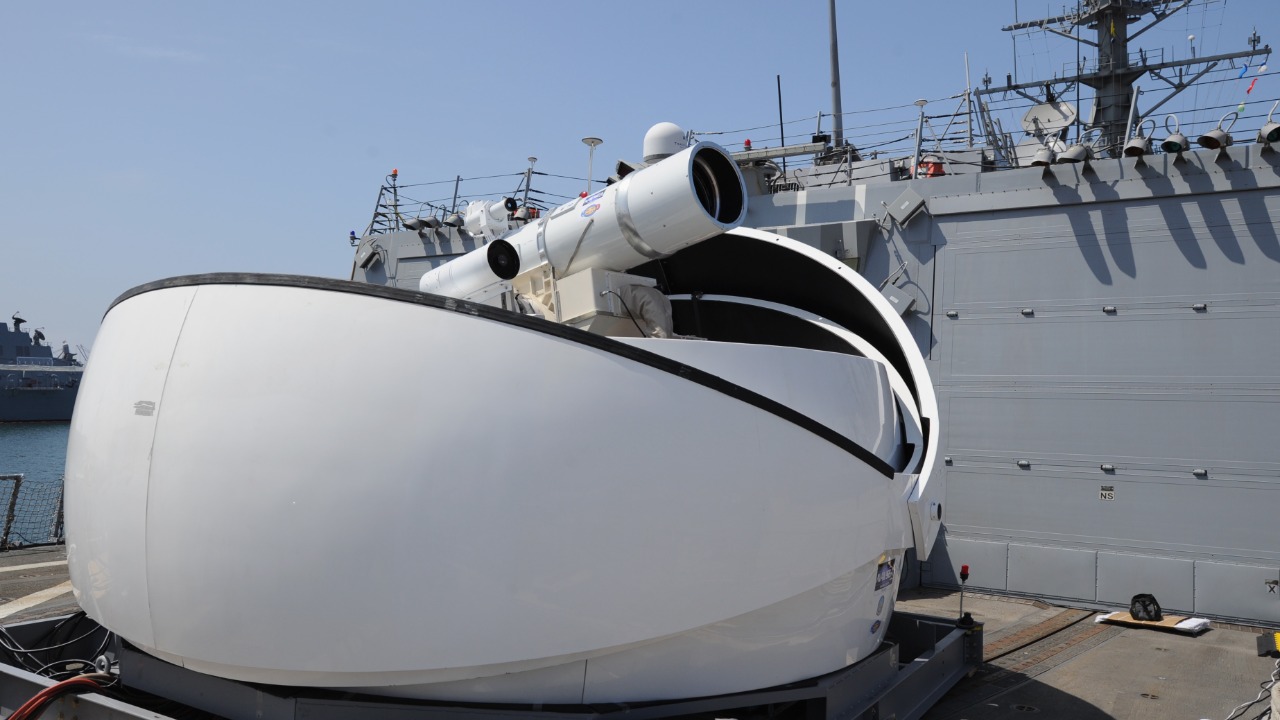
The strategic driver behind Japan’s investment in shipboard lasers is the growing threat from low cost, high volume aerial systems. Commercial style quadcopters, fixed wing drones, and loitering munitions can be fielded in large numbers at relatively low cost, forcing navies to consider how many expensive interceptor missiles they are willing to fire at each incoming object. A 100 kilowatt laser, by contrast, consumes only electrical power and can engage targets as long as the ship’s generators and cooling systems keep up, a concept often described as “unlimited ammunition” bounded only by power supply in technical discussions of directed energy. Demonstrations of the Japanese system show it burning through small drones in seconds, a capability highlighted in engineering focused videos and clips of the weapon mounted on Asuka, including footage circulated via shipboard tests.
Japan is not alone in turning to high energy lasers for drone defense, but the Asuka deployment places it among a small group of states that have moved from prototypes to operationally relevant platforms. Reporting on other 100 kilowatt class systems, such as Israel’s ground based Iron Beam, underscores how this power level can defeat rockets, mortars, and unmanned aircraft at tactically useful ranges, as described in technical coverage of the Iron Beam laser. Japan’s decision to focus first on shipboard defense reflects its maritime geography and the vulnerability of surface vessels to saturation attacks by drones and small projectiles, where magazine depth and engagement speed are critical.
Economic and operational advantages over missiles
Beyond the physics, the economics of a ship mounted laser are central to its appeal. Each shot from a conventional surface to air missile can cost hundreds of thousands or even millions of dollars, while the target might be a quadcopter assembled from commercial parts. A 100 kilowatt laser pulse, by contrast, draws on the ship’s electrical system and cooling loop, making the marginal cost per engagement a fraction of a missile intercept. Analysts following Japan’s program emphasize that this cost asymmetry is one of the main reasons the navy is pushing directed energy into sea trials, a point echoed in technical explainers on the 100 kilowatt weapon and its ability to cut through drones mid flight.
Operationally, the laser also changes how commanders think about magazine management. Instead of counting down a finite number of interceptor missiles, a ship with a high energy laser can, in principle, engage wave after wave of small threats as long as it maintains power and thermal balance. This does not eliminate the need for missiles, which still provide long range and all weather capability, but it allows the laser to handle close in, line of sight targets and preserve expensive interceptors for more complex threats. Defense oriented reporting on Japan’s plan to migrate the system from JS Asuka to an Aegis destroyer underscores that the navy views the laser as a complement to, not a replacement for, existing air defense suites, a view reflected in analyses of the future Aegis integration.
What comes next for Japan’s directed-energy arsenal
The sea trials on JS Asuka are only the first step in what Japanese planners envision as a broader directed energy portfolio. The same 100 kilowatt class architecture could, in principle, be adapted for land based air defense or scaled for higher power levels as shipboard power systems evolve. For now, the focus is on proving that the fiber laser can operate reliably in the harsh maritime environment, maintain beam quality over tactically relevant distances, and integrate smoothly with existing radar and combat management systems. Technical analyses of the Asuka installation describe a modular design that could ease future upgrades, a point reinforced in engineering focused coverage of the navy’s test platform.
Globally, Japan’s move aligns it with a small but growing club of militaries fielding high energy lasers for real world defense missions. As other navies watch how the Asuka trials unfold, they will be looking for data on reliability, maintenance burden, and actual engagement performance against drones and mortar like threats. If the system performs as advertised, it could accelerate adoption of similar weapons on surface combatants and reshape how fleets plan for drone swarms and short range rocket attacks. For Japan, the deployment signals that directed energy is no longer a distant research project but a practical tool entering the fleet, a shift captured in detailed reporting on its ongoing sea trials and the broader modernization of its naval defenses.