
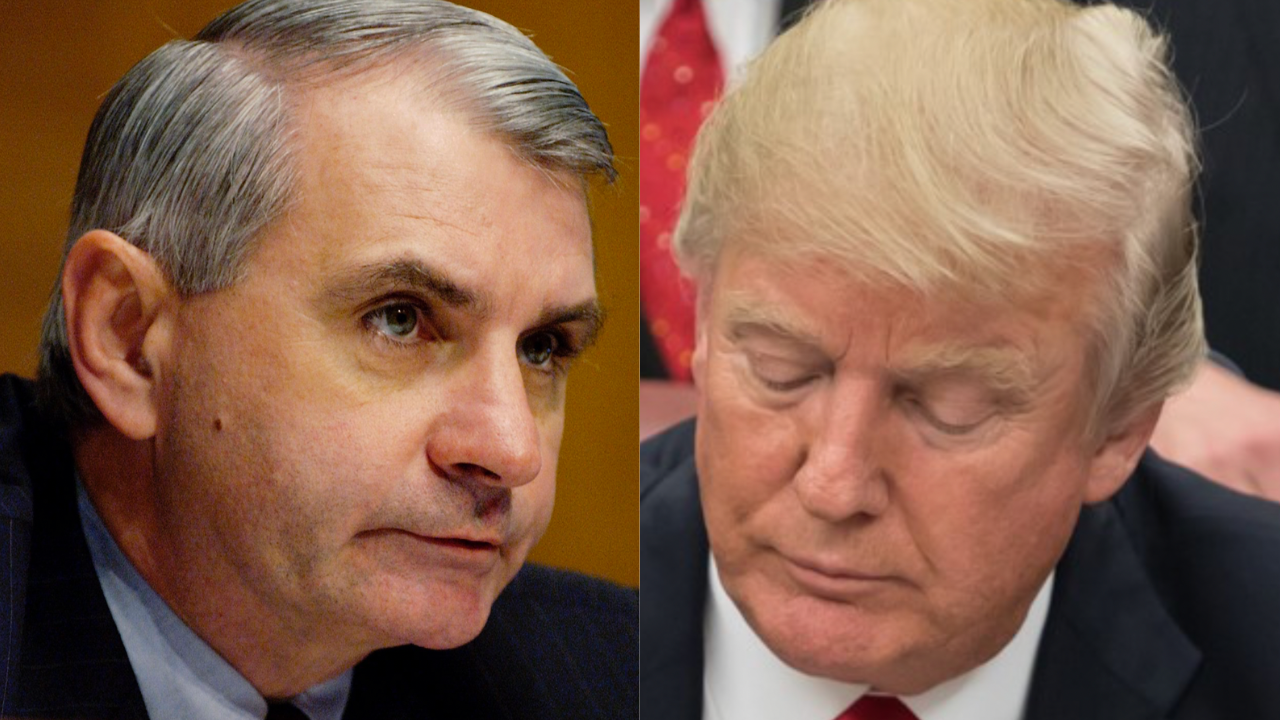
Sen. Jack Reed (D-R.I.), the ranking member of the Senate Armed Services Committee, renewed his push Tuesday for Republicans to join Democrats in invoking the War Powers Resolution to end what he called Trump’s unauthorized war with Iran — saying he has voted multiple times to halt operations and will continue pressing for bipartisan accountability.
“America needs leaders who respect and uphold the Constitution,” Reed wrote on X. “I’ve voted multiple times to end this unauthorized war. And I will not stop pressing Republicans to finally summon the courage to join Democrats in doing the right thing and holding Trump accountable.”
Reed’s post came on the same day that Democratic senators including Markey, Sanders and others were making similar calls from the Senate floor — and as CENTCOM announced fresh strikes against Iranian targets, making what Reed calls an unauthorized war difficult to portray as anything other than ongoing and active military conflict.
Reed’s Constitutional Argument
Reed has argued since the first U.S.-Israeli strikes on Iran on February 28 that the administration never sought or received congressional authorization for military operations against Iran, as required under the War Powers Resolution for sustained military action beyond 60 days, according to his official Senate statement warning that Trump’s war in Iran risks repeating the failures of Iraq.
“The President launched this war unilaterally, 46 days ago, without presenting evidence to Congress or the American people that Iran posed an imminent threat to the United States, without a clear and achievable objective, without a plan for what comes next, and without congressional authorization,” Reed said in an April 2026 Senate floor speech, per his official speeches page. He compared the situation directly to the lead-up to the Iraq War, warning that the administration was repeating the same pattern of confident assertions, absent evidence and no exit strategy.
Reed has introduced and voted for multiple War Powers Resolutions seeking to end U.S. military operations against Iran. A notable Senate vote in June 2026 passed 50-48 on a House-passed resolution to check the unauthorized operations — a rare majority in favor of constraining executive war-making authority, according to his official Senate statement on the latest developments in Iran. The resolution nonetheless failed to become law, as it would have required presidential signature or a veto override.
Why Reed’s Role Matters
As ranking member of the Senate Armed Services Committee, Reed is the top Democrat on the panel that oversees the Pentagon, writes the National Defense Authorization Act and conducts oversight of military operations. His sustained opposition to the Iran war carries institutional weight beyond a standard floor speech — it represents the formal Democratic position on the committee that will conduct oversight of the conflict’s conduct, costs and legal basis.
Reed is a West Point graduate and Army Ranger veteran who served as a paratrooper in the 82nd Airborne Division before entering politics. He has been a consistent voice for military restraint and congressional authority over war-making throughout his Senate career, authoring and co-sponsoring multiple reforms to the War Powers Resolution. His framing of the Iran war as a constitutional issue rather than simply a policy disagreement reflects a view he has held across multiple administrations, according to his official Senate release on Iraq parallels.
The Republican Response Reed Is Pushing For
Reed’s specific call Tuesday was directed at Republican senators, urging them to join the Democratic majority that voted for the June War Powers Resolution. The 50-48 vote that passed the resolution included all Senate Democrats but only a small number of Republicans — not enough to achieve the two-thirds majority that would be needed to override a presidential veto. Reed has argued that the constitutional argument for congressional war-making authority is not a partisan one and that Republicans who have historically championed legislative prerogatives should be willing to apply those principles to a Democratic as well as a Republican president.
So far, that argument has not moved enough Republicans to change the political math. Senate Armed Services Chairman Roger Wicker and Majority Leader John Thune have both backed the administration’s Iran operations, arguing that the president’s authority as commander in chief encompasses the actions taken. No senior Republican on the Armed Services Committee has publicly endorsed the War Powers Resolution approach, per Reed’s official statements.
The War at Day 136
Reed’s Tuesday post came as the Iran war entered its 136th day with no diplomatic resolution in sight. The June 17 Memorandum of Understanding — which had paused hostilities and briefly reopened the Strait of Hormuz — collapsed last week after Iran attacked commercial vessels and Trump declared the ceasefire “over” from the NATO summit in Ankara. CENTCOM has since conducted multiple rounds of strikes, the naval blockade on Iranian ports has been reimposed, and Iran has threatened to formally close the Strait of Hormuz, according to CENTCOM’s official public releases.
The war has cost 13 American lives and wounded 290 more, produced disputed civilian casualty figures and consumed tens of billions in defense spending, all without a formal declaration of war or authorization for use of military force from Congress, per Reed’s official statement on the latest developments. Reed’s argument — that the Constitution requires Congress to make that decision — is one he has been making since February 28 and shows no signs of stopping regardless of how the military situation develops.
Reed’s Broader Pattern
Reed has delivered sustained floor speeches, issued formal statements, introduced legislation and voted on multiple resolutions related to the Iran war over the past five months. His Tuesday X post was a compressed version of the argument he has been making at length since the first strikes — that the war is unauthorized, that it risks repeating the failures of Iraq, and that Republicans who believe in constitutional governance have an obligation to act on that belief even when it means confronting a president of their own party.
“The question before us is not whether you support or oppose military action against Iran,” Reed said in one of his Senate floor speeches, per his official speeches page. “The question is whether you believe the Constitution means what it says — that Congress, not the president alone, has the authority to commit this nation to war.” Whether that argument eventually moves enough Republican senators to change the legislative outcome remains the central question heading into the fall congressional session and the November midterms.