
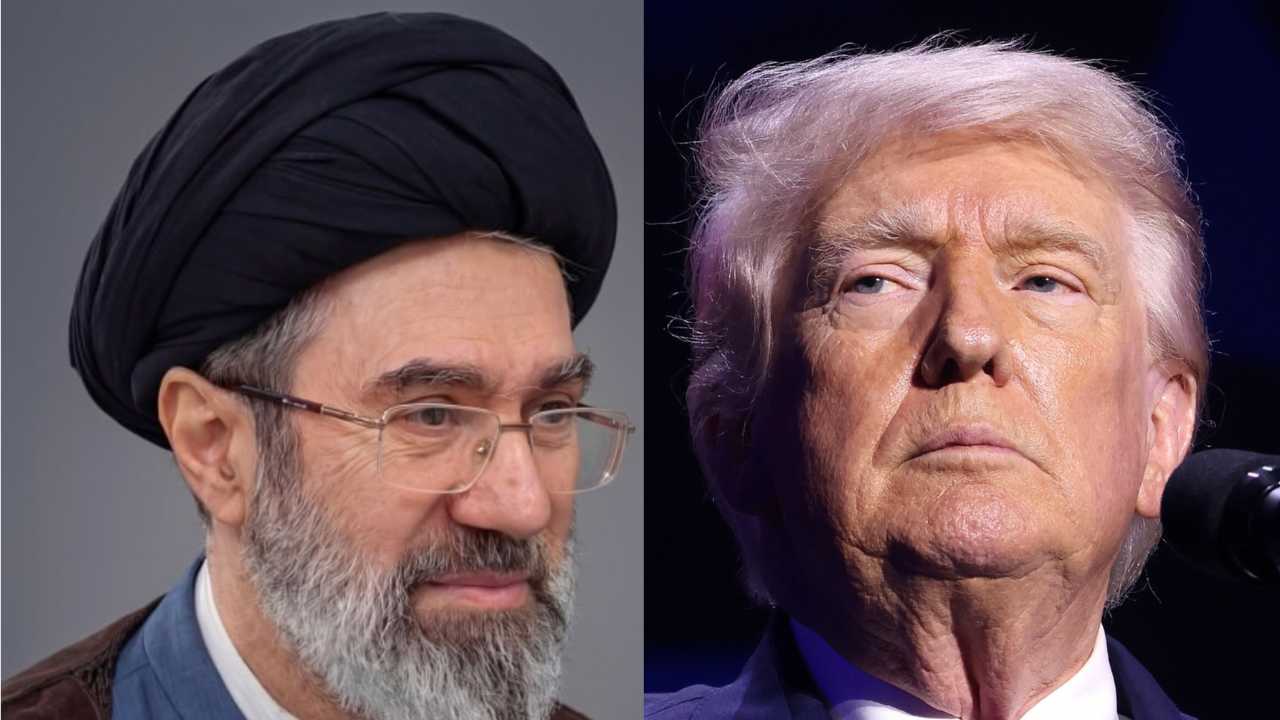
Iran announced early Sunday that it had opened fire on a vessel in the Strait of Hormuz and was shutting down the critical waterway indefinitely, rejecting a U.S. ultimatum and plunging the already fragile cease-fire with Washington into fresh uncertainty. The move came just hours after Iran’s foreign minister met with his Omani counterpart in Muscat in an inconclusive bid to negotiate safe passage through the strait, and it landed alongside a written vow of revenge from Iran’s new supreme leader and an escalating exchange of threats between Tehran and President Trump.
The Strike and the Closure
The Navy of Iran’s Islamic Revolutionary Guard Corps said in a statement that a vessel had switched off its tracking systems and “jeopardized maritime security” before it was struck and halted. The IRGC did not identify the ship or specify how it had been attacked. According to the statement, several vessels had attempted to move through the waterway on what Iran characterized as an unauthorized route and had ignored warnings to correct course.
Iran’s navy said the strait would remain closed “until further notice” and until “the end of U.S. interference in this region.” It further warned that any retaliation for the strike would draw a “severe response,” adding that “new enemy bases in the region will be targeted.” U.S. Central Command confirmed shortly after Iran’s announcement that American forces had already begun a round of retaliatory strikes.
Talks in Oman Collapse Without a Breakthrough
The closure came only hours after Iranian Foreign Minister Abbas Araghchi traveled to Oman to meet with Foreign Minister Sayyid Badr Albusaidi, in a session both sides described as an exchange of views on mechanisms for the safe passage of ships through the strait. Araghchi made no public commitment to reopening the waterway. Oman’s state news agency said afterward that negotiators from both countries would continue discussions “at the technical and political levels,” but gave no indication that a breakthrough was near.
A senior Iranian source told Reuters that Iran, the United States, Qatar and Pakistan had agreed in principle to a mediated call that organizers were trying to arrange for Saturday, though it remained unclear whether that effort succeeded. Oman has been serving as the principal mediator in the broader effort to end the war, which has destabilized the Persian Gulf and driven up energy prices worldwide since the United States and Israel launched airstrikes on Iran on February 28.
Separately, CNN reported Saturday that Oman had circulated a draft proposal for managing the strait that would allow free navigation through a southern corridor in Omani territorial waters, while requiring vessels using the northern corridor through Iranian waters to obtain Iran’s prior approval, without imposing tolls. The White House and State Department did not respond to requests for comment on the proposal. The plan would mark a significant departure from prewar norms in the strait, when ships generally passed without restriction.
A Week of Escalating Strikes
Iran’s closure of the strait followed a week of intensifying confrontation between Tehran and Washington centered on the waterway. U.S. officials said Iran fired on three commercial tankers transiting the strait earlier in the week, including vessels linked to Qatar and Saudi Arabia — both U.S. allies in the region. Iran did not claim responsibility for those attacks, though analysts told Reuters that Tehran has used such strikes in the past to build leverage ahead of negotiations.
The attacks prompted a heavy American response: U.S. forces struck roughly 170 Iranian military targets over two days, according to the U.S. military. An Iranian health ministry spokesman said on social media Friday that at least 17 people were killed in the strikes, and state television identified at least eight of the dead as soldiers. Iran retaliated in turn, firing waves of ballistic missiles and drones at U.S. military sites in Kuwait and Bahrain, and for the first time since the cease-fire began, at Jordan.
In response to the tanker attacks, the United States revoked a sanctions waiver on Tuesday that had temporarily allowed the sale of Iranian oil. Araghchi accused Washington of violating the terms of the cease-fire agreement. “There can only be mutual compliance,” he wrote on X on Friday.
Trump Declares the Cease-Fire “Over”
President Trump said Friday that the United States and Iran had agreed to keep talking despite the week’s escalation, even as he declared that the cease-fire reached in June had collapsed. “The Islamic Republic of Iran has asked us to continue ‘talks.’ We have agreed to do so, but the United States has stated to them, in no uncertain terms, that the Cease Fire is OVER!” Trump wrote on Truth Social.
U.S. officials had separately delivered an ultimatum to Tehran, telling reporters Friday that they expected Iran to publicly declare an end to attacks on commercial shipping in the strait and to acknowledge that all transit routes were open, with no tolls imposed. Officials warned that absent such a declaration, “we’re not going to have a good outcome for them.”
Assassination Threats and a Show of Force
The standoff has been sharpened by a parallel confrontation over Trump’s safety. The Wall Street Journal and other U.S. outlets reported this week that Israel had shared intelligence with Washington indicating Iran had recently devised a plot to assassinate the president. Trump responded on social media by saying he had ordered the U.S. military to prepare thousands of missiles for launch against Iran should Tehran attempt to carry out an assassination, writing that “1000 Missiles are Locked and Loaded and aimed at the Islamic Republic of Iran.”
U.S. law enforcement officials have said Iran has pursued multiple plots against Trump and other American officials in recent years.
Iran’s New Supreme Leader Vows Revenge
Adding to the volatility, Iran’s new supreme leader, Ayatollah Mojtaba Khamenei, issued a rare written statement Saturday vowing retribution for the killing of his father and predecessor, Ayatollah Ali Khamenei, who was killed in the opening days of the U.S.-Israeli war on February 28. “We pledge to avenge the blood of the martyred leader and all the martyrs,” the message read.
It was the new supreme leader’s first public statement since a weeklong funeral for his father concluded with burial in Mashhad on Thursday, a ceremony he did not attend. He has not been seen or heard publicly since succeeding his father in early March and is believed by Iranian and Israeli officials to have been wounded on the first day of the war. Despite widespread resentment of the elder Khamenei’s 37-year rule, millions of mourners joined funeral processions across Iran and Iraq, which the Islamic Republic used to project unity in the face of its adversaries. At the ceremonies Thursday, some mourners carried banners reading “We Will Kill Trump.”
Oil Markets and the Stalled Push for a Broader Deal
Roughly a fifth of the world’s oil supply passed through the Strait of Hormuz before the war began, and Iran’s effective blockade of the waterway has already pushed energy prices higher, contributing to inflation worldwide. The latest closure threatens to compound those pressures at a politically delicate moment for Trump, with U.S. congressional elections approaching in November.
The renewed flare-up has also cast doubt on prospects for a broader nuclear agreement between Washington and Tehran. Under the terms of the June cease-fire, the two sides were to negotiate a more comprehensive pact within 60 days — a deadline that now appears increasingly out of reach as both countries remain locked in a standoff that is neither full-scale war nor lasting peace.