
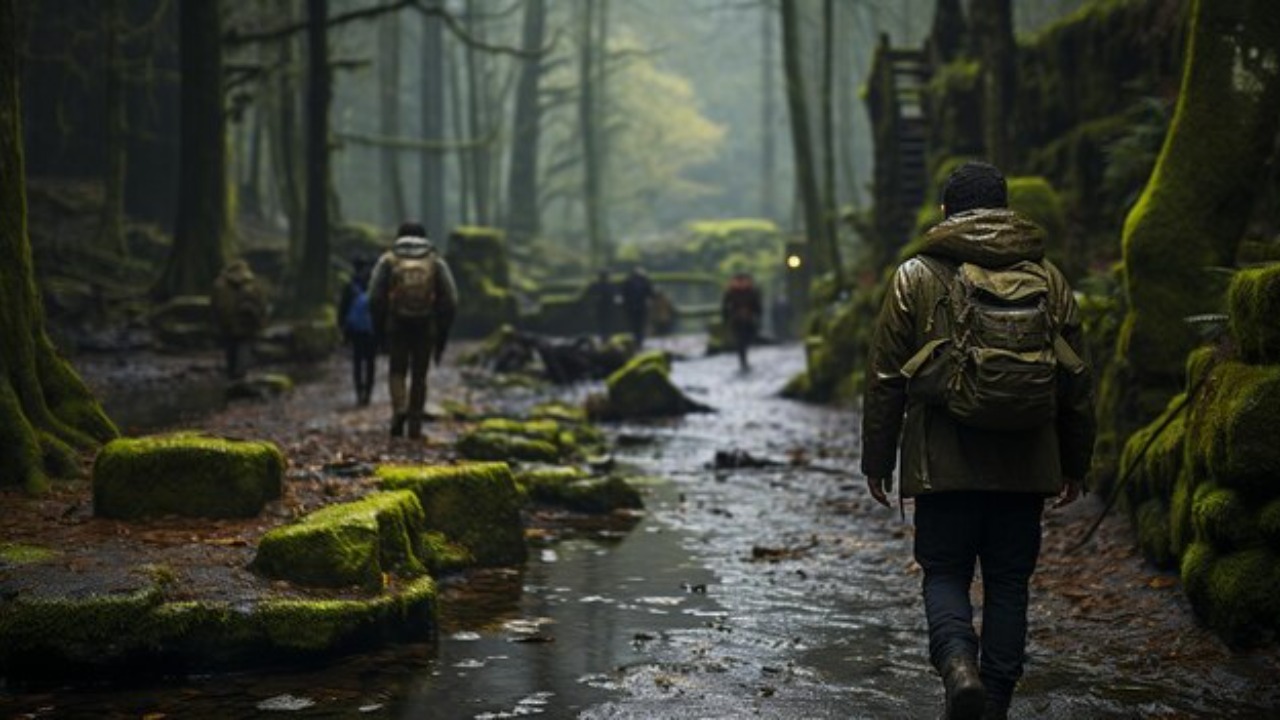
The trailhead parking lot was still half-asleep when I pulled in, headlights cutting across a row of frosted windshields. A few other early birds were doing the same quiet choreography: tying laces, sipping coffee, pretending we weren’t checking the sky every thirty seconds. The forecast had promised “a chance of light showers,” which is basically the weather’s way of saying, “Don’t blame me later.”
I clicked on my headlamp and jogged into the dark, that familiar mix of excitement and mild dread you get when you’re voluntarily running uphill before most people have even hit snooze. The air was cold enough to feel crisp but not cruel, and the trail had that damp, piney smell that makes you believe in good decisions. It felt like the kind of morning you brag about afterward.
A calm start that felt almost too easy
The first few miles were smooth, the kind where your legs settle into a rhythm and your brain finally stops negotiating for more sleep. I passed the usual landmarks—an old wooden bridge, a switchback with a view of the valley lights, a rock that looks like a loaf of bread if you squint. Birds started warming up in the trees, and the horizon behind the ridgeline hinted at sunrise without fully committing.
I’d planned a loop that tops out near an exposed saddle, then drops back into the forest on the other side. Nothing extreme, but enough elevation to earn breakfast. I carried a light jacket, a beanie, and a small emergency layer because I’ve learned that “just a quick run” is how people end up as cautionary tales.
By mile six, the trail stopped feeling friendly
Somewhere after the first big climb, the wind picked up like it had been waiting for the sun to come out and start a fight. It wasn’t a steady breeze, either—more like gusts that arrived uninvited and rearranged your plans. The trees began to sway and groan in that way that makes you suddenly aware they are, technically, very large objects.
Then the clouds rolled in fast, flattening the light and dimming the whole world like someone turned down a switch. The temperature dropped enough that my fingers felt clumsy. I told myself it was a passing front, the kind that moves through in ten minutes, and kept running because optimism is free and inertia is powerful.
The weather flip: rain, then something sharper
At mile eight, the trail opened up near the saddle, and that’s when the weather flipped from “annoying” to “oh.” Rain came in sideways, stinging my cheeks, and the wind had that hard edge that doesn’t feel like regular weather anymore. The visibility shrank in a hurry—first the next ridge disappeared, then the trees fifty yards away blurred into gray.
The strangest part was how fast it happened. One minute I could see the winding trail ahead, and the next I was jogging inside a cloud that had opinions. I pulled on my jacket, but it felt like trying to negotiate with a fire hose.
“Rapidly deteriorating”: the radio call nobody wants
I’d just slowed to a careful hike when I heard a crackle and a voice over a handheld radio behind me. A park ranger—standing near a junction sign and looking like someone who’d been sent out specifically to stop people like me from doing stupid things—called into dispatch. I caught the phrase that made my stomach drop: conditions were “rapidly deteriorating.”
He glanced up and waved me over, then repeated it to my face in a calmer tone. There was no drama in his voice, which somehow made it more serious. He wasn’t scolding; he was giving the kind of update that sounds like it comes with a clock.
What the ranger was seeing that I wasn’t
Up close, it was clear he’d been tracking the bigger picture: wind direction shifting, clouds thickening, the kind of incoming system that looks manageable from a phone app but behaves differently on a ridgeline. He mentioned gusts increasing on the exposed sections and the chance of hail or graupel, that tiny ice pellet stuff that makes trails slick in seconds. He also said a few hikers farther up had already turned around after getting pelted.
It wasn’t just about discomfort, either. A wet, cold runner moving slowly at higher elevation can lose heat quickly, and the wind accelerates that in a way people underestimate. Add low visibility and a confusing junction, and you’ve got a recipe for one wrong turn becoming a real problem.
The quick decision: turn around, no debate
I asked the obvious question—“Do you think it’ll pass?”—because humans love bargaining with weather. He shook his head and said the system was building, not clearing, and that they were advising everyone to head down to tree cover. There was a simplicity to it: this wasn’t the day to be stubborn.
So I turned around. No summit goals, no “just another mile,” no heroic nonsense. I tucked my chin into my jacket, tightened my hood, and started moving back the way I came, focusing on steady steps and staying warm rather than trying to salvage my pace.
Getting off the ridge felt like stepping back into color
It’s amazing how quickly conditions can change with a little elevation loss. Ten minutes down from the saddle, the wind softened and the rain became more normal, like it remembered it had manners. The trees blocked the gusts, and the trail, while wet, stopped feeling like it was actively trying to evict me.
I passed two hikers heading up, both in light shells and big smiles, and I gave them the update the ranger gave me. They hesitated, looked at the sky, and did that silent calculation between optimism and common sense. One of them joked, “Well, this is an exciting way to start a Saturday,” and I said, “Exciting is one word for it,” as I kept moving.
Why “nice start, nasty turn” is so common on trail runs
Mountain and foothill weather can change fast because you’re dealing with elevation, terrain, and wind corridors that funnel systems into weird shapes. Before sunrise, everything can feel stable—cool air, calm trees, quiet skies—because the atmosphere hasn’t fully started mixing. Once the day warms up or a front pushes through, conditions can flip in minutes.
And ridgelines are like stages for bad weather. They’re exposed, they’re higher, and they tend to catch the first punch: stronger gusts, colder air, and that sudden whiteout feeling when cloud cover drops. If you’ve ever been on a ridge where you can’t see the next trail marker, you know how quickly “fun run” turns into “logistics exercise.”
What I was glad I had (and what I wished I’d packed)
I was grateful for the basics: a wind-resistant shell, a beanie, and enough calories to keep my energy steady while I slowed down. My phone was charged, my route was downloaded offline, and I had a small light even though dawn was coming. Those little redundancies are boring right up until they’re the reason you stay comfortable.
I also wished I’d brought lightweight gloves and a slightly warmer mid-layer. My hands got cold enough that opening a gel packet felt like a puzzle designed by someone who hates runners. Next time, I’m adding gloves to my “always, even if it looks fine” list.
Back at the trailhead, the storm finally showed its full hand
By the time I reached the parking lot, the rain was heavier and the wind was swinging the branches around like it was auditioning for a disaster movie. A couple of cars had fogged windows, and people were sitting inside, waiting out the worst of it. The ranger’s truck rolled in not long after, and he gave a quick check-in with a nod that said, “Good call.”
I sat in my car, heater blasting, watching sheets of rain sweep across the asphalt. There was a small, sheepish relief in knowing I’d made the unglamorous choice to turn around. The run didn’t go as planned, but it did end with me dry, safe, and already thinking about pancakes—which, honestly, is a pretty solid finish line.