
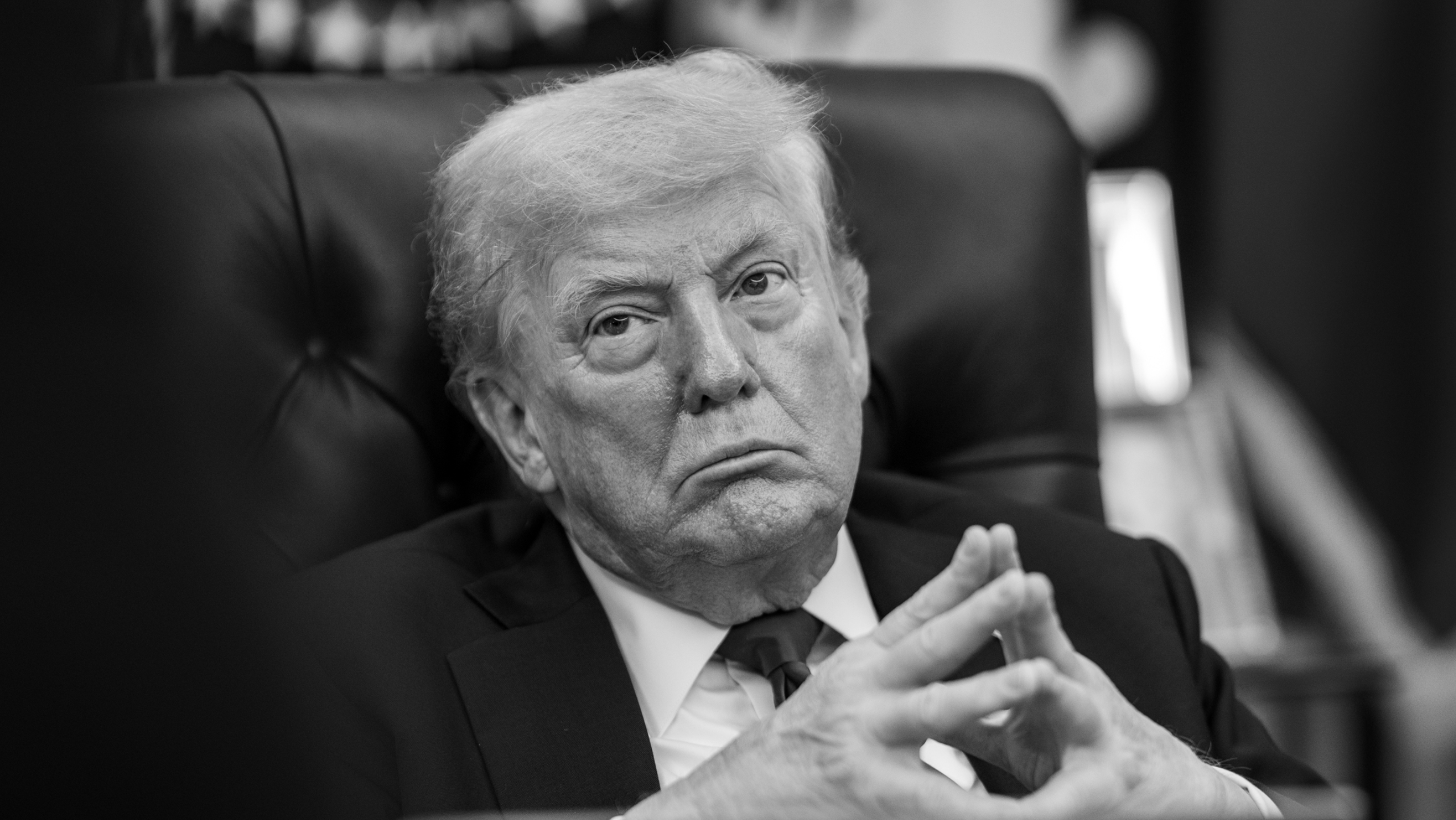
President Donald Trump made clear on Monday that the financial strain being felt by American households has absolutely no bearing on his approach to nuclear negotiations with Iran, telling reporters before departing the White House that he thinks about “one thing” and one thing only when it comes to the ongoing conflict with Tehran.
When a reporter asked Trump directly, “Mr. President, to what extent are Americans’ financial situations motivating you to make a deal?” his answer was blunt and unequivocal. “Not even a little bit,” Trump said. “The only thing that matters when I’m talking about Iran, they can’t have a nuclear weapon. I don’t think about Americans’ financial situation. I don’t think about anybody. I think about one thing. We cannot let Iran have a nuclear weapon. That’s all. That’s the only thing that motivates me.”
The remarks came at a moment when the economic pressure on ordinary Americans is impossible to ignore. The Consumer Price Index rose 3.8 percent from a year earlier in April, the highest level since 2023, with inflation outpacing wage growth in what economists described as a double-whammy for already strained consumers. After adjusting for inflation, wages fell for the first time in three years. The index for energy rose 3.8 percent in April alone, accounting for over forty percent of the monthly all items increase.
At the gas pump, the situation is even more acute. The national average gas price stood at $4.54 per gallon as of May 8, up 44 percent from a year earlier, according to the American Automobile Association. That surge is directly tied to the ongoing conflict with Iran and the continued choking of the Strait of Hormuz, through which a significant portion of the world’s oil supply flows. U.S. West Texas Intermediate futures advanced nearly five percent to over $100 per barrel in recent trading, while the international benchmark Brent crude futures climbed alongside it.
The human impact of those numbers has been significant. The University of Michigan Consumer Sentiment Index dropped to 48.2 in early May 2026, a record low since the survey began in the 1940s, driven by concerns about high prices for personal finances as well as buying conditions for major purchases. Economists noted that the Middle East conflict was unlikely to meaningfully boost sentiment until supply disruptions had been fully resolved and energy prices fell,
Against that backdrop, Trump’s declaration that Americans’ financial conditions do not enter into his thinking at all represents a remarkably candid admission for a sitting president. The statement strips away the usual political framing that leaders use to connect foreign policy decisions to domestic well-being, presenting instead a single-minded focus on the nuclear question that leaves little room for economic considerations, regardless of what those conditions look like at home.
The nuclear standoff itself has grown increasingly complicated. Trump has grown impatient with the continued closure of the Strait of Hormuz, as well as what he perceives as division in the Iranian leadership that is preventing substantial concessions on nuclear talks. Iran’s latest counterproposal was swiftly rejected, with Trump calling it “totally unacceptable.” Iran’s counteroffer proposed a staggered, phased approach that would focus initial stages on declaring an end to the war and lifting sanctions, deferring the nuclear program to later talks — a sequence at direct odds with Washington’s position.
The U.S. position has been that Iran must conduct “zero enrichment,” a demand Iran has rejected on multiple occasions. Iran has refused to surrender its roughly 400 kilograms of highly enriched uranium, insisting the material is not intended for weapons development, and has also rejected dismantling its nuclear facilities. The gap between the two sides on that central question is wide, and Trump’s comments suggest it is one he views as entirely non-negotiable, regardless of what resolving it may cost Americans at the gas station or the grocery store.
The talks have been mediated by Pakistan, with issues under discussion including freedom of navigation through the Strait of Hormuz, Iran’s nuclear and ballistic missile program, reconstruction, sanctions, and a long-term peace agreement. In its current form, a proposed memorandum of understanding would declare an end to the war in the region and open a 30-day period of negotiations on a more detailed agreement to open the strait, limit Iran’s nuclear program, and lift U.S. sanctions. Nothing, however, has been agreed upon, and the talks remain fragile.
Trump’s Republican Party faces the risk of a voter backlash over higher prices in midterm congressional elections in November, making his comments Monday all the more politically striking. While his party navigates an electorate battered by surging costs, the president made clear that the prospect of political fallout from those economic conditions carries no weight in his calculations on Iran. The nuclear question, in his telling, exists in a category entirely its own — and everything else, including the financial reality of the Americans he governs, sits outside it.