
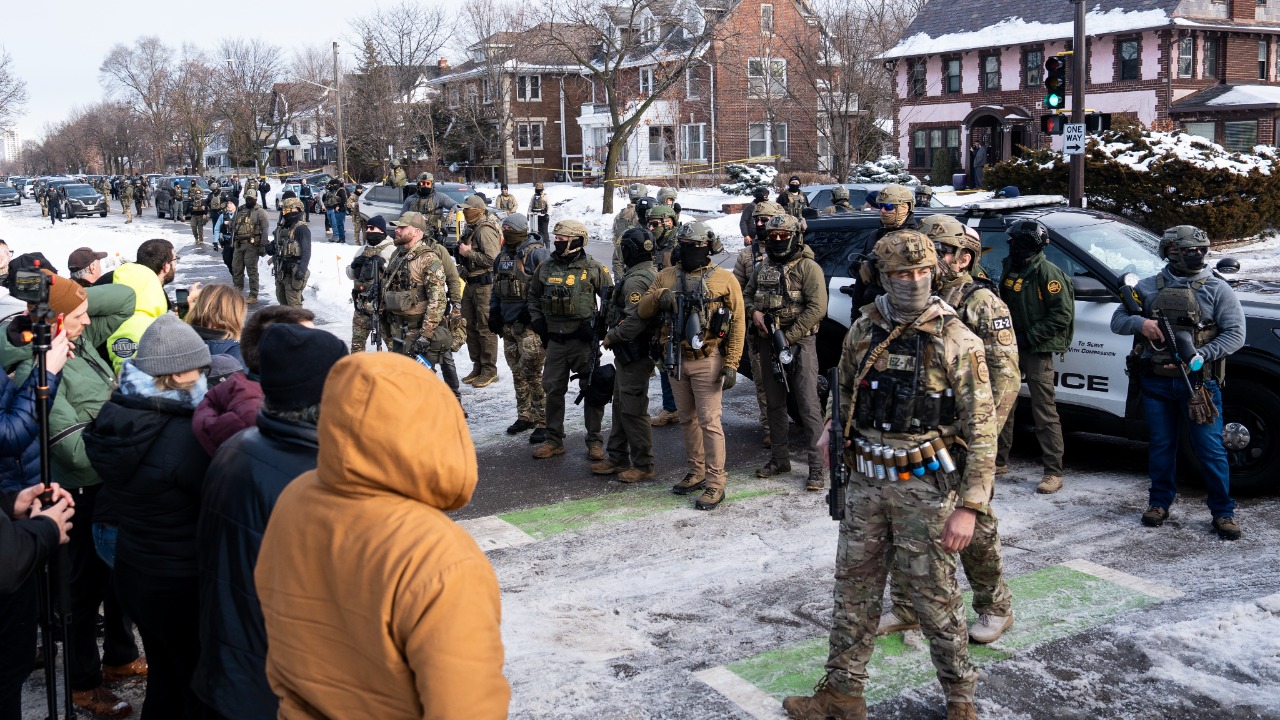
Federal authorities are preparing to send another large wave of immigration and security personnel into Minnesota, deepening a confrontation that began with a fatal shooting by an ICE officer in Minneapolis. Homeland Security Secretary Kristi Noem has confirmed that “hundreds more” federal agents will join an already sizable presence in the Twin Cities region as protests grow and local leaders demand answers. The scale of the buildup, and the speed with which it has unfolded, now raises urgent questions about public safety, civil liberties, and who is really in charge on the streets.
From one shooting to a statewide surge
The current escalation began with a single encounter. An ICE officer in Minneapolis shot and killed a woman during an enforcement operation, an incident that witnesses captured on video and that quickly spread across social media. In the days that followed, crowds gathered outside the regional ICE headquarters at the Bishop Henry Whipple Federal Building, where state senator Kelly Morrison and Rep Angie Craig tried to enter the facility and press for information about the killing and the broader operation that surrounded it, according to Kelly Morrison.
Instead of easing tensions, the federal response has grown more muscular. Earlier this month, the Department of Homeland Security began what officials described as a major immigration enforcement push, sending a reported 2,000 agents into 2,000 different locations in and around Minneapolis to target workplaces, transit hubs, and other sites. That initial surge, which already transformed the atmosphere in neighborhoods across the city, set the stage for the new announcement that hundreds more officers will now follow.
Noem’s rationale and the Trump administration’s strategy
Homeland Security Secretary Kristi Noem has framed the new deployment as a matter of basic security for federal personnel. She has argued that agents need greater numbers and heavier support to carry out immigration arrests “safely” in the face of growing protests and what she describes as organized resistance. In public remarks, she has said that DHS is sending “hundreds” of additional officers to Minnesota so that ICE teams and DHS personnel can continue their work without fear of being overrun or blocked.
The Trump administration has treated Minneapolis and the broader Minnesota region as a test case for a more aggressive interior enforcement model. Earlier in Jan, federal officials began a large scale operation that they described as a crackdown on undocumented residents and alleged fraud in public benefit programs, a campaign that involved the Department of Homeland Security, ICE, and other units under The Trump administration. Noem has also suggested, without providing detailed evidence, that the city’s social safety net has been abused on a wide scale, a claim that helps explain why the White House is willing to pour so many federal resources into one metropolitan area.
On the ground in Minneapolis and across Minnesota
For residents of Minneapolis and nearby communities, the effect of this strategy is visible on street corners and outside workplaces. Hundreds of Border Patrol officers have been mobilized to join ICE teams in the city, with Noem saying that DHS is drawing on units that usually operate along the southern border and redeploying them to the upper Midwest, according to her comments about Hundreds of Border. Footage circulating online shows tactical style teams moving through residential blocks and commercial districts, a sight that many local residents associate more with border towns than with a Midwestern city.
That visual shift has fed a sense of siege among immigrant families and their neighbors. In Minnesota, community groups report that people are skipping work, avoiding clinics, and keeping children home from school because they fear being swept up in raids, a pattern that national immigration advocates have documented in other large scale operations. The anxiety is especially acute in Minneapolis, where the fatal shooting has become a rallying point for protests that stretch from downtown streets to suburban church parking lots.
Competing narratives and the political fallout
As the federal footprint grows, the political narratives around it are hardening. Noem and her allies insist that the operation is a necessary response to lawbreaking and unrest, and they point to images of clashes outside ICE facilities as proof that agents face real danger. In one briefing, she said that Hundreds more officers are headed to Minnesota and that the public should expect to see Border Patrol agents taking people into custody far from the border, a message that aligns with reports of Hundreds of new arrivals. Supporters of the crackdown argue that the federal government has both the authority and the obligation to enforce immigration law even when local officials object.
Critics, including many Minnesota Democrats, see something very different. They describe a sweeping show of force that risks inflaming tensions and undermining trust in law enforcement, particularly after the killing of Renee Good by an ICE officer, a case that has drawn national attention through coverage of Renee Good. In their view, the decision to send Hundreds more ICE officers into Minnesota as protests erupt across the United States reflects a broader political strategy that treats immigration enforcement as a stage for confrontation, a concern echoed in reporting on Hundreds of new ICE deployments.
I see the clash most clearly in how national and local priorities diverge. On one side, the Trump administration is pressing ahead with a high profile enforcement push that it portrays as a test of federal resolve, a campaign that includes ICE teams, Border Patrol units, and other Federal officers concentrated in Homeland security operations in Minneapolis. On the other side, state and local leaders are trying to manage protests, protect residents, and preserve some measure of trust in institutions that now appear to many as occupying forces. National coverage, including the Up First briefing on ICE in Minnesota and related stories about Iran and the Federal Reserve, has placed the Minneapolis crackdown in a wider context of federal power and domestic unrest, as seen in Up First. As Noem continues to announce new deployments and as ICE, Minnesota officials, and community advocates trade accusations, the city is left to live with the daily reality of a federal surge that shows no sign of ending soon.
The stakes extend beyond one state. Reports describe Hundreds more ICE officers deployed to Minnesota as protests erupt across the country, a pattern that suggests the Minneapolis operation could serve as a template for similar actions elsewhere, according to coverage of ICE protests. Homeland Security Secretary Kristi Noem has become the public face of that approach, appearing alongside President Trump and defending the decision to send Hundreds more federal agents to Minneapolis even as evidence from the shooting and its aftermath contradicts some government claims, a tension highlighted in accounts of The Trump administration’s next steps. As I weigh these competing narratives, I see a city and a state caught between a federal show of strength and a local demand for accountability, with little sign that either side is ready to back down.
In Minnesota, the legal and political fallout is only beginning. National briefings now list ICE in Minnesota alongside Iran and the Federal Reserve as top tier stories, a sign of how central the state has become to the national debate over immigration enforcement, as reflected in ICE coverage. As protests continue and as Hundreds more federal agents arrive, the question is not only how many officers the Department of Homeland Security can send, but how long residents of Minnesota will accept a federal presence that feels less like assistance and more like occupation.