
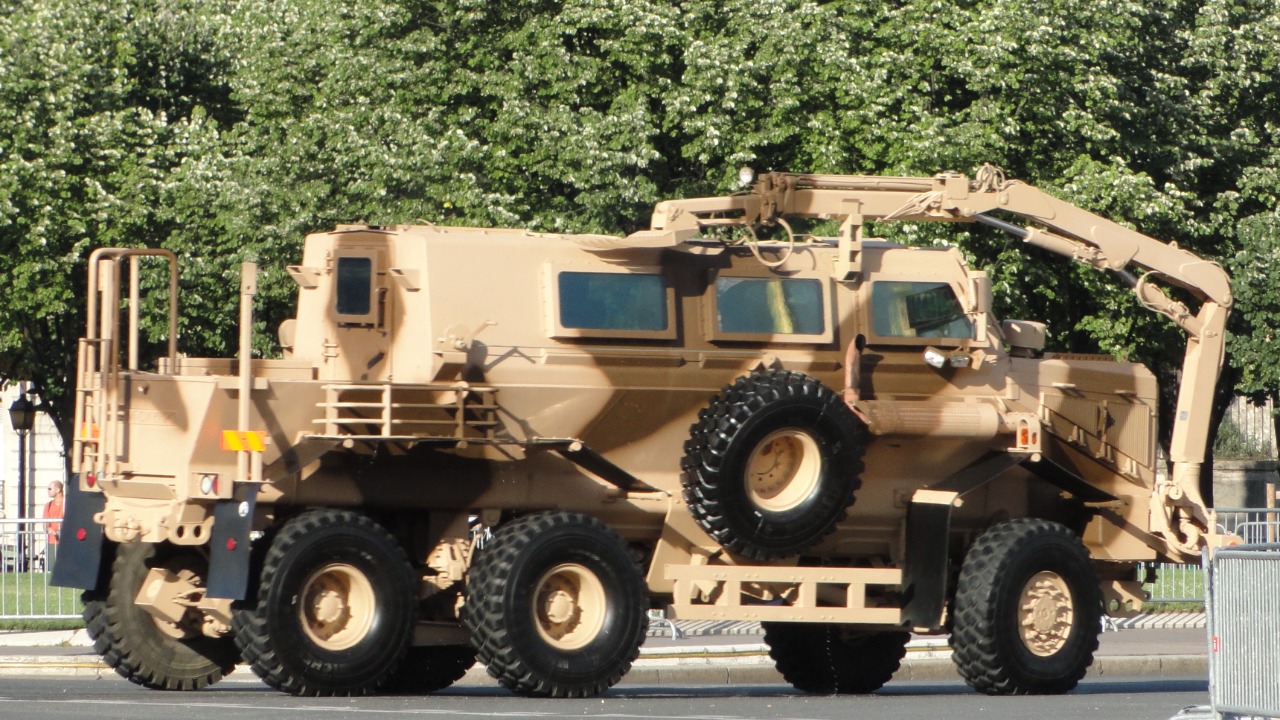
The Buffalo mine-protected vehicle became a recognizable feature of Iraq- and Afghanistan-era counter-IED operations not because it made roadside bombs “go away,” but because it helped shift how route-clearance teams managed risk. Built as a U.S.-origin MRAP optimized for route clearance and IED-related tasks, the Buffalo combined a survivability-focused design with standoff inspection and handling features that allowed crews to evaluate suspicious points in the road from behind armor. In a conflict where inexpensive, hidden explosives could impose outsized costs, that combination helped reduce casualties while supporting the daily work of keeping key routes usable.
The Buffalo’s significance is closely tied to a broader shift in thinking: away from relying on lighter tactical vehicles for predictable road movement, and toward designing for blast survivability and repeat exposure. It was not the only answer to the IED problem, and it did not remove danger from the mission. But in route-clearance formations supporting U.S. Army and U.S. Marine Corps operations, it offered a more protected way to examine potential hazards that previously could force troops to dismount into the danger area.
What changed: less reliance on exposed dismounts
IEDs punish routine. Counter-IED teams often had to clear the same roads again and again so fuel, food, ammunition, and patrols could move. Early in the wars, that work frequently brought personnel close to suspected devices—either by dismounting to inspect, or by approaching in vehicles not built around blast protection. The Buffalo emerged during the wider MRAP procurement surge, when protecting crews against mines and IED effects became a baseline requirement rather than an afterthought.
Public descriptions of the Buffalo commonly emphasize two elements tied to its role: a hull form associated with blast deflection (often described as V-shaped) and a means to examine and manipulate suspicious objects at a distance, commonly linked to an articulated arm used to “interrogate” potential threats. The operational value was straightforward: reduce how often humans had to be the sensor or the tool right next to a suspect object. A crew could stop short, examine an anomaly, use mechanical reach to probe or move it when appropriate, and coordinate for specialized support without immediately putting people on foot at the point of greatest risk.
Why it reduced casualties: protection plus changed routines
Casualty reduction was not the result of a single feature or a single vehicle. It came from stacking advantages. A platform designed around mine and blast survivability generally improves a crew’s chances when a detonation occurs, especially against threats aimed at the roadway. That matters because the difference between an attack and a loss is often determined by what happens to the occupants during the blast event.
The Buffalo also supported a more deliberate way of working. Route-clearance teams could identify irregularities, maintain standoff, use onboard inspection and handling tools to reduce uncertainty, and integrate supporting assets—such as EOD expertise, electronic countermeasures, and overwatch—before committing personnel. In practical terms, it helped make “don’t dismount yet” a more realistic default in situations where earlier approaches might have required immediate close inspection.
None of that made the mission safe. The Buffalo reduced risk; it did not eliminate it. Adversaries adapted with larger charges and more complex tactics, reinforcing that survivability is an ongoing contest rather than a solved engineering problem.
How it fit into the fight: teams, not single vehicles
The Buffalo is most closely associated with U.S. Army and U.S. Marine Corps counter-IED efforts in Iraq and Afghanistan, where keeping roads open was a constant requirement. Route clearance was typically a combined effort involving engineers, EOD technicians, convoy security, and command-and-control elements to manage what happened when something looked wrong. In that system, the Buffalo often worked at the front of the problem—positioned at or near the suspected site—while other elements provided security, technical assessment, and response options.
Industrial reporting commonly links the Buffalo to Force Protection, Inc., later absorbed into larger defense-industry structures. Variant details and corporate lineage can be difficult to describe precisely without dedicated sourcing, but the main point is clear: the vehicle was shaped by an urgent wartime demand to field protected mobility quickly and then adapt as threats evolved. That urgency influenced production, deployment timelines, and how units learned to employ the platform under pressure.
Why it mattered strategically: movement is capability
IED campaigns aim at more than casualties. They can restrict movement, disrupt sustainment, and force a commander to spend time and resources simply to keep routes open. When roads become too dangerous, bases and communities can be effectively isolated, and maneuver forces can be pushed into fewer predictable options.
By helping route-clearance teams operate with more protection and practical standoff tools, the Buffalo supported freedom of movement—an everyday combat capability in insurgent environments. In plain terms: if you can move, you can sustain and maneuver with more choice. If you can’t, the enemy shapes the battlefield by dictating where risk accumulates.
The tradeoffs: protection brings constraints
The Buffalo reflected the MRAP reality: solving one problem can introduce others. Vehicles optimized for blast protection can be heavy and tall, which can limit off-road mobility, complicate movement in dense urban areas, and narrow route options. Those constraints can slow operations and encourage more deliberate convoy tactics, adding another layer to the balance between tempo, security, and predictability.
Sustainment and readiness also shape real-world effectiveness. Heavier protected vehicles can demand more maintenance, specialized parts support, and training time—especially when the mission includes technical tasks such as using standoff tools while coordinating with EOD and security elements. Those requirements affect how widely the capability can be distributed and how consistently it can be kept available.
What outlasted the platform
The Buffalo’s lasting impact is less about one vehicle and more about what it helped normalize: survivability-first design, standoff methods, and specialized counter-IED vehicles integrated into combined teams. That mindset influenced how forces thought about protected mobility beyond the immediate wars, reinforcing the idea that blast protection and exposure reduction are foundational in environments where roadside explosives are routine.
What happened to specific fleets after peak deployments can vary over time, with outcomes shaped by policy, storage decisions, and evolving partner needs. The enduring requirement is clearer: route clearance and IED defeat remain relevant anywhere adversaries can emplace explosives along lines of communication. Future approaches will still be judged by the same basic standard the Buffalo addressed—how to keep people alive and effective while the mission continues.
For readers looking back on the MRAP era, the Buffalo illustrates a pragmatic form of adaptation: reduce exposure, add standoff, and design for survivability—then expect the enemy to respond. It did not end the IED threat, but it helped make a brutal, repetitive mission more survivable and more disciplined, supporting logistics and maneuver in wars where a disturbed patch of road could change everything.