
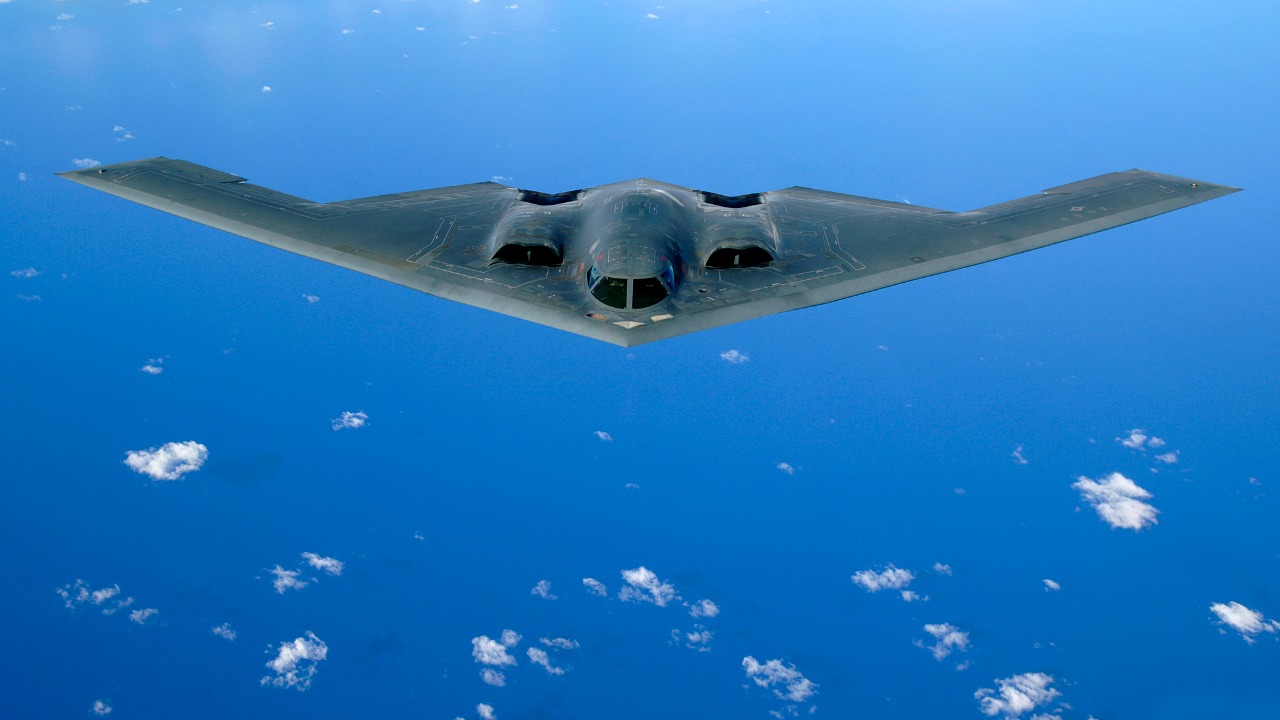
The B-2 Spirit didn’t just add another bomber to the U.S. Air Force inventory—it changed how planners think about delivering strike power into the most heavily defended airspace. Built around a low-observable “flying wing” design, the B-2 was conceived for a specific problem: reaching high-priority targets when an adversary’s integrated air defense system (IADS) is still intact and at its most dangerous. That idea—stealth-enabled access as an early-campaign option—still shapes how the United States thinks about long-range strike and nuclear deterrence modernization.
From the late Cold War into the decades that followed, the B-2 has been treated as a high-end tool for missions where access matters more than mass. It sits within U.S. strategic aviation and supports both conventional operations and the nuclear deterrence mission. That dual role also explains why it remains a reference point in comparisons between legacy bombers like the B-1 and B-52 and the newer B-21 Raider.
What the B-2 changed: penetration as a planned option
Before stealth became central to air campaign design, striking deep targets in contested territory often meant building large packages—escorts, electronic attack, suppression of enemy air defenses, and tankers—sequenced to open corridors through defenses. The B-2 helped normalize a different approach: a bomber that could be planned as an early entry option, not simply a platform that needed a corridor cleared for it first. By reducing the likelihood of detection and engagement, stealth shifted how planners could sequence operations against heavily defended targets.
That shift matters not because stealth makes an aircraft “invisible”—it doesn’t—but because it can make tracking and targeting more difficult. When detection is delayed, uncertain, or intermittent, defenders have less time to cue sensors, position interceptors, and commit weapons effectively. In practical terms, the B-2’s value is creating decision space for the attacker while compressing the defender’s ability to react.
The flying wing is only part of the story
The B-2’s low-observable approach is often reduced to its distinctive flying-wing silhouette, but its operational impact comes from a broader set of design and employment choices. Shaping and specialized materials matter, but so do mission planning, tactics, and communications that support signature management. Even with many details not publicly releasable, the takeaway is straightforward: stealth is a system, not a single feature.
That system-level approach is what made the B-2 more than an incremental step in range or payload. It enabled planners to consider strikes against high-value targets—such as command functions, air defense enablers, and critical nodes—without assuming the route and timing would be easily exposed. And because the aircraft is associated with both conventional and nuclear roles, it also carries a strategic signal: the United States maintains a penetrating bomber option rather than relying entirely on standoff attack or other parts of the strategic triad.
Why it mattered strategically: deterrence and defense planning
Against modern air defenses, the question is not simply whether an aircraft can fly, but whether it can complete the mission when the defender is actively trying to prevent it. The B-2 affects that calculation because it complicates confidence in layered defenses as a reliable “sanctuary” for critical assets. In deterrence terms, a credible penetrating bomber can influence an adversary’s assumptions about what can be protected behind an IADS.
That influence is not a one-way advantage. A force that believes key targets are exposed may invest in additional sensors, redundancy, and new concepts of detection and interception. The B-2 remains strategically relevant because it forces adaptation and shapes planning on both sides, rather than delivering a permanent solution to the air defense problem.
Who makes it work: operators, support assets, and sustainment
Operationally, the B-2 is tied to national-level requirements as much as theater needs. Its employment depends on more than the aircraft itself: supporting assets, secure planning and communications, and command-and-control arrangements that connect a bomber sortie to strategic objectives. That context is part of what makes the platform significant—and why its readiness and availability attract attention.
On the industrial side, Northrop Grumman anchors the program, but the real capability is sustained by a wider stealth enterprise: materials, testing, sustainment processes, and upgrades that preserve relevance over time. Much of that work is routine and rarely visible, but it is what turns a low-observable design into an operational capability that can be generated when needed.
The small-fleet reality: concentrated capability, limited margin
The B-2 also comes with a constraint that shapes how it is used: it exists as a small fleet. That reality encourages a selective approach to tasking. It is not typically treated as a ubiquitous presence platform or a day-to-day workhorse. Instead, it is often associated with scenarios where penetration is uniquely valuable—high-end contingencies, high-value targets, and early-phase operations in contested environments.
A small fleet concentrates risk as well as capability. Any sustainment challenge, modernization delay, or availability dip can have an outsized effect on the force’s ability to offer a penetrating bomber option. Beyond debates about cost or workload, the operational issue is capacity: fewer aircraft means less surge margin and less flexibility when global demands collide.
Stealth isn’t a force field: the discipline behind low observability
The B-2’s reputation rests on low observability, but that advantage depends on maintenance and operational discipline. Surface condition matters, handling procedures matter, and mission planning is part of managing the aircraft’s overall signature. That doesn’t mean the B-2 is inherently delicate; it means its effectiveness is tied to sustained investment and process rigor.
And even when those conditions are met, stealth is not immunity. Detection and engagement are probability problems influenced by enemy sensors, tactics, geography, and the broader operational environment. The B-2 redefined how the problem could be approached, but it did not eliminate the need to account for air defenses or the supporting capabilities that make penetration viable.
What comes next: B-2 lessons and the B-21 era
The B-2’s legacy is increasingly discussed in the context of what follows it. In modernization debates, the B-21 Raider is framed as the next evolution of penetrating strike—evidence that the requirement the B-2 validated has not disappeared. If anything, the spread of advanced sensors and tighter networking makes survivable access a more demanding, not less demanding, challenge.
That does not mean the B-2 is immediately obsolete. Its continued relevance is tied to sustainment and upgrades that keep it useful against sophisticated IADS and in contested command-and-control environments. The transition is best understood as continuity with refinement: the B-2 proved the operational concept, and newer systems aim to scale it and make it more sustainable over time.
Why Combat Rated readers should care
The B-2 Spirit’s real achievement is that it reshaped what “credible” can mean for long-range bombing. Instead of assuming defended airspace must be systematically softened before bombers can operate with confidence, the B-2 helped make penetration itself a planned option for certain high-value missions. That shift affects deterrence, campaign sequencing, and how adversaries build and prioritize their air defense networks.
In a world where competitors continue investing in IADS and multi-domain detection, the B-2 remains both a capability and a case study. It shows the payoff of stealth, the trade-offs of sustaining it, and the operational discipline required to keep it meaningful. Most of all, it demonstrates that survivability is not just an airframe attribute—it is the ability to keep generating missions that planners can trust when the stakes are highest.