

San Antonio-class amphibious transport docks are built around a simple battlefield requirement: move Marines, their vehicles, and their firepower from sea to shore fast enough, and in enough mass, to matter in the opening hours of a fight. They do it by combining a cavernous well deck, a full-size flight deck, and a command suite that turns the ship into a floating hub for complex assaults. In an era of long-range missiles and contested coastlines, how these ships actually push Marines into combat zones is central to whether amphibious warfare still works.
From the outside, they look like slab-sided gray boxes, but inside, every passageway, ramp, and hangar is arranged to get combat-loaded Marines off the bunks and onto landing craft or aircraft with minimal delay. The class is designed to sail with an embarked Marine Expeditionary Unit, plug into a wider Amphibious Ready Group, and then fan out Marines by air and sea in carefully sequenced waves that can range from humanitarian relief to high-end combat.
Hull, volume, and the basic mechanics of sea-to-shore
The starting point is size and layout. At roughly 684-foot-long, 105-foot wide, The San Antonio hull gives planners the volume to embark hundreds of Marines, their vehicles, and pallets of ammunition while still reserving space for a full aviation deck and a floodable well. That footprint lets the Navy treat each ship as a self-contained launch platform, able to stage armored vehicles on the vehicle deck, move them through wide ramps, and load them directly onto landing craft without clogging narrow corridors. The Navy pairs that physical capacity with a combat system built around the Ship Self, Defense System, or SSDS, which testing on platforms like CVN and LHA has shown can integrate sensors and weapons into a single defensive picture, according to The Navy.
Inside that hull, the design focus is on flow. Wider passageways, larger hatches, and open troop berthing areas are laid out so combat-loaded Marines can move in full kit from their racks to staging areas without bottlenecks. Officers from embarked units describe the extra cargo volume as a force multiplier, with one Marine leader, Sep Scott, explaining that the additional storage translates directly into more warfighting equipment the Marines can bring to the fight, the equivalent of having all the tools in the toolbox instead of choosing a few. That internal capacity is what allows planners to stage multiple waves of vehicles and gear, not just a single lift, so the ship can sustain operations ashore rather than delivering a one-time punch.
Well deck operations and the landing craft “conveyor belt”
The most visible way San Antonio-class ships move Marines into combat zones is through the well deck, a floodable bay in the stern that functions like a garage opening directly into the sea. When the ship ballasts down, the stern gate lowers and landing craft slide in and out, turning the LPD into a seagoing pier that can launch and recover multiple waves of assault craft. Historical amphibious concepts envisioned that The Marines would be transported ashore in landing craft emerging from enclosed well decks, a model that still underpins how modern amphibious transport docks push troops toward the beach, as described in accounts of The Marines moving from ship to shore.
From that well deck, the workhorses are hovercraft and utility boats. Whether operating from the well deck of an amphibious transport ship, through the surf zone, or beyond the beach inland, the LCAC (LANding Craft, Air CUSHION) has become a multimission craft that can haul heavy vehicles and troops at high speed over water and directly onto unimproved shorelines, as highlighted in Whether focused on logistics or assault. Alongside LCACs, slower Landing Craft Utility boats carry additional vehicles and supplies when speed is less critical, creating a layered “conveyor belt” of surface connectors. The ship’s vehicle decks feed this system, with Marines driving armored vehicles directly onto LCACs or LCUs, then disembarking ashore ready to roll into combat rather than pausing to reconfigure loads on the beach.
Flight deck, aviation mix, and vertical assault
Above the waterline, the flight deck turns the LPD into a vertical assault platform. The class was explicitly designed to support the MV-22 tiltrotor, and embarked units have used that capability to extend the reach of their operations far beyond the visible coastline. In one deployment, the ship’s captain described how Working as a team with the Marines of the 26th MEU significantly increased the capabilities the ship could provide across the full range of military operations, underscoring how aviation and shipboard command functions mesh. That partnership allows commanders to plan simultaneous helicopter and tiltrotor waves, inserting infantry deep inland while surface craft deliver armor closer to the shore.
The aviation mix is broad. Marines from the Marine Corps fly AV-8B Harrier attack jets, F-35B Lightning II short takeoff and vertical landing fighters, CH-53 heavy-lift helicopters, AH-1 attack helicopters, UH-1 utility helicopters, and MV-22 Osprey transport helicopters as part of the broader amphibious force, a portfolio of aircraft that can stage from big-deck assault ships and operate in concert with LPDs, according to descriptions of Marines aviation support. The San Antonio-class flight deck and hangar are sized to host a tailored slice of that mix, including MV-22s and helicopters, while other ships in the Amphibious Ready Group carry the jets. That arrangement mirrors how other navies think about LPD aviation, with one industry leader Talking about how the Indian Navy intends to operate current and future helicopters and even fixed-wing aircraft from its own LPD designs.
Marines, vehicles, and the human factor on board
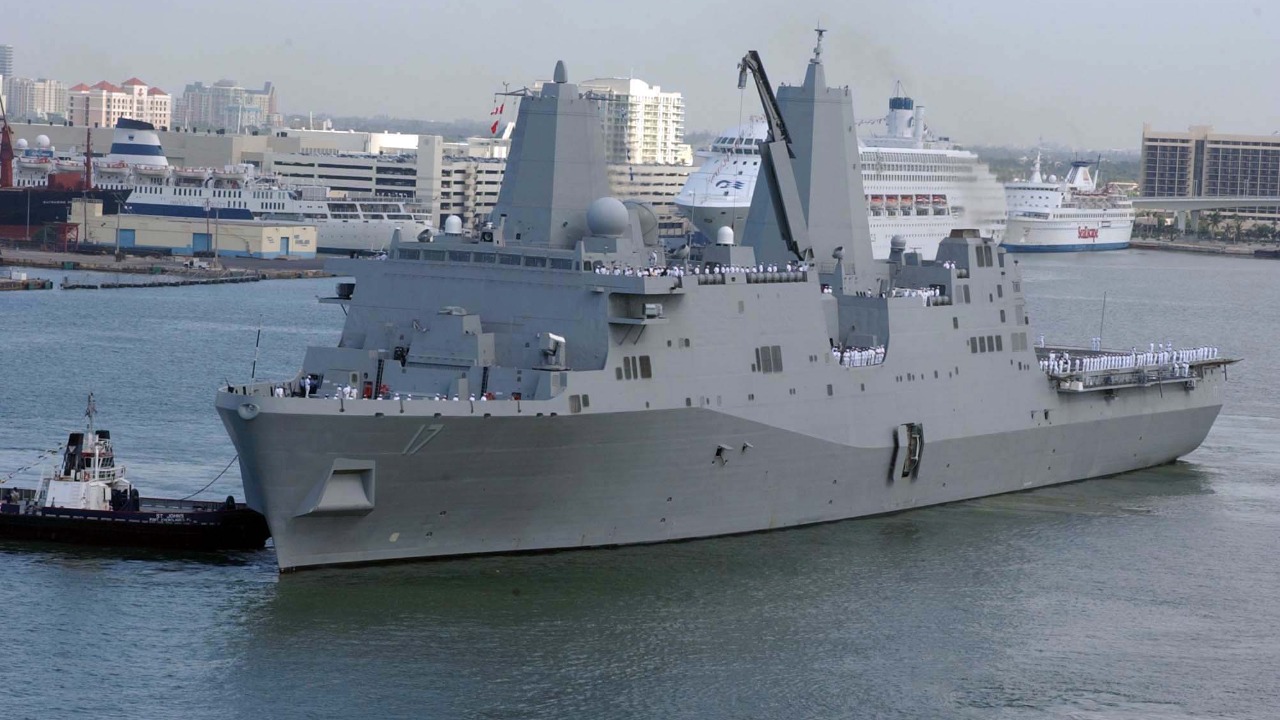
Moving Marines into combat zones is not just about steel and propulsion, it is about how people and machines are organized inside the ship. The principal mission of each LPD in the San Antonio class is to deploy combat and support elements of Marine Expeditionary Units and Brigades, a role that demands enough berthing, vehicle stowage, and command spaces to host a full cross-section of infantry, logistics, and aviation detachments, as spelled out in descriptions of LPD missions. That mission profile shapes everything from the size of troop berthing compartments to the location of armories and briefing rooms, so units can plan, gear up, and move to staging areas in a predictable rhythm.
That rhythm has evolved with aviation transitions. One Marine aviation unit documented how it transformed platforms from the CH-46 Sea Knight to the MV-22 Osprey, marking the last operational use of the venerable 46-series helicopter as crews shifted to tiltrotor tactics that demand different deck handling and maintenance patterns, a change captured in Sea Knight footage. On board an LPD, that kind of transition means new procedures for spotting aircraft on the deck, different fueling and arming routines, and updated training for deck crews and embarked Marines who now plan for faster, longer-range vertical assaults. The ship’s internal spaces, from hangars to maintenance shops, are configured to absorb those changes while still keeping the flow of Marines to the flight deck and well deck as frictionless as possible.
Command, contested seas, and the future of amphibious employment
San Antonio-class ships are not just transports, they are command nodes in a more unpredictable deployment model. Deployment of troops is now based on the “Dynamic Force Employment” concept, which is designed to make it harder for adversaries to predict how and where U.S. forces will appear, complicating any attempt to locate the target and launch an attack, according to analysis of Deployment of patterns. In that environment, an LPD may shift rapidly between deterrence patrols, crisis response, and high-end exercises, all while embarked Marines rehearse the same core tasks of loading, launching, and sustaining forces ashore. The ship’s command and control suites, integrated with SSDS and other networks, allow it to coordinate those moves with other amphibious ships, surface combatants, and aircraft.
That flexibility has been tested in real-world operations. During one extended mission, Naval Forces Europe and Africa reported that the amphibious transport dock ship USS San Antonio supported operations where embarked aircraft carried out dozens of combat sorties, highlighting how the ship’s aviation and command capabilities can be leveraged in complex theaters, as noted by Naval Forces Europe, Africa, and Fleet Public Affairs. At the same time, critics have warned that the Marine Corps San Antonio-class amphibious ships are vulnerable in high-threat environments, with one assessment arguing that Team 17 designers interfaced closely with Marines to shape the hull but did not give it a robust offensive weapon suite, leaving the ships as “sitting ducks” without escorts or layered defenses, a concern detailed in an Oct critique of the Team approach.
Those debates are unfolding as the Marine Corps looks to reshape amphibious operations around new platforms and concepts. Senior leaders have pointed to two new ship classes as central to the future of amphibious warfare, while also acknowledging that legacy ports like the Olongapo of old will not return in the same form, even as something else emerges to meet the recreational needs of soldiers and sailors, a reflection captured in Jun discussions of future force design and the Olongapo of past eras. For now, however, the San Antonio-class remains the backbone of the Navy’s amphibious transport fleet, a class whose 684-foot-long, 105-foot beam hulls, LCAC-capable well decks, and MV-22-ready flight decks continue to define how the United States moves Marines from sea bases into contested littorals.