
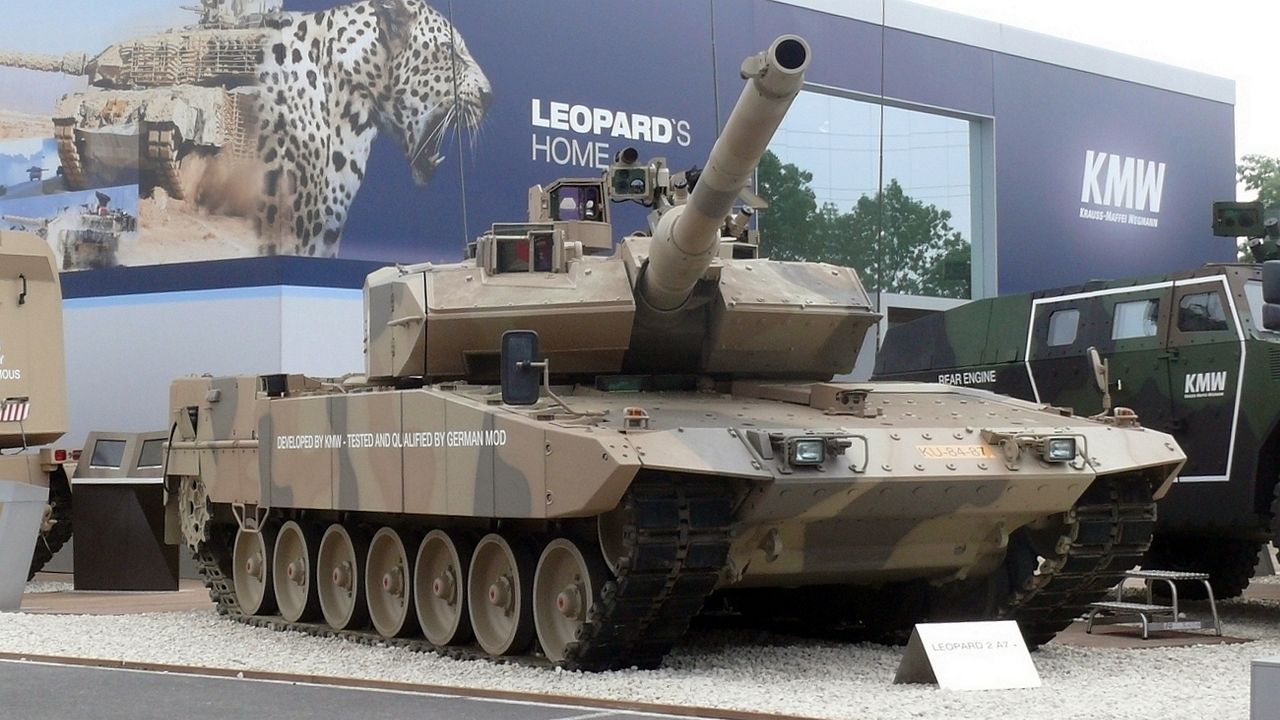
Modern militaries aren’t abandoning armored vehicles—but they are changing how armor survives and fights when movement is easier to detect and faster to target. Recent conflicts, including Ukraine and Nagorno-Karabakh, and repeated combat experience in the Middle East have reinforced a basic point for procurement planners: exposed vehicles, static positions, and predictable routes are increasingly vulnerable to mines, massed artillery, loitering munitions, and small drones that feed rapid “sensor-to-shooter” targeting. The response is less about endlessly piling on armor thickness and more about building vehicles and formations that can reduce detection, reduce the chance of a hit, and keep operating after contact.
This shift is shaping decisions across NATO European armies—especially those focused on deterrence and defense on the eastern flank—as well as in the US Army and Marine Corps. The fighting in Ukraine, in particular, has accelerated field modifications and influenced what industry is trying to package into upgrade kits and new production designs. Israel and Turkey also appear frequently in the broader conversation because active protection and drone-centric concepts have moved closer to baseline expectations for many modern forces.
What changed: survivability is now a layered requirement
High-intensity war has made survivability less of a single metric and more of a layered problem. Vehicles must contend with top-attack threats, persistent observation from drones, and faster artillery response times. That drives demand for active protection systems (APS), electronic warfare (EW), signature reduction, and counter-UAS sensors and effectors alongside traditional passive armor and internal survivability measures.
It also reshapes what “mobility” means. Speed and cross-country performance still matter, but so does moving in ways that limit how quickly an opponent can identify, classify, and target a vehicle. Modern armored platforms are increasingly expected to contribute to a network—sharing warnings and situational awareness—while also managing the risk that emissions can give away positions.
APS, counter-UAS, and the push to address top attack
APS has become one of the most visible parts of this shift, with Trophy often cited publicly as a widely known example of a hard-kill system. The point is not that APS makes vehicles “invincible”—it doesn’t—but that it can raise the difficulty of successful direct-fire attacks and improve the odds of crews surviving first contact. In high-intensity combat, modest improvements in survivability can help preserve trained personnel and maintain unit cohesion.
More difficult, and more common in recent fighting, is the drone problem: small UAVs and loitering munitions that can spot vehicles, adjust fires, or strike directly, often as part of a rapid targeting cycle. Counter-UAS measures are therefore moving from optional add-ons toward routine requirements, but there is no single solution. EW may disrupt some links, sensors can improve warning, and kinetic options can help in certain cases—yet adversaries adjust with different tactics, flight profiles, and degrees of autonomy.
From field modifications to integrated upgrades—without losing speed
Improvised add-on protection and “drone cages” became a visual shorthand for adaptation, but many militaries now want to translate battlefield improvisation into standardized, supportable solutions. That creates an unavoidable tension: field modifications can appear quickly and reflect immediate lessons, while integrated factory solutions tend to be safer, better balanced, and easier to sustain across a fleet. Procurement organizations are trying to capture the speed of field fixes while turning the most useful ideas into maintainable upgrade paths.
Modularity supports that approach when it is real rather than rhetorical. Mission packages, bolt-on protection, and configurable electronic suites can help armies tailor vehicles to specific threat environments and update subsystems as they age or become outdated. It also offers a way to improve existing fleets without waiting for an all-new platform—an important consideration when budgets, training pipelines, and industrial throughput are limiting factors.
Where this is showing up: Leopard 2, Abrams, and the IFV modernization push
In Europe, Leopard 2 remains a central reference point because it is widely fielded and has multiple upgrade paths in public discussion. The focus is increasingly on integrating sensors, situational awareness, and survivability measures that reflect top-attack risks and drone-cued fires—not just adding weight wherever possible. The pace of upgrades matters as much as the specification, because deterrence depends on fielded readiness, not planned configurations.
In the United States, Abrams modernization and SEP upgrades follow similar logic: sustaining a heavy platform in a battlefield saturated with reconnaissance and precision effects. The US effort to pursue a next-generation infantry fighting capability through OMFV underscores another trend: the IFV is just as central to survivability as the tank, because it carries the infantry, fights in close contact, and must operate under the same observation and fires. Meanwhile, Bradley and a range of European platforms—CV90, Puma, Boxer, and AJAX—continue to shape debates over protection, digital architecture, and how to balance tracked and wheeled forces.
Tracked vs. wheeled: less ideology, more sustainment
The tracked-versus-wheeled argument has sharpened because high-intensity warfare is as much about sustainment as it is about tactical performance. Tracked vehicles can bring advantages in cross-country mobility and, depending on configuration, growth potential for protection and payload—but they often demand more maintenance and recovery capacity. Wheeled platforms can simplify some logistics and offer operational mobility, yet they face their own survivability trade-offs in environments dominated by mines, artillery fragmentation, and overhead threats.
Many armies are increasingly treating fleet design as a force-mix problem rather than a single-platform bet. Heavy tracked units may remain essential for breaching and close combat, while wheeled systems can provide scalable presence, rapid reinforcement, and support variants. In either case, outcomes depend on combined arms—engineers, fires, air defense, and training—because vehicle design alone does not decide campaigns.
The “must-have” variants: recovery, engineering, and air defense
One of the most consequential shifts is renewed attention to the unglamorous parts of an armored force: recovery, repair, engineering, and other support variants that determine whether combat power can be restored after losses. Recent fighting has highlighted how quickly vehicles can be damaged, immobilized, or worn down—and how much operational momentum depends on recovering and repairing them under pressure. That lesson is pushing militaries to look beyond buying combat platforms and toward building the ecosystem that keeps fleets usable.
Persistent ISR also elevates short-range air defense and counter-UAS capabilities within armored formations. If drones and loitering munitions can loiter over routes and assembly areas, armored units need protection that moves with them, not only coverage at higher echelons. This requirement feeds directly into vehicle design through power generation, mounting space, electronic integration, and crew workload—factors that complicate upgrades but are difficult to avoid in a drone-saturated environment.
Networking the fight: “sensor-to-shooter” as both threat and opportunity
Pervasive sensors link survivability to how quickly a unit can detect threats, share information, and respond. “Sensor-to-shooter” networking—connecting scouts, drones, vehicles, and fires—has become both a threat to exposed forces and an opportunity for those who can shorten their own decision cycle. Militaries want networks that are faster, more resilient, and harder to disrupt, while also reducing the chance that those networks become beacons for enemy targeting.
This emphasis is pushing procurement toward more open architectures and software-upgradeable components, even on platforms that are still fundamentally mechanical. It also forces practical trade-offs in emissions control: the same sensors and radios that improve awareness can increase detectability. Managing when to be “loud” and when to be “quiet” becomes as much a training and doctrine issue as a technology choice.
Industrial constraints: capacity, supply chains, and the cost of speed
Modernization plans run into a hard constraint: industrial capacity. Major land manufacturers—Rheinmetall, KNDS, BAE Systems, General Dynamics, Patria, Hanwha, and Turkish and Israeli firms—are widely discussed in connection with upgrades, new production, and enabling subsystems such as protection and sensors. Even when funding is available, supply-chain bottlenecks, skilled labor shortages, and long-lead components can limit how many vehicles can be delivered or modernized in a given timeframe.
That reality encourages incremental improvements and “good enough now” packages instead of waiting for ideal future solutions. It also puts a spotlight on stockpiles and sustainment: spare parts, optics, engines, tracks or tires, and munitions can matter as much as additional hulls. In a prolonged fight, readiness rates and repair throughput can outweigh theoretical fleet size.
What happens next: layered protection, rapid fielding, and fewer single-point answers
The direction of travel is clear even if the final answers are not: layered survivability (APS where feasible, EW and counter-UAS where practical, better top-attack and mine protection, and signature management) paired with improved situational awareness and networking. Armies will keep balancing rapid fielding of interim kits against integrated solutions that reduce crew burden and sustainment risk. They will also continue adjusting tactics for constant observation—dispersion, deception, and faster transitions between movement, concealment, and protection.
The strategic consequence is straightforward: if armored forces cannot survive long enough to maneuver, deterrence weakens and offensive operations become far more costly. If they can adapt—through technology, doctrine, and sustainment—tanks and IFVs remain relevant as protected mobility and firepower, not as invulnerable fortresses. The lesson from recent wars is not that armor is obsolete; it is that armor must evolve into a system-of-systems, and those improvements must be fielded in time and at scale to matter.