
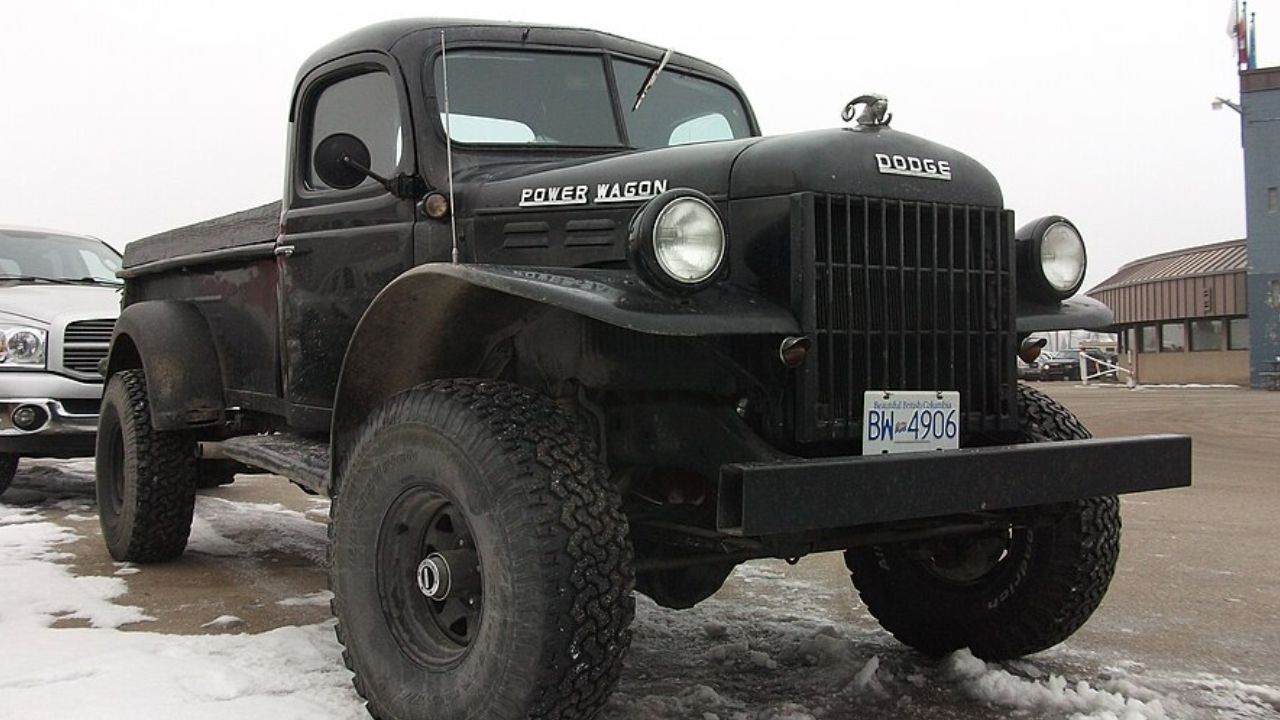
If you’ve ever seen a vintage Dodge Power Wagon in the wild, you probably did a double-take. It looks like a pickup, sure, but it carries itself like a piece of job-site equipment that somehow got license plates. That “built for work first” vibe isn’t an accident—it’s the whole reason the Power Wagon became a legend.
While other postwar pickups were busy getting friendlier for farms and families, the Power Wagon stuck close to its military and industrial DNA. It wasn’t trying to be the smoothest ride on Main Street. It was trying to be the truck that still moves when the road stops existing.
Born from wartime hardware, not showroom trends
The Power Wagon’s story starts with Dodge’s World War II 4×4 trucks, especially the WC series that served everywhere from supply lines to rough backcountry routes. Those trucks needed stout frames, low gearing, and parts that could take a beating without asking for much in return. When the war ended, Dodge saw an opportunity: civilians still needed that kind of capability, just without the camouflage.
So instead of designing a light-duty pickup and adding “off-road” badges later, Dodge essentially adapted a proven military-style platform for civilian use. The early Power Wagons weren’t pretending to be refined—they were honest about their purpose. That honesty turned into a personality, and the personality turned into a following.
A chassis that felt more like a tool than a toy
The Power Wagon stood apart because it was heavy-duty in the way that matters: the bones. Think sturdy ladder frame construction, solid axles, and running gear designed to haul, pull, and crawl without drama. In an era when many pickups were evolving toward lighter, more everyday usability, the Power Wagon leaned into being unapologetically overbuilt.
That overbuilt nature showed up in the truck’s proportions and stance. It sat tall, looked purposeful, and didn’t bother hiding its capability behind chrome. If other pickups were work boots, the Power Wagon was more like steel-toe boots with a little dried concrete still on them.
Four-wheel drive that wasn’t a novelty
Today, 4×4 badges are everywhere—sometimes on vehicles that rarely see more than a gravel driveway. But in the Power Wagon’s early years, four-wheel drive was still a serious feature, not a marketing checkbox. Dodge offered a system meant for real traction needs: muddy fields, snowy passes, logging roads, and places where “turning around” isn’t an option.
And it wasn’t just about powering all four wheels. The gearing and hardware were geared toward controlled movement under load, the kind you need when you’re easing down a slope with equipment in the bed or dragging something stubborn out of a ditch. It’s not glamorous, but it’s exactly what made the truck special.
The factory winch: the original “get out of trouble” button
One of the most iconic Power Wagon features was the available front-mounted winch, offered from the factory when that sort of thing was rare. For folks working in remote areas—utility crews, foresters, ranchers—it wasn’t a toy. It was insurance, a way to self-recover when help might be hours away and cell coverage was pure science fiction.
A winch also fit the Power Wagon’s whole vibe: preparedness. It told you this truck was expected to meet problems head-on, literally. If you’ve ever watched an old winch spool under load, you know it’s equal parts mechanical poetry and “please keep your fingers away from that cable.”
Worksite credibility that spread by word of mouth
What really cemented the Power Wagon’s reputation wasn’t a flashy launch campaign—it was the way it performed for people who needed it. These trucks found homes with municipalities, construction outfits, mining operations, and rural owners who cared more about results than ride quality. When a vehicle consistently shows up, starts up, and hauls out, people remember.
That kind of reputation travels fast in tight-knit working communities. One dependable truck becomes two, then a small fleet, and before long the name “Power Wagon” turns into shorthand for capability. It’s the same way certain tools become the default choice: not because they’re pretty, but because they don’t quit.
Not the smoothest ride—and that was kind of the point
To be clear, the classic Power Wagon wasn’t built to float down the highway. The ride could be bouncy, the steering could feel busy, and the whole experience reminded you that you were operating something designed for toughness. People didn’t buy it for comfort; they bought it because comfort doesn’t pull a stuck tractor free.
And yet, that ruggedness is exactly what enthusiasts love today. There’s a directness to older heavy-duty trucks—you feel the road, the drivetrain, the weight shifting. It’s the automotive equivalent of using a well-worn hammer: not delicate, but deeply satisfying when you need it.
A long legacy that modern Power Wagons still nod to
The Power Wagon name didn’t stay frozen in time. Decades later, Dodge (and later Ram) revived the Power Wagon as a specialty heavy-duty off-road model, aiming for the same basic idea: a work-capable truck with extra traction and recovery tools. Modern versions add the comfort and tech buyers expect, but the mission remains familiar—go farther, get stuck less, and have a plan when you do.
That through-line matters because it explains why the badge still means something. Plenty of trucks can look tough, and many are genuinely capable. The Power Wagon, historically, earned its credibility the hard way: by being designed from the start to work in places where failure is expensive.
Why the heavy-duty roots still matter now
In today’s world of lifestyle pickups and endless trim packages, the Power Wagon’s origin story feels refreshingly straightforward. It stood apart because it wasn’t built around a commuter’s needs—it was built around the demands of rough terrain and real labor. That foundation created a truck that looked different, drove different, and, most importantly, delivered differently.
That’s why the Power Wagon continues to grab attention at shows, on trails, and in the occasional blurry “spotted this beast at the gas station” photo. It’s not just nostalgia. It’s respect for a machine that came from heavy-duty roots and never tried to pretend otherwise.