
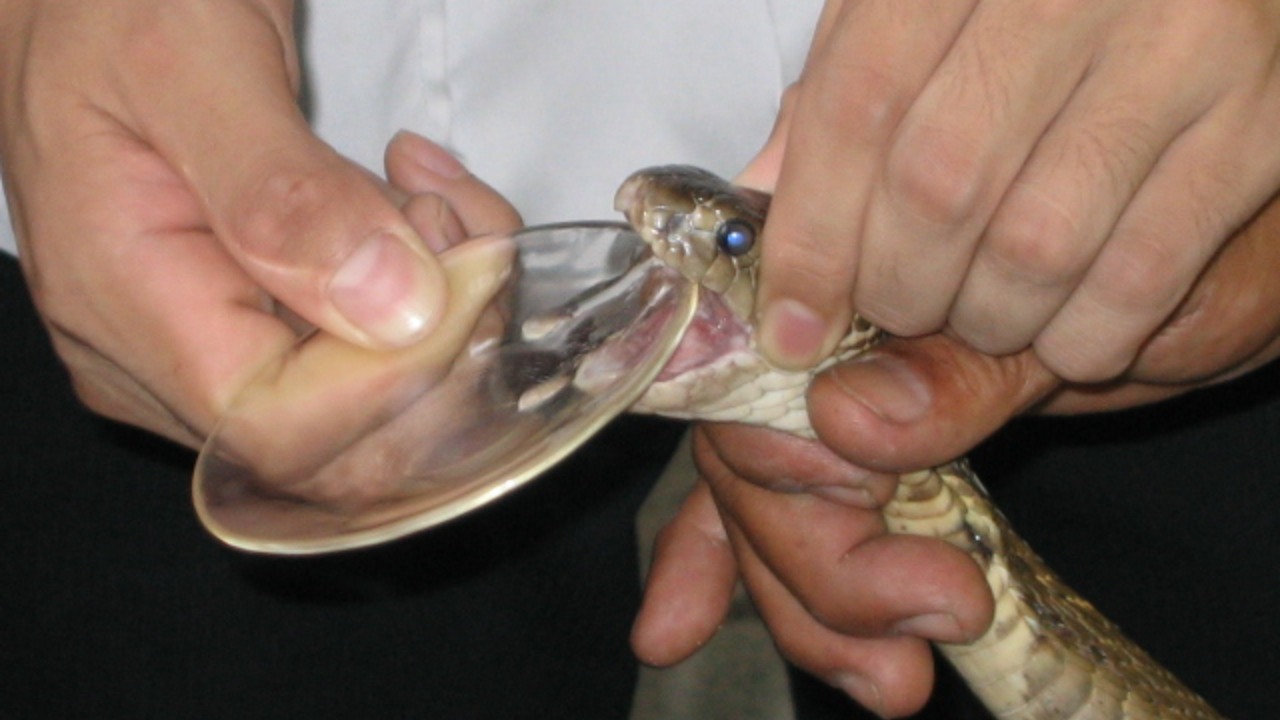
For nearly two decades, a Wisconsin man has done something most of us would flee from, inviting some of the world’s deadliest snakes to sink their fangs into his arms in a personal quest to outsmart venom. That man is Tim Friede, a self-taught snake expert whose body has become a living experiment in immunity and whose blood is now being mined by scientists searching for a universal antivenom. His story sits at the uneasy intersection of obsession, risk and a potentially transformative advance in global health.
I find his case impossible to dismiss as a mere stunt, because the same bites that once looked like reckless bravado are now feeding a sophisticated research pipeline. By letting venom enter his veins again and again, Friede has turned himself into an unlikely partner for immunologists who hope to turn his antibodies into a treatment that could protect victims from multiple snake species with a single shot.
The man who chose the fangs
When I trace the arc of Tim Friede’s life, what stands out first is the sheer scale of his commitment. Over roughly 18 years, he has not only handled cobras, mambas and other notorious reptiles, he has allowed them to bite him repeatedly and has also injected himself with carefully measured doses of their venom. One account notes that he subjected himself to exactly 856 venom injections, a number that captures both the methodical nature of his regimen and the extraordinary risk he accepted each time he picked up a syringe. In parallel, he let live snakes bite him in controlled settings, turning his own body into a test bed for what he hoped would become “hyper immunity” to a broad range of toxins.
Those bites were not occasional curiosities. One scientific account describes how Friede let the him again and again, and that in total he let snakes bite him 202 times in pursuit of this goal. Another report frames the same ordeal more broadly, describing a man who let in the hope of building that extreme immunity. I read those figures not as spectacle but as the raw data of a personal experiment that pushed the boundaries of what any individual should reasonably endure.
From backyard experiment to laboratory asset
What began as a private crusade has now been pulled firmly into the realm of formal science, and that transition is crucial. Researchers did not simply show up and draw blood; they proceeded only after receiving approval from an ethics review board, obtaining informed consent from Friede and providing him with detailed documents about the project. Only then did they begin isolating the antibodies that his immune system had built up against a wide array of snake toxins, including those in the SNX family. For me, that procedural rigor matters, because it marks the line between a dangerous hobby and a legitimate collaboration that respects both the subject and the stakes.
Once his blood reached the lab, the work shifted from personal risk to molecular engineering. Scientists studying his samples have focused on how his antibodies latch onto venom components and neutralize them, using that information to design synthetic versions that can be produced at scale. One report describes how the first antibody they built, known as LNX-D09, protected mice from a lethal dose of whole venom from six snake species, a striking result compared with traditional antivenoms that are usually tailored to a single species. In that moment, Friede’s years of self-exposure stopped being just a personal shield and became a template for a new kind of drug.
Inside the race for a universal antivenom
As I follow the scientists’ work, what emerges is a clear ambition to move beyond the patchwork of region specific antivenoms that currently dominate care. One account notes that Friede’s blood helped create a new antivenom that targets the venom of 19 snake species, a breadth that would have been unthinkable with older methods that rely on immunizing horses with one or two venoms at a time. Another report describes how blood could revolutionize snakebite treatment by providing the blueprint for antibodies that work against multiple species in a single formulation.
Behind those ambitions are specific people and institutions whose roles I find worth spelling out. One report highlights how, eight years after first encountering Friede, Eight years of work brought together Glanville and Peter, the latter identified as Richard J. Stock Professor of medical sciences at Columbia University‘s Vagelos Coll of Physicians and Surgeons. Their collaboration underscores that this is not a fringe project but a serious effort rooted in mainstream biomedical research.
The global stakes of one man’s obsession
To understand why Friede’s blood matters, I have to step back and look at the burden of snakebite worldwide. Venomous snakes are a major global health problem, particularly in low and middle income countries where access to timely care is limited and where antivenom supplies are often patchy or unaffordable. One report describes how Friede, pictured with cobras, kraits and many others, let snakes bite him some 200 times to help create a better antivenom, a personal ordeal that now intersects with the needs of rural farmers, children and field workers who face these animals not by choice but by geography.
Several accounts emphasize just how broad that threat is. One describes a Man Bitten by Snakes 200 Times May Help that works against the venom of 19 snake species, a scale that could simplify logistics for clinics that now must stock multiple vials for different local snakes. Another highlights how Tim Friede let 200 snakes bite him over 18 years and now his blood may hold the key to protecting people from several of the World Health Organization’s deadliest snake species. When I picture a black mamba, described with a Getty Images photograph as arguably the world’s deadliest snake, I see the stakes of this work not in the drama of a single man’s choices but in the possibility that his antibodies could one day stand between a bite in a remote field and a preventable death.