
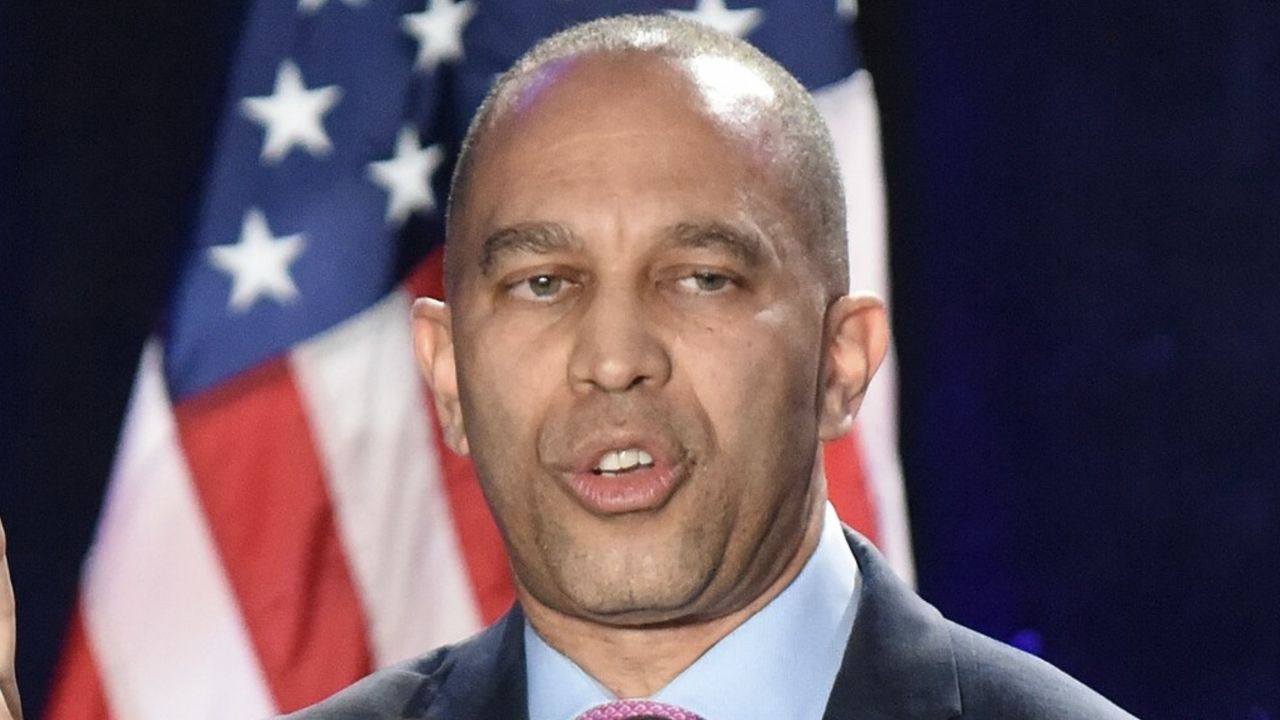
House Minority Leader Hakeem Jeffries used a social media post on Saturday to renew his party’s core argument against President Donald Trump’s military campaign in Iran, telling followers that the conflict Republicans once promised would be brief has instead stretched on for half a year with no resolution in sight. The New York Democrat’s post, published to X at 3:44 p.m. on August 29, 2026, arrived one day after the war formally reached its six-month mark.
The Post
Jeffries wrote:
“Republicans told America their reckless war of choice would last four weeks. It’s now gone on for more than six months. Enough.”
A War That Was Supposed To Be Short
The conflict Jeffries referenced began on February 28, 2026, when the United States joined Israel in launching coordinated strikes on Iran, an operation the Pentagon code-named Operation Epic Fury. Trump addressed the nation from Mar-a-Lago the night the strikes began, framing the campaign as necessary to eliminate what he described as imminent threats from the Iranian regime, including its nuclear program. The opening salvo killed Supreme Leader Ali Khamenei and much of Iran’s military leadership, and triggered hundreds of retaliatory missiles and thousands of drones launched from Iran across the region.
In the days after the strikes began, Trump predicted the fighting could last four to five weeks. That timeline proved wrong almost immediately. Iran expanded the war to several Gulf states, and the conflict drew the United States into what critics have called another quagmire in the Middle East. By late August, six months in, Iran’s regime had endured, Trump’s standing at home had fallen, the Strait of Hormuz remained largely closed, and U.S. weapons stocks had been depleted.
Six Months, Unmet Goals
According to reporting published around the war’s half-year anniversary, Trump laid out six specific goals for the conflict in his initial February address, and six months later had failed to fully achieve any of them. That reporting also noted that as the midterm elections approached and Trump’s approval ratings slumped, the president began trying to cast the war as a victory, at one point posting an AI-generated image of himself in a war zone standing beside a sign reading “MISSION ACCOMPLISHED 2026.”
The human cost of the campaign has also grown substantially since it began. Since the start of the war, 18 U.S. service members have died and more than 750 have been wounded. Trump has attended three dignified transfer ceremonies to honor fallen troops since the conflict began.
Jeffries’ Opposition From Day One
Jeffries did not wait to criticize the operation. On the day the strikes were launched, he released a statement arguing that “the framers of the United States Constitution gave Congress the sole power to declare war as the branch of government closest to the American people,” and that “the Trump administration must seek authorization for the preemptive use of military force that constitutes an act of war.” He added at the time, “if Iran’s nuclear program was ‘completely and totally obliterated’ by the military strikes in June 2025, as Donald Trump boldly proclaimed, there should be no need to strike them now.
Days later, appearing on CNN’s News Central, Jeffries said American taxpayers had no appetite for another prolonged conflict, telling host Kate Bolduan that “the American people are not interested in their taxpayer dollars being spent for another failed regime change war.”
Pressing For A Vote To End The War
As the war entered its second month, Jeffries pushed for the House to return from recess to vote on a War Powers Resolution originally introduced by Rep. Ro Khanna and Rep. Thomas Massie. In an April “Dear Colleague” letter, he wrote that “our brave men and women in uniform have been put into harm’s way in the Middle East without justification,” adding that “more than a dozen have been killed and hundreds seriously injured” and that “a two-week ceasefire is woefully insufficient.
When a temporary ceasefire was announced that same month, Jeffries appeared on CNN’s Special Coverage with Anderson Cooper and rejected it as inadequate, saying “we need a permanent end to Donald Trump’s reckless war of choice, which is why House Democrats have demanded that Speaker Mike Johnson immediately reconvene the House back into session so we can move a War Powers Resolution that will end this conflict permanently.”
Later that month, speaking on the House floor during debate over the resolution, Jeffries defended Democratic colleagues whose patriotism had been questioned by Republicans, saying “the most patriotic thing that we can do is stand up to ensure that our men and women in uniform aren’t being recklessly sent into a costly war of choice.” He argued the conflict “was entered into without any plan, any objective, any exit strategy, any public support and any approval of the United States Congress.”
The Fight Over War Funding
In June, after the Senate passed a War Powers Resolution led by Senate Democrats, Jeffries declared that Congress “shouldn’t spend another dime of taxpayer dollars on Operation Epic Failure,” a pointed reference to the military’s own code name for the operation. He said House Democrats had “opposed this war from the very beginning” and argued the campaign had “made our country weaker relative to Iran than the position that we were in before Donald Trump started this war.”
Days later, when the Trump administration requested more than $70 billion in additional war funding, Jeffries released a statement asserting that “after repeatedly promising to end foreign wars, Donald Trump and Pete Hegseth plunged America into Operation Epic Failure with no objective, strategy or support.” He said the campaign had “cost taxpayers billions, led to the deaths of 13 servicemembers, engulfed the entire region in conflict and skyrocketed the already high cost of living at home,” and concluded that “the Trump administration cannot be trusted with another dime connected to the war.”
The Six-Month Mark
By the time the war reached its official half-year anniversary on August 28, Jeffries had continued tying the conflict to the broader cost-of-living debate that has defined House Democrats’ 2026 midterm messaging. Appearing on MS NOW the day after the anniversary, he noted that “yesterday marked the six-month anniversary of President Trump’s war with Iran, a conflict the administration told us would be over in a matter of days,” adding that the administration had that same week announced an “Economic D-Day” against Iran.
That same week, Jeffries also linked the war to a broader pattern of criticism of the administration, telling supporters in a video posted to social media that Democrats had “battled the Trump administration on tariffs, battled them on Medicaid, battled them on Epstein, battled them on nutritional assistance, battled them on the Affordable Care Act, battled them on the reckless war of choice in Iran, battled them on ICE funding, and battled them on the unprecedented corruption unleashed on the American people.”
Saturday’s Post
Saturday’s message distilled six months of that argument into a single line. By writing that Republicans “told America their reckless war of choice would last four weeks” and that “it’s now gone on for more than six months,” Jeffries repeated a comparison Democrats have made consistently since the war’s opening days, pairing the administration’s early, optimistic timeline against the campaign’s actual duration. The post’s closing word, “Enough,” echoed the tone of his statements throughout the year demanding that Republicans allow a permanent, binding end to the conflict through a War Powers Resolution vote.
Where Things Stand
As of late August, the war remained unresolved. Trump’s standing at home had fallen, the Strait of Hormuz remained largely closed, and U.S. weapons stocks were reported depleted six months into the conflict. A heated exchange between Sen. Jon Ossoff, D-Ga., and Secretary of Defense Pete Hegseth weeks earlier had illustrated how the administration’s early declaration of victory, made just two weeks into the war, had backed it into a corner as the conflict dragged on. Jeffries and House Democrats have said they intend to continue pressing for both an end to U.S. involvement and a halt to further war-related spending, positioning the six-month milestone as a fresh argument heading into the 2026 midterm campaign.