
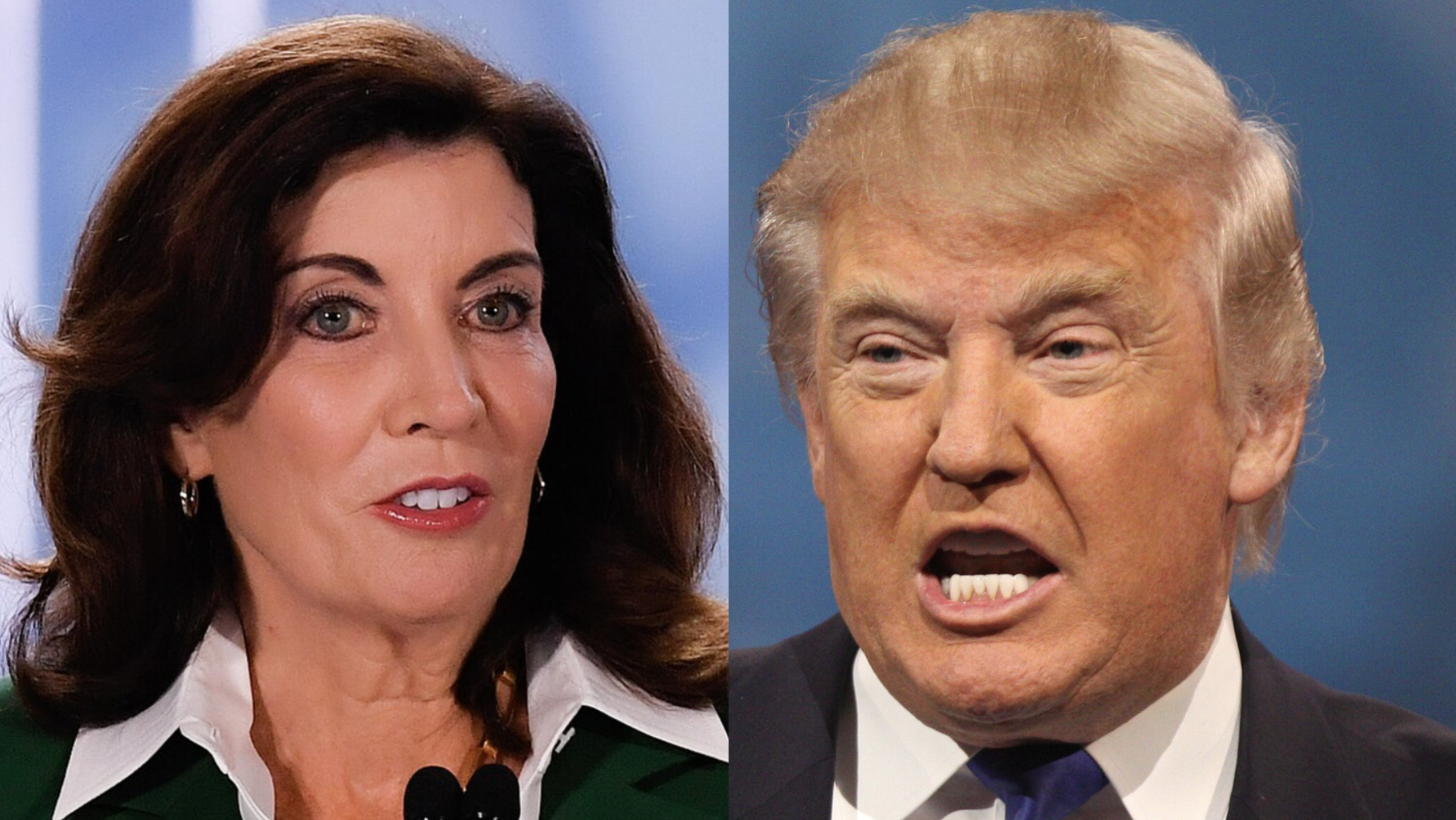
New York Governor Kathy Hochul said Tuesday she was “heartened” by the Supreme Court’s decision rejecting what she called the Trump administration’s “cruel attack” on birthright citizenship, invoking her own family’s immigrant history as the nation’s high court struck down President Donald Trump’s executive order seeking to strip automatic citizenship from children born in the United States to undocumented or temporarily present parents.
The Supreme Court ruled 6 to 3 on Tuesday to block Trump’s order, with Chief Justice John G. Roberts Jr. writing for the majority that children born in the United States, regardless of their parents’ immigration status, are citizens at birth under the Fourteenth Amendment’s Citizenship Clause. “Citizenship, then and now, was the right to have rights — to freely participate in our political community,” Roberts wrote, adding that the framers of the amendment “extended that promise to ‘every free-born person in this land.'”
Hochul reacted to the ruling Tuesday morning on X, framing the decision through the lens of her own family history. “As the granddaughter of Irish immigrants, I am heartened to see the Supreme Court’s decision rejecting the Trump administration’s cruel attack on birthright citizenship,” Hochul wrote at 9:47 a.m. “For generations, immigrants have come to New York in search of freedom and opportunity, helping build the strongest, most vibrant state in the nation. The Statue of Liberty stands proudly in our harbor, and New York will always stand with those seeking the promise of America.”
Tuesday’s statement was consistent with a position Hochul has held since the earliest days of Trump’s second term. On Jan. 20, 2025, the day Trump signed the executive order titled “Protecting the Meaning and Value of American Citizenship,” Hochul’s office issued a statement declaring that “Birthright citizenship isn’t just enshrined in our constitution — it’s key to the fundamental promise of America,” and pledging that “New York is prepared to take any action within our power to ensure that those born in our state have all the rights and protections that prior generations of new Americans have been granted.”
In the days that followed, Hochul elaborated on her opposition in television interviews, telling CBS6 in Albany that the executive order represented an attempt “to really deconstruct the United States Constitution,” and arguing that litigation would be New York’s “first defense” against the policy. She added at the time that taking away citizenship from people who had lived their entire lives in the United States “is not along with New York values.”
New York joined a multistate legal challenge to the order shortly after it was signed, with Attorney General Letitia James leading the effort. Hochul publicly backed that litigation on X in early 2025, writing that her office and a coalition of states were “suing to immediately stop President Trump’s dangerous and unconstitutional order trying to end birthright citizenship,” and pledging to “protect the integrity of our Constitution, its fundamental rights, and the promise of the American dream.”
The order never took effect. It was blocked by a series of federal court injunctions beginning in February 2025, when a judge in New Hampshire issued the first preliminary injunction in litigation brought by the ACLU and its partners. Additional injunctions followed in Washington, Maryland and Massachusetts, while separate lawsuits were filed in California, New York and the District of Columbia. The case that ultimately reached the Supreme Court, Trump v. Barbara, stemmed from a nationwide class-action lawsuit filed after the Supreme Court’s June 2025 ruling in a related case, Trump v. CASA, Inc., which limited the use of so-called universal injunctions but left it to lower courts to determine whether broad relief was still justified specifically in the birthright citizenship cases.
Hochul has not been alone among New York Democrats in tying the citizenship fight to the state’s identity as a historic gateway for immigration. Her Tuesday statement’s reference to the Statue of Liberty echoed remarks she made after the Supreme Court’s narrower June 2025 ruling on universal injunctions, when she said the decision made it “easier for Donald Trump to impose unconstitutional, dangerous and un-American policies,” while maintaining that “birthright citizenship is a constitutional right, and nothing in today’s decision changes that.” At the time, she added that “Immigrants and their families are the backbone of our communities and a vital part of New York’s identity,” and vowed to “continue to use every tool at my disposal to protect them from the cruelty coming out of Washington” — language she returned to again in Tuesday’s statement.
The Supreme Court’s Tuesday ruling drew on more than a century of precedent, citing the 1898 case United States v. Wong Kim Ark, in which the court held that a man born in San Francisco to Chinese immigrant parents who had not naturalized was nonetheless a U.S. citizen. Trump had argued that the Fourteenth Amendment’s citizenship guarantee was intended only for children of formerly enslaved people and was never “meant for the entire world to occupy the United States,” a position Roberts rejected in his opinion, writing that the administration’s reading of the amendment was a “dramatically revisionist view” with “scant evidence” to support it.
Trump attended oral arguments in the case in person in April, the first time a sitting president had done so, and wrote afterward on Truth Social that the United States was “the only Country in the World STUPID enough to allow ‘Birthright’ Citizenship.” The ruling, finalized 6 to 3 on Tuesday, with Roberts joined by Justices Sonia Sotomayor, Elena Kagan, Ketanji Brown Jackson, Amy Coney Barrett and Brett Kavanaugh, closes out a legal battle that began on Trump’s first day back in office and has run for roughly a year and a half.
For Hochul, the ruling validates a position she staked out from the outset of the administration, even as she has at times sought to avoid direct confrontation with Trump on issues tied to federal funding for New York. Tuesday’s statement, paired with her past comments invoking the Statue of Liberty and her own immigrant ancestry, signals that birthright citizenship remains one area where the governor has been willing to draw a clear public line against the administration’s immigration agenda.