
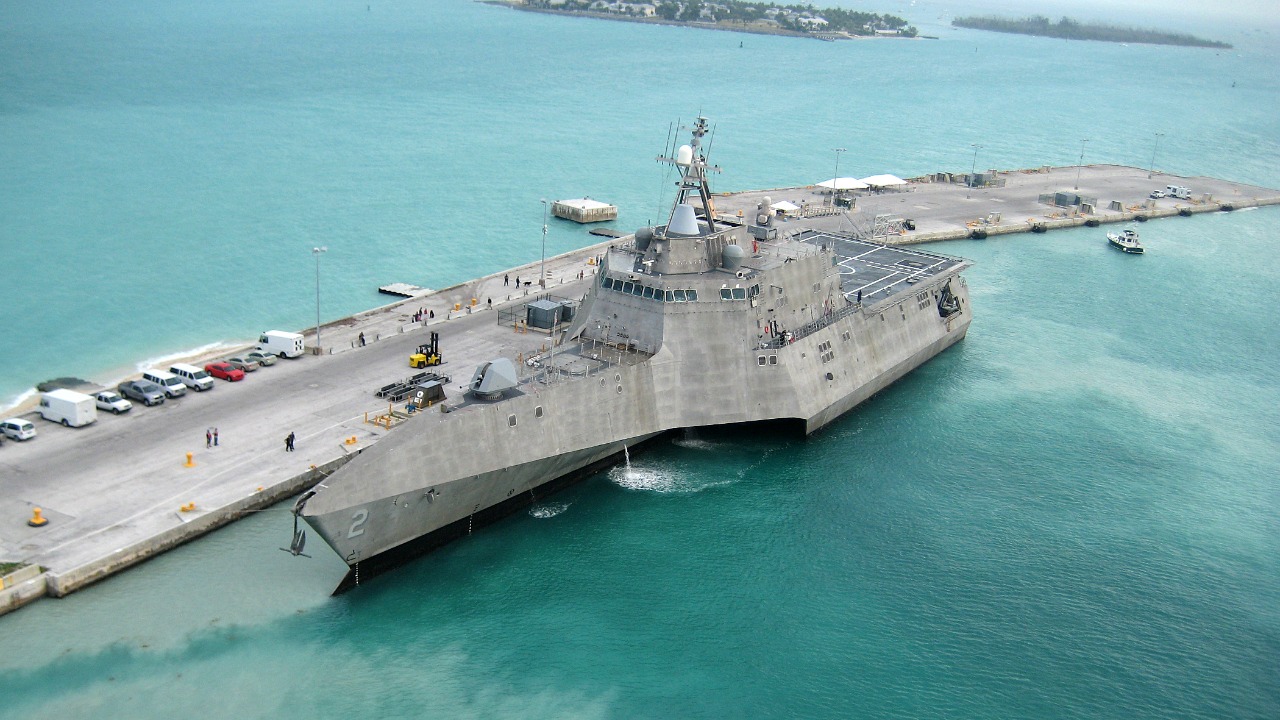
The U.S. Navy’s Littoral Combat Ship experiment produced two very different answers to the same question: how to fight fast and close to shore. The Freedom and Independence variants diverged in hull form, materials, and mission approach, and over time the Navy reshaped both designs and their roles in response to hard operational lessons. Understanding what changed, and why, explains how a bold dual-variant gamble turned into a tightly constrained niche fleet.
Both versions of the LCS were conceived as fast, agile, mission-focused warships for near-shore operations, but the Navy’s evolving view of survivability, logistics, and mission packages steadily pushed them away from interchangeable modularity and toward specialized, permanently configured ships. The story of Freedom versus Independence is less a head-to-head contest than a case study in how design choices ripple through maintenance, manning, and strategy.
From one littoral vision to two competing hulls
The starting point for both variants was a single operational idea: a Littoral Combat Ship that could sprint into coastal waters, hunt mines and submarines, and counter small surface threats with a small crew and modular payloads. Official descriptions present The Littoral Combat Ship as a fast, agile, mission-focused warship designed to operate in near-shore environments while still integrating with larger surface forces, a role that demanded high speed and shallow draft more than heavy armor or large crews. Within that broad concept, the Navy chose to buy two distinct seaframe designs rather than commit early to a single winner.
The Navy’s test and evaluation reporting describes how it pursued both the USS Freedom (LCS 1) class and the Independence class in parallel, with The Navy buying a semi-planing monohull constructed of steel and aluminum for Freedom and an aluminum trimaran design for Independence. Planning and construction decisions meant the first ships of both LCS classes were delivered before the designs were mature so that improvements could be built into future hulls, a deliberate choice to learn at sea rather than in the lab. That dual-source strategy was meant to maintain competition and mitigate technical risk, but it also locked in two separate logistics chains and two very different engineering baselines inside a single LCS label.
Freedom: fast monohull, complex mechanics
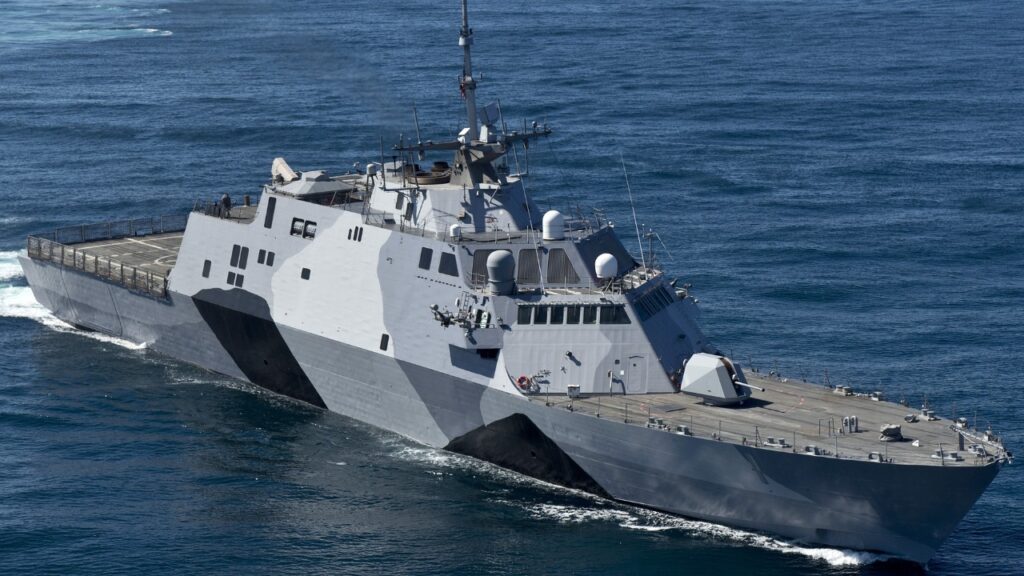
The Freedom variant leaned into a more conventional warship silhouette, but with commercial high-speed DNA. Reporting on the builders notes that Freedom’s 378-foot hull is a hybrid derivative of two Fincantieri commercial ferries, including the high-speed Jupiter class, which had already demonstrated extreme sprint performance. That heritage supported the LCS requirement for very high speed in a relatively compact hull, and the Navy’s own fact files describe LCS as a fast and agile platform, but the choice to adapt commercial concepts into a semi-planing steel monohull with an aluminum superstructure introduced integration and durability challenges once the ships entered service.
As the program matured, the Freedom design became associated with propulsion and reliability problems that undercut its promise as a low-maintenance coastal workhorse. Analysis of the program notes that with the twin designs in a single LCS class, the Navy created the monohull Freedom variant alongside the trimaran Independence, and later had to address enduring propulsion issues that required a fix to secure effectively unlimited LCS propulsion parts. Other assessments of the LCS program describe how the first examples of the LCS taught the Navy about basic hull form and corrosion behavior, including early Freedom-class ships that suffered from unexpected interactions with their piers. Those experiences, combined with the complexity of the combined diesel and gas turbine machinery, helped drive the Navy’s decision to cap Freedom procurement at 10 hulls and rethink how these ships would be used.
Independence: aluminum trimaran and big-deck ambitions
The Independence variant took a radically different path, trading the monohull for a wide aluminum trimaran optimized for stability and aviation capacity. The Navy’s test documentation describes the Independence class as an aluminum trimaran design, and separate program information highlights The Independence Variant as delivering combat capability from core self-defense systems while supporting rapidly interchangeable mission modules and aviation assets. The trimaran form gave Independence a very wide beam and a large flight deck, which became one of its defining advantages, allowing the ship to hold two MH-60 helicopters and support extensive unmanned aviation and mine countermeasures gear.
That unconventional hull did not emerge from a blank sheet of paper. Military history sources trace the Independence hull design back to a project at Austal to design a high speed, 40-knot, 74 km, 46 m cruise ship, a commercial lineage similar in spirit to Freedom’s ferry roots but realized in aluminum and with three hulls instead of one. Over time, however, operational feedback highlighted design shortcomings alongside the benefits. The lack of bridge wings on Independence was identified as a top problem in the entire LCS program, and structural issues such as hull cracking and corrosion became recurring themes in outside reporting on the Independence class. These realities forced the Navy to weigh the advantages of a huge flight deck and stable trimaran against the maintenance burden of an all-aluminum combatant operating at high speed in demanding sea states.
Mission modules abandoned, specialization takes over
The most consequential shift in the LCS story did not start in the engine room or the hull, but in the mission concept. The original idea was that LCS seaframes would carry rapidly interchangeable mission packages for surface warfare, anti-submarine warfare, and mine countermeasures, allowing a single hull to swap roles in a matter of days. Official descriptions of LCS still emphasize mission-focused design and modularity, and program information for The Independence Variant highlights rapidly interchangeable mission modules as a core feature. In practice, however, the mission packages proved difficult to field on schedule and hard to integrate with the ships’ limited space, power, and crew size.
As development dragged and operational demands sharpened, the Navy moved away from the vision of frequent role swapping and toward permanent specialization. Reporting on the Independence class notes that each ship is now set to get a single mission package installed permanently, with most packages still not fully available. Broader analysis of the LCS program explains that the Navy shifted to permanently assigning specific missions to different ships, with the Independence variant primarily dedicated to Mine Countermeasures and the Freedom variant focused on Surface Warfare. Discussions among naval observers echo that reality, pointing out that for the SUW mission module, the only fully mature package consists of two 30 mm cannons, a 24 cell VLS for short-range missiles, and associated systems, a modest loadout that underscores how far the program moved from its early promises of plug-and-play lethality.
Logistics strain, early retirements, and a truncated future
Running two distinct designs under one class label created a logistics and sustainment burden that eventually outweighed the benefits of competition. The Navy’s own LCS class overview notes that the LCS class consists of two variants, the Freedom variant and Independence variant, designed and built by two industry teams, and that LCS can deploy alone or with other ships for undersea and surface warfare missions. That duality meant separate training pipelines, different spare parts inventories, and parallel maintenance expertise for a relatively small number of ships. Program analyses describe how the twin designs in a single LCS class complicated the supply chain and forced the Navy to secure unlimited LCS propulsion parts to keep the fleet viable, a sign of how sustainment concerns were driving strategic decisions.
The operational and logistical headaches fed directly into force structure choices. Commentary on the program notes that the USS Freedom (LCS-1) and Independence (LCS-2), the lead ships of the two LCS variants, were both decommissioned early, a stark indicator of how quickly the Navy was willing to write off the first hulls once their value as test platforms was exhausted. More recent reporting on procurement states that the Navy only wants 10 Freedom-class hulls, a sharp reduction from earlier ambitions for a much larger LCS fleet. At the same time, broader assessments of whether LCS was a mistake point out that the first examples of the LCS taught the Navy about hull form and corrosion, but also reinforced the sense that the dual-variant approach had created more complexity than capability. Those lessons are now shaping the pivot toward the Constellation-class frigate as the Navy’s preferred small surface combatant.
What the LCS experiment changed in naval design thinking
Despite the criticism, the LCS program did not stand still. Both Freedom and Independence variants have been slated for lethality upgrades, including the addition of weapons such as the Naval Strike Missile, to address long-standing complaints that they were under-armed for contested environments. Official LCS fact files emphasize that the class delivers combat capability from core self-defense systems, and later program updates describe efforts to increase firepower and refine mission systems. External analyses, including video explainers from outlets like Military TV, frame these changes as part of a broader attempt to salvage combat value from a fleet that struggled to match its original hype.
The deeper impact of the Freedom versus Independence experience lies in how it reshaped the Navy’s appetite for risk in ship design. The decision to field two immature designs in parallel, to rely heavily on commercial high-speed hull concepts from Fincantieri and Austal, and to bet on modular mission packages all at once created a dense cluster of technical and operational uncertainties. Subsequent reporting on LCS and the Navy’s future plans makes clear that the service is now favoring more evolutionary designs, such as the Constellation-class frigate, that build on proven hull forms and integrated combat systems rather than radical modularity. The LCS experiment showed that speed, shallow draft, and flexibility are valuable, but also that they cannot compensate for fragmented logistics, immature mission systems, and structural vulnerabilities. In that sense, the changes forced on both Freedom and Independence have already been banked into the design DNA of the ships that will follow them.