
It’s hard to think of a tougher first day on the job than Abraham Lincoln’s. By the time he arrived in Washington in March 1861, the country was already splitting at the seams, several Southern states had announced they were leaving the Union, and whispers of assassination followed him like bad weather. In modern terms, it was like being elected CEO while the building is on fire and half the board has quit.
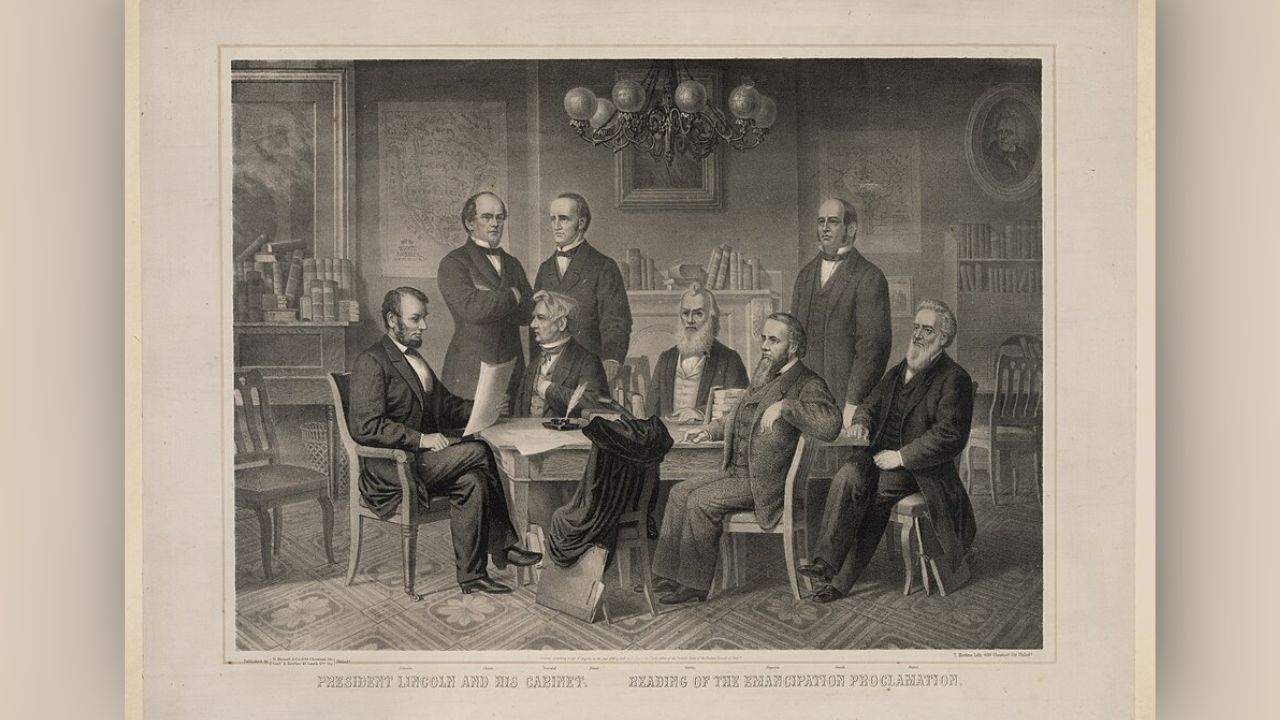
Lincoln didn’t inherit a normal political headache. He stepped into a full-blown national emergency where every decision could tip the United States toward survival or collapse. And he had to make those calls in public, with newspapers roaring, politicians scheming, and families watching sons march off to war. Pictured above President Lincoln and his cabinet and the reading of the emancipation proclamation.
A nation coming apart before he even unpacked
Before Lincoln ever took the oath, seven states had already seceded and formed the Confederate States of America. That meant the “United” part of the United States was suddenly up for debate, and not in an academic way. Federal forts and property in the South were being seized, and the new Confederate government was daring Washington to respond.
Lincoln’s election in 1860 had triggered the break, but the causes ran far deeper—especially slavery and the political power built around it. The country had been arguing over slavery for decades, making compromise after compromise, like patching a leaking roof with tape. By 1861, the storm finally tore it open.
The Fort Sumter problem: surrender, resupply, or start a war
One of the first major tests was Fort Sumter, a U.S. military fort in Charleston Harbor. It was surrounded, running low on supplies, and basically functioning as a countdown clock. If Lincoln abandoned it, he risked signaling that secession worked; if he reinforced it, he could be seen as provoking bloodshed.
He chose to send supplies, framing it as a humanitarian move rather than a military escalation. The Confederacy answered with cannon fire in April 1861, and the Civil War began. Lincoln didn’t “start” the conflict in a simple sense, but he also didn’t sidestep it—and history suggests there wasn’t a clean sidestep available.
Raising an army while keeping the country democratic
Once the shooting started, Lincoln had to build a war effort fast. The United States had a small standing army, and suddenly it needed hundreds of thousands of soldiers, mountains of equipment, and a strategy that could actually work. At the same time, elections still had to happen, courts still had to function, and Congress still had to argue (loudly, as usual).
That balancing act—waging total war while trying to preserve a free society—is part of why Lincoln’s crisis looks so enormous even today. In other countries, leaders in wartime often clamp down and call it a day. Lincoln did expand federal power dramatically, and he took controversial steps, but the basic machinery of democracy kept turning.
He had to manage a “team of rivals” that didn’t always want him to succeed
Lincoln’s Cabinet was famously packed with strong personalities, including several men who’d competed against him for the Republican nomination. It’s a little like hiring your loudest critics and then asking them to help you run the show. Sometimes it worked brilliantly; sometimes it produced drama that would’ve fed cable news for years.
Lincoln’s strength wasn’t that he avoided conflict—he didn’t. It was that he could absorb it, learn from it, and keep people pointed (more or less) in the same direction. He listened carefully, told stories to make a point, and had a knack for seeing the long game when everyone else was stuck on the next headline.
The war wasn’t going well, and the casualty numbers were staggering
The early years were brutal. Union armies suffered embarrassing defeats, and even victories came at horrifying cost. Battles like Antietam and Shiloh left the nation stunned, not just by the scale of death but by the grim realization that this wouldn’t be quick.
Lincoln carried those losses personally. He visited hospitals, read letters from grieving families, and spent long nights pacing the White House. It’s easy to talk about strategy and politics, but the human toll was always right there—thousands of fresh graves, and a president expected to keep everyone’s hope alive anyway.
Slavery turned the war into something bigger—and riskier
Lincoln ran for president promising to stop slavery’s expansion, not immediately abolish it everywhere. But the war changed the math. Enslaved people fled to Union lines, the Confederacy relied on slave labor, and it became clearer that ending slavery wasn’t just a moral question—it was tied to winning.
The Emancipation Proclamation, issued after Antietam and effective in 1863, declared freedom for enslaved people in areas under Confederate control. Critics pointed out its limits, and they weren’t wrong. Still, it fundamentally shifted the war’s purpose and made emancipation a Union war aim, which also reduced the chance of European powers siding with the Confederacy.
It also demanded political courage. Not everyone in the North supported emancipation, and Lincoln knew it could cost him votes, weaken support for the war, or spark backlash. He did it anyway, betting that the country couldn’t be put back together on the same broken foundation.
Rights, security, and the kind of choices nobody wants to make
Lincoln’s presidency raised hard questions about civil liberties during wartime. He authorized actions like the suspension of habeas corpus in certain circumstances, aiming to limit sabotage and rebellion, especially in border states. Supporters argued it was necessary; opponents called it unconstitutional overreach.
The uncomfortable truth is that crises don’t politely arrive with perfect options. Lincoln was trying to keep the Union alive while facing internal threats, political violence, and outright rebellion. Whether every move was justified is still debated, but the pressure cooker he operated in is hard to overstate.
Even winning wasn’t the end of the crisis
By 1864, Lincoln faced reelection with the war dragging on and public morale fraying. For a while, it looked like he might lose. Then military successes, especially in Atlanta, helped turn the tide, and Lincoln won—effectively securing continued Union war policy and the push toward ending slavery.
In early 1865, with the Confederacy collapsing, Lincoln pressed for the 13th Amendment to abolish slavery nationwide. Unlike the Emancipation Proclamation, this was permanent law, not a wartime measure. Getting it through Congress required intense persuasion, political deal-making, and timing that had to be just right.
And then, just as the war ended, the country faced the massive challenge of Reconstruction—how to rebuild the South, protect newly freed people, and prevent the conflict from simply reshaping itself. Lincoln had plans, but he never got to carry them out. He was assassinated in April 1865, days after Confederate General Robert E. Lee’s surrender at Appomattox.
Why Lincoln’s crisis still feels unmatched
Plenty of presidents have faced emergencies—economic collapse, world wars, terror attacks, pandemics. Lincoln’s crisis was different in one key way: the country itself was breaking into pieces, and the basic idea of a United States was on trial. He wasn’t just trying to fix a problem; he was trying to keep the whole experiment from ending.
What makes Lincoln so compelling isn’t that he had superhuman certainty. He had doubts, made mistakes, and adjusted course repeatedly. But in the middle of the worst national fracture imaginable, he managed to hold together a democracy, guide a vast war effort, and push the nation toward abolishing slavery—while knowing that any misstep could bring it all down.