
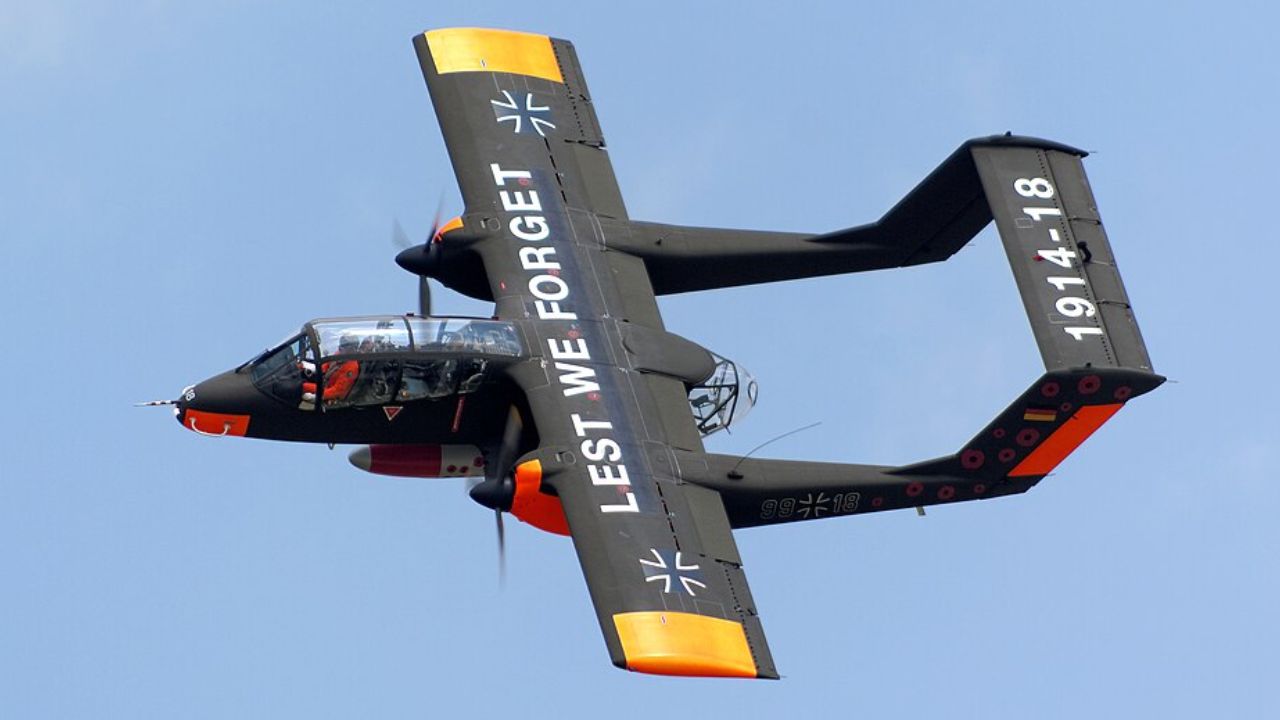
If you hang around pilots, maintainers, or aviation nerds long enough, the OV-10 Bronco will eventually come up. Not as a “remember that weird plane?” footnote, but as a genuinely beloved tool that did exactly what it was built to do. Decades after its debut, the Bronco still gets talked about with the kind of fond respect usually reserved for a trusty pickup truck that never quits.
The surprise isn’t that it looks cool—though it definitely does, with its twin booms and stubby wings. The surprise is how modern its core idea still feels: a rugged, straightforward aircraft designed for messy, real-world missions where practicality matters more than glamour. In an era obsessed with speed and stealth, the Bronco’s lasting reputation is basically a reminder that “useful” never goes out of style.
Born for the in-between missions
The OV-10 Bronco came out of a very specific need in the 1960s: a light aircraft that could observe, coordinate, and support troops on the ground without requiring a runway fit for an airliner. It wasn’t meant to be a fighter and it wasn’t meant to be a slow, defenseless spotter either. It lived in the middle—close air support, forward air control, reconnaissance, light transport, and even psychological operations depending on the configuration.
That “in-between” job is harder than it sounds. You need visibility, endurance, radios that actually reach the right people, and an airframe that can take a beating from dust, heat, and rough handling. The Bronco’s design leaned into that reality instead of pretending the battlefield was a clean laboratory.
A design that looks odd because it’s honest
The Bronco’s twin-boom layout and high wing weren’t styling choices, they were problem-solving choices. The cockpit sat high with excellent visibility, which is exactly what you want when your job is finding things on the ground and talking other aircraft onto targets. The twin engines added redundancy, and the wide, stable stance helped when operating from short or unimproved strips.
Then there’s the cargo area behind the cockpit—a detail that always catches people off guard. The Bronco could carry small loads, gear, or a few passengers in a pinch, which made it a flexible little workhorse. No one would confuse it with a transport plane, but on a bad day, “it fits and it flies” is a pretty great feature.
Short-field chops and rugged day-to-day usability
Ask anyone why the Bronco is still admired and you’ll hear some variation of “it could operate from just about anywhere.” It was built with short takeoff and landing performance in mind, which meant it could get closer to the action and spend more time doing the job instead of commuting from distant runways. That kind of access is invaluable when time matters and infrastructure doesn’t cooperate.
It also had a reputation for being maintainable in the field, not just in a spotless hangar. Practical systems, accessible components, and a design that tolerated rough conditions helped keep it flying. For crews, that translated into something wonderfully simple: fewer drama-filled surprises.
Why pilots loved it: visibility, stability, and “good manners”
The Bronco had what pilots often call good manners. It was stable at low speeds, predictable to fly, and well-suited for long loiter times—exactly what you want when you’re orbiting an area, watching for movement, and coordinating with people who don’t have the luxury of pausing the situation. It didn’t need to be the fastest aircraft; it needed to be the most useful aircraft in that slice of the mission.
That big-picture usefulness shows up in the cockpit layout too. The aircraft was built around the idea that crews would be working—navigating, spotting, talking, coordinating—not just flying from point A to point B. When an airplane makes the work easier rather than harder, people tend to remember.
Real-world service that cemented its reputation
The Bronco is often associated with the Vietnam era, where it served in roles like forward air control and observation. It could mark targets, coordinate strikes, and keep eyes on situations that changed quickly. In that environment, responsiveness and persistence were worth their weight in gold.
Its career didn’t end there. Broncos flew in various countries and agencies over the years, showing up in different paint schemes and with different equipment packages depending on the mission. That long service life isn’t an accident; it’s usually a sign that the basic design was solid and the aircraft filled a niche that never fully disappeared.
The Bronco’s second life: firefighting, monitoring, and niche operations
One reason the OV-10 keeps popping back into conversations is that its strengths translate well outside traditional combat roles. In aerial firefighting support, for example, the need to loiter, observe, and direct other aircraft is very similar to classic coordination missions. A platform that can fly slowly, see well, and stay on station can be incredibly valuable when crews are juggling smoke, terrain, and rapidly shifting conditions.
It’s also been used for monitoring and other specialized tasks where endurance and visibility beat raw speed. In a world full of highly optimized aircraft, the Bronco is refreshingly adaptable. It’s the aviation version of a multitool: not the best at everything, but surprisingly good at the things that matter most.
So why does it still feel relevant today?
Modern air forces and agencies have drones, advanced sensors, and precision everything, so it’s fair to ask why an older, manned turboprop still inspires admiration. The answer is that technology doesn’t erase the need for persistence, communication, and judgement in complex environments. Sometimes you need a crew in the loop, looking out the window, interpreting what they see, and talking directly to the people who need help.
And sometimes you just need an aircraft that can show up, do the job, and not make a big deal about it. The Bronco’s practicality—short-field performance, visibility, adaptability, and a design that values real-world usability—has aged remarkably well. It may not be flashy, but it’s the kind of airplane that makes you think: maybe “boring and effective” is actually the highest compliment.
A classic that earns its nostalgia
Plenty of aircraft are remembered because they were fast, beautiful, or historically famous. The OV-10 Bronco is remembered because it was handy. That’s a different kind of legacy, and honestly, it’s the kind that tends to last.
Even now, when someone spots a Bronco at an airshow or in an old photo, the reaction is rarely indifferent. People grin, ask questions, and trade stories about what it could do and why it worked so well. Practicality might not sound romantic, but the Bronco proves it can be downright lovable.