
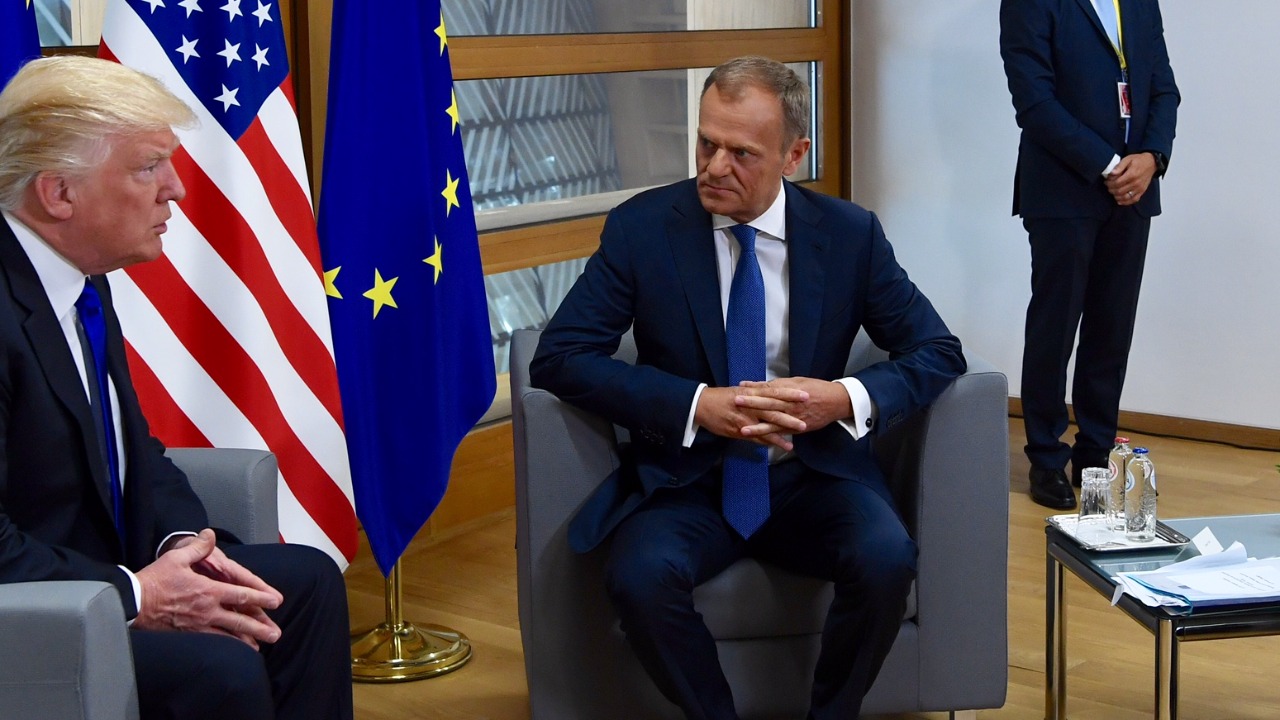
The latest clash over Greenland is no longer a quirky sideshow in transatlantic politics. It has become a stress test for NATO, for European unity, and for how far President Donald Trump is prepared to push United States power in the Arctic. When Poland’s prime minister warns that a military move on the island would mean “the end of the world as we know it,” he is not indulging in hyperbole so much as sounding an alarm about the collapse of a security order that has held for three quarters of a century.
At stake is more than a frozen territory on the map. Greenland sits at the intersection of climate change, great power rivalry, and alliance credibility, and the way Washington handles its renewed obsession will shape how partners in Europe, including Poland, judge the reliability of American leadership. I see Donald Tusk’s stark language as a deliberate attempt to force that reckoning into the open.
The Polish warning that jolted NATO
When Polish Prime Minister Donald Tusk declared that a United States invasion of Greenland would be “the end of the world as we know it,” he was putting a precise name to a fear that has been simmering inside NATO capitals. He framed such a move as a direct assault on the postwar order that has relied on NATO solidarity to “hold back the evil forces,” a phrase that underscored how he sees the alliance as a moral as well as strategic project. In his view, a unilateral land grab by Washington would not just be another dispute among allies, it would be a rupture that calls into question the entire premise of collective defense, a point he drove home in warnings to the wider NATO alliance.
Tusk’s language was sharpened by his refusal to entertain any Polish military role in Greenland. He ruled out sending troops and stressed that Poland would not participate in an operation that he believes would shatter the 75 year partnership between Europe and the United States. In doing so, he placed Warsaw on the side of restraint, even as he acknowledged that some in the alliance might be tempted to follow Washington’s lead. His comments, reported in detail in Defence coverage and echoed in Polish political debate, were aimed as much at his fellow Europeans as at Washington, a reminder that alliance loyalty has limits when core principles are at stake.
Trump’s Greenland fixation moves from rhetoric to policy
President Donald Trump’s fascination with Greenland is not new, but it has now migrated from offhand remarks to concrete political moves. Earlier this year, he again spoke of the island as a strategic prize that the United States has “long coveted,” language that signaled he sees it less as a partner territory and more as an asset to be acquired. That rhetoric has been matched by legislative action in Washington, where Congressman Fine of Florida’s 6th district introduced the Greenland Annexation and, a proposal that treats the island as a candidate for full incorporation into the United States, justified in part by the perceived threat posed by China and Russia in the Arctic.
That shift from talk to draft law has alarmed European leaders who had once dismissed Trump’s Greenland comments as a passing curiosity. A high stakes meeting at the White House with Denmark, which is responsible for Greenland’s foreign and security policy, laid bare the gap between Washington’s ambitions and Copenhagen’s red lines. Danish officials described any attempt to change Greenland’s status without their consent as “totally unacceptable,” a phrase that captured the depth of their opposition and was widely noted in reporting on the White House talks. I read that clash as a sign that what began as a provocative idea has hardened into a policy trajectory that could bring the United States into direct confrontation with a close ally.
Why Greenland matters far beyond the Arctic Circle
To understand why this dispute has become so charged, it helps to recall what is at stake in Greenland itself. The island is the world’s largest non continental landmass, rich in minerals and sitting astride key North Atlantic and Arctic sea lanes that are opening as the ice melts. For Washington, Moscow, and Beijing, control over or access to Greenland is a way to project power into the High North, monitor missile routes, and secure future shipping corridors. That is why the United States already maintains the Thule Air Base there and why any talk of annexation is heard in European capitals as a signal that Washington wants to lock in dominance over a rapidly changing region.
For Denmark and the European Union, Greenland is also a test of whether smaller territories can exercise meaningful autonomy in the shadow of great powers. Greenlandic leaders in Nuuk have pushed for greater self rule and control over natural resources, while still relying on Danish support and NATO security guarantees. A forced change in status, or even the perception that Washington is trying to strong arm Copenhagen and Nuuk, would reverberate through debates about sovereignty from the Baltics to the Balkans. That is one reason Polish Prime Minister Donald Tusk has linked Greenland to broader “global security challenges,” warning that Europe faces decline if it cannot respond collectively to such pressures, a message he has repeated in appeals that Donald Tusk Warns must act “one for all” or accept that it is “finished.”
Poland’s strategic calculus and the “one for all” doctrine
Poland’s position in this drama is more complex than a simple refusal to send troops. As a frontline NATO state bordering Russia’s sphere of influence, Poland has long argued for a strong American presence in Europe and has invested heavily in defense. Yet Tusk has now drawn a clear line, stating that Poland will not dispatch soldiers to Greenland and that it will not endorse an operation that he believes would undermine the very alliance that protects his country. In a social media message, he stressed that Polish Prime Minister speaks for Poland when he says that any attempt by the United States to take Greenland by force would cross a line that Warsaw cannot accept.
At the same time, Tusk has used the Greenland dispute to press a broader argument about European responsibility. He has warned that Europe must unite or it is “finished,” urging Poland and its neighbors to treat Trump’s appetite for Greenland as a wake up call rather than a passing controversy. In his telling, the choice is stark. Either Europe stands “one for all, and all for one,” or it drifts into irrelevance as Washington, Moscow, and Beijing carve up strategic spaces from the Arctic to the Indo Pacific. That message, captured in detailed accounts of how Europe must respond to Trump’s Greenland focus, reflects a Polish leader who is trying to reconcile his country’s reliance on American power with a growing conviction that Europe needs its own strategic voice.
A 75 year alliance at a crossroads
What makes Tusk’s warning so potent is that it speaks directly to the fragility of a 75 year alliance that has weathered crises from Suez to Iraq. He has cautioned that a United States move to annex Greenland could “shatter the 75 year alliance,” language that underscores how he sees this episode not as an isolated dispute but as a potential breaking point. In his conversations with President Donald Trump, the Polish leader has described such a scenario as a “disaster” for transatlantic relations, a word that captures both the strategic and symbolic damage he believes would follow if Washington treated an allied territory as a prize to be seized. That concern has been widely reported as a pivotal European warning to the American president.