
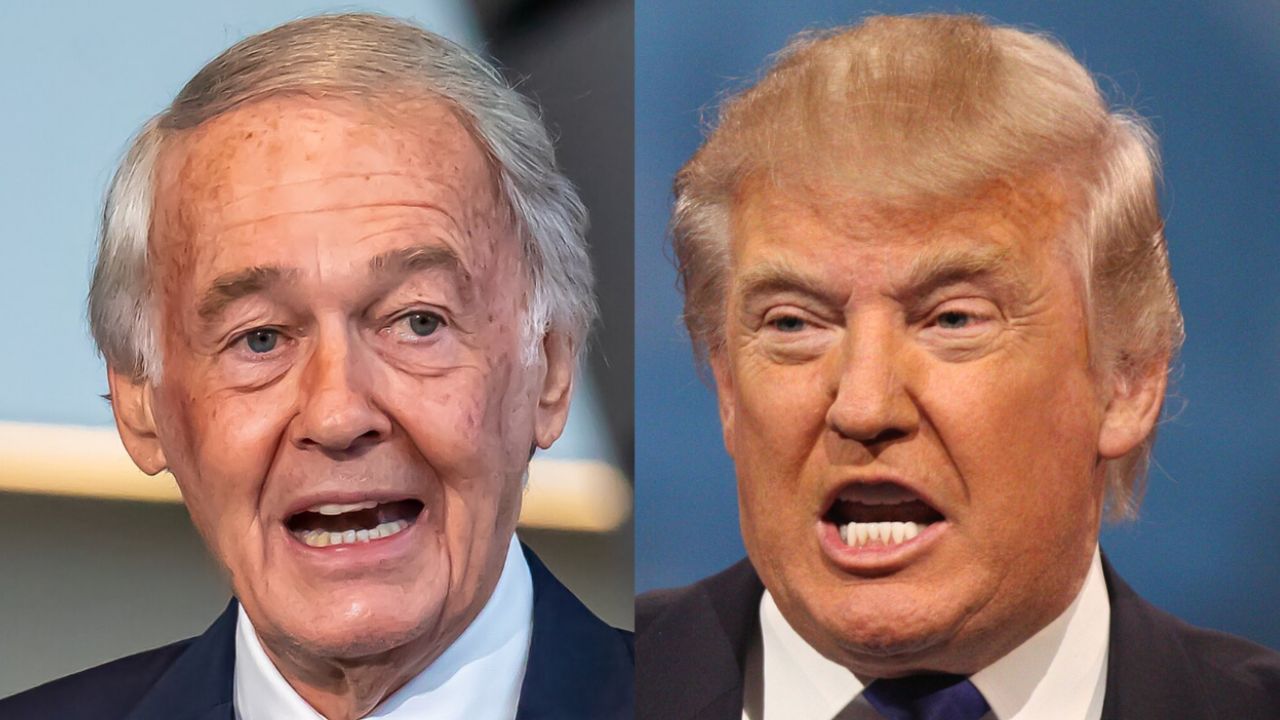
Senator Edward J. Markey (D-Mass.) escalated his campaign against the Trump administration’s ongoing war with Iran on Tuesday, seizing on a new nonpartisan budget analysis to declare that the true cost of the six-month conflict has soared past $145 billion once higher fuel prices paid by American families are factored in. The Massachusetts Democrat’s statement, posted to X at 6:05 p.m. on September 15, 2026, came hours after the Congressional Budget Office released its own independent estimate putting the direct cost to the Pentagon at more than $38 billion.
Markey’s post read, in full:
“After six months of an illegal and unnecessary war with Iran, Trump’s war machine has spent more than $38 Billion. If we include increased fuel costs to Americans, the cost is more than $145 Billion and growing. American families don’t need to pay for this disaster. Enough. End the war now.”
The senator was responding directly to reporting published earlier that day by The New York Times, which detailed the findings of a 19-page Congressional Budget Office analysis requested by top Democrats on the House and Senate budget committees. According to the Times, the CBO said the war had cost the United States roughly $38 billion through August 1, and it projected the conflict would continue to run up bills of $2 billion to $3 billion per month for as long as fighting continues.
The budget office’s report noted that its work had been complicated by the Pentagon’s silence. The CBO said its assessment “reflects the costs of replacing expended munitions and equipment lost in battle, increased flying hours, other operations and increased fuel costs,” but cautioned that its estimates were “subject to considerable uncertainty” because the Defense Department did not respond to requests for information — a break from the normal practice of federal agencies cooperating with the nonpartisan scorekeeper.
Beyond the direct budgetary toll, the CBO’s analysts found that the war has already worked its way into the broader economy. The agency said more than 40 percent of the rise in inflation for personal consumption expenditures in the second quarter of 2026 was attributable to higher energy costs tied to the conflict, driven by supply disruptions in the Strait of Hormuz and the Red Sea. Looking ahead, the CBO projected the war would add roughly half a percentage point to inflation in the first quarter of 2027, which analysts said would in turn push up interest rates on Treasury securities.
The report also detailed a significant depletion of U.S. missile defense stockpiles. CBO estimated that the conflict has consumed between one-half and two-thirds of the American inventory of key interceptor systems — including Patriot, Terminal High Altitude Area Defense (THAAD), and Standard Missile-3 and Standard Missile-6 interceptors — since June 2025. Rebuilding those stockpiles, the agency said, could take “at least five years” even with increased production. The CBO warned the shortfall “would become especially problematic if a conflict arose with an opponent whose arsenal included large numbers of ballistic and cruise missiles,” specifically naming China as an example.
Of the $21.7 billion in expended munitions CBO tallied through August 1, interceptors alone accounted for $13.1 billion. The agency also counted $10.4 billion in additional flying-hour costs and $2.7 billion tied to higher fuel prices. Analysts placed the unit cost of a single Patriot or SM-6 interceptor at roughly $4 million, a THAAD interceptor at about $12 million, and the more sophisticated SM-3 at approximately $28 million.
The CBO’s $38 billion figure lands close to the estimate Defense Secretary Pete Hegseth gave under oath during Senate Appropriations Committee testimony in late July, when he told lawmakers the war had cost $37.5 billion to that point. The new analysis was requested by Representative Brendan Boyle of Pennsylvania, the top Democrat on the House Budget Committee, who said in a statement that “this nonpartisan C.B.O. report makes clear that the war has also cost American taxpayers tens of billions of dollars and counting, while continuing to drive up costs.”
The Pentagon pushed back sharply on the report’s implications. Sean Parnell, the department’s chief spokesman, said in a statement that “claims of U.S. munition shortages are false,” adding: “When the fake news media irresponsibly amplifies these lies, the real-world consequence is clear: Our enemies are emboldened to provoke — or attack — American troops. America’s military remains the most powerful fighting force on earth. We have everything required to strike at the time and place of the president’s choosing.”
Markey’s Tuesday statement is the latest in a monthslong pattern of public opposition to the war that dates back to its opening days. In a March 4, 2026 release from his Senate office, issued after a War Powers resolution to end U.S. military action against Iran failed 47-53, Markey said: “Donald Trump is conducting an illegal and reckless war in Iran. Congress has not authorized this war, nor should it, as Trump drags us into a dangerous and unnecessary conflict.” He went on to accuse the president of shifting justifications for the war, saying Trump had first claimed Iran’s nuclear and missile programs posed an “imminent threat” before later saying he “had a feeling” Iran was going to attack — a claim Markey said had no evidence behind it.
Markey returned to the issue later that same month, after a second War Powers resolution led by Senator Chris Murphy also failed, 47-53. In that March 24, 2026 statement, Markey tied the war’s toll directly to household budgets, noting that gasoline prices had risen 35 percent — or about $1 per gallon — since the war began, and that 13 U.S. servicemembers had been killed. “As Trump prepares to send more troops to the Middle East, the costs of Trump’s illegal war will only grow in number and severity, with the cost to human life, the cost to American and Middle East security and stability, and the cost of oil and gasoline. This war is an ever-expanding quagmire with no clear exit that is only making us less safe. We must end this war now,” Markey said.
Markey is far from alone among congressional Democrats in framing the war’s price tag as a political liability for the administration. House Appropriations Committee Ranking Member Rosa DeLauro issued a statement in March after reports surfaced that the Pentagon was seeking as much as $200 billion for the war effort, saying the administration wanted “another $200 billion from American taxpayers to fund the war he chose to start” at a time when “the American people are overwhelmingly opposed to this war.”
The war’s economic fallout has continued to build even as the CBO report was being finalized. Crude oil prices topped $106 a barrel and Brent crude rose above $109 on Tuesday, reportedly after Saudi Arabia canceled shipments following the closure of a major pipeline built to bypass the Strait of Hormuz. Nationally, regular gasoline averaged about $4.33 per gallon, up nearly 18 cents from the previous week and $1.15 higher than a year earlier, according to AAA figures cited alongside the CBO’s release.
The financial reckoning has also collided with the administration’s efforts to secure new war funding on Capitol Hill. The White House has requested as much as $70 billion in emergency military spending to cover the costs of the Iran war and fund new weapons and personnel, but that request has stalled in Congress. Democrats have refused to advance new war funding through the standard bipartisan appropriations process, while Senate Republicans have shown little appetite for a House-led effort to push the money through using the partisan reconciliation process.
Tuesday’s CBO findings arrived one day after a separate Pentagon inspector general report delivered Congress a similar assessment of the war’s direct budgetary impact and its toll on U.S. munitions inventories, according to reporting on the CBO release. The overlapping findings from two independent oversight bodies — arriving within 24 hours of each other — have given Democrats fresh, nonpartisan ammunition as the war approaches its 200-day mark this week, with Democratic lawmakers in both chambers pressing for renewed floor votes on Iran war powers resolutions to mark the milestone.
As of Tuesday evening, neither the White House nor President Trump had issued a direct public response to Markey’s statement or to the broader CBO findings on the war’s cost. The conflict, which began on February 28, 2026, remains without a clear resolution timeline, even as its financial and political costs continue to mount on Capitol Hill.