
If you think being president is stressful now, picture it in 1814, when the Capitol was still a work in progress and the British were marching toward it. James Madison, the soft-spoken “Father of the Constitution,” suddenly found himself in a loud, messy real-world exam: could the young United States actually defend itself? The War of 1812 didn’t just challenge his policies—it challenged the survival of his administration’s credibility.
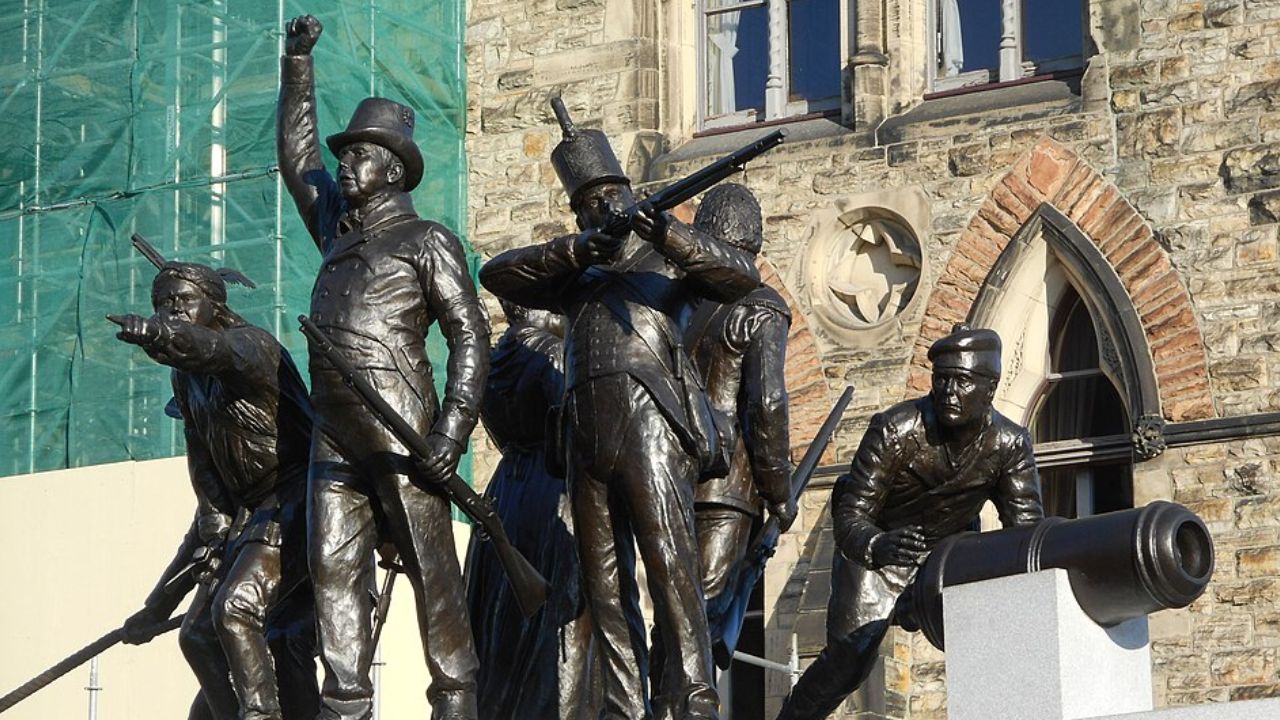
Madison had come into office with a reputation built on ideas and institutions, not battlefield swagger. He was careful, bookish, and more comfortable shaping a system than commanding an emergency. Then the war hit, and the presidency became less about theory and more about triage. Pictured above: War of 1812 monument on Parliament Hill.
A war nobody could ignore—and few agreed on
By the time war was declared in June 1812, many Americans already felt boxed in. Britain’s Royal Navy was stopping U.S. ships, restricting trade, and impressing American sailors—basically forcing them into service, which understandably didn’t go over well. On the frontier, violence involving Native nations, British influence in Canada, and American expansion added more fuel to the fire.
Still, the country wasn’t unified. “War Hawks” in Congress wanted to push back hard and believed Canada might be taken quickly, like a bold gamble that would pay off. But much of New England and other commercial regions saw the war as a threat to trade and livelihoods, and they weren’t shy about saying so.
Madison’s hardest job: leading a divided republic
Madison didn’t have the luxury of national consensus, and that alone would’ve been enough to keep anyone up at night. The Federalist Party, especially strong in parts of the Northeast, opposed the war and criticized Madison relentlessly. Some states dragged their feet on mobilizing militia, and the constant political sniping made coordination feel like herding cats—armed, argumentative cats.
This wasn’t just inconvenient; it was dangerous. War requires speed and unity, and Madison often got delay and dissent. Every setback on the battlefield doubled as political ammunition back home.
An army still figuring itself out
The United States in 1812 wasn’t built for a major war with the world’s most powerful navy. The regular army was small, training was uneven, supplies were inconsistent, and the officer corps included a mix of talented leaders and political appointments. On paper, America had manpower; in practice, it had problems.
Early campaigns were rough. U.S. efforts to invade Canada stumbled, in part because of poor planning and in part because militia forces sometimes refused to cross the border, arguing their duty was defensive. Madison, who valued constitutional limits, found himself facing a brutal irony: the very system designed to prevent tyranny could also slow down decisive action in a crisis.
The White House burns, and the presidency looks suddenly fragile
Then came August 1814, the moment that made the war feel personal in the most humiliating way possible. British forces marched into Washington after the American defeat at Bladensburg, and they set fire to key public buildings, including the Capitol and the President’s House—what we now call the White House. It was shocking, and not just because of the flames; it was the realization that the national capital was vulnerable.
Madison fled the city, and while that was the practical move, it still looked terrible in headlines and in rumor. His wife, Dolley Madison, became a kind of steadying symbol during the chaos, famously helping save important items—including the large portrait of George Washington—before evacuating. If you ever wondered how much “optics” mattered in early America, well, Washington burning answered that pretty clearly.
Trying to run a war with empty pockets
Military disasters are bad, but financial chaos is the kind of thing that can quietly end a government. The U.S. had let the charter of the First Bank of the United States expire in 1811, partly because Madison’s party distrusted centralized financial power. Once war began, the lack of a strong national bank made it harder to borrow money, move funds, and stabilize the currency.
The government leaned on loans and state banks, but it wasn’t smooth. Inflation, shaky credit, and regional financial differences made paying for troops and supplies harder than it needed to be. Madison, who had once resisted a national bank on principle, started to see how ugly war finance could get without one.
Small wins that mattered more than they seemed
Even with the setbacks, the war wasn’t a nonstop disaster. American naval victories early on—like the USS Constitution’s famed successes—boosted morale and proved the U.S. could fight effectively at sea, at least in certain matchups. On the Great Lakes, battles like Oliver Hazard Perry’s victory at Lake Erie helped secure crucial territory and disrupted British plans.
And while the burning of Washington grabbed attention, other American defenses held. Baltimore, for example, resisted a major British attack in September 1814, and the sight of the flag over Fort McHenry inspired “The Star-Spangled Banner.” Those moments didn’t erase the problems, but they gave Americans something essential during a grim stretch: confidence.
The political pressure cooker at home
As the war dragged on, frustration rose. Trade disruptions hit coastal communities, while frontier areas dealt with violence and displacement. Critics accused Madison of incompetence, and supporters accused opponents of disloyalty—an argument that can get ugly fast in any era.
The Hartford Convention in late 1814, where New England Federalists gathered to air grievances, fed fears of disunion. Some talk veered toward radical ideas about state power and even separation, though the gathering’s final proposals focused more on constitutional changes than an outright break. Either way, it underlined the central problem Madison faced: he was trying to win a war while convincing Americans they were still on the same team.
Peace arrives—and changes Madison’s legacy
Peace negotiations in Ghent produced a treaty in December 1814 that essentially restored things to the way they were before the war, at least on paper. No major territory changed hands, and many of the issues that started the conflict—like impressment—weren’t spelled out in a clean, satisfying way. If you judge it like a scoreboard, it can look like a draw.
But timing is everything. News traveled slowly, and the stunning American victory at the Battle of New Orleans in January 1815—fought after the treaty was signed but before it was widely known—reshaped public memory. Suddenly, the war felt like a triumphant defense of national honor rather than a scrambled survival story.
Why this was Madison’s greatest test
Madison’s presidency wasn’t tested by a single scandal or one election-night twist. It was tested by a whole chain of crises: military weakness, bitter partisanship, money trouble, and the jaw-dropping sight of the capital in flames. Through it all, he stayed in office, kept the government functioning, and—eventually—helped steer the nation into peace.
The war also pushed him to evolve. By the end of his presidency, Madison supported creating the Second Bank of the United States and endorsed measures that looked a lot like the stronger national infrastructure he’d once been cautious about. History doesn’t always reward leaders for being right at the start; sometimes it rewards them for surviving the storm and learning what the storm exposed.