
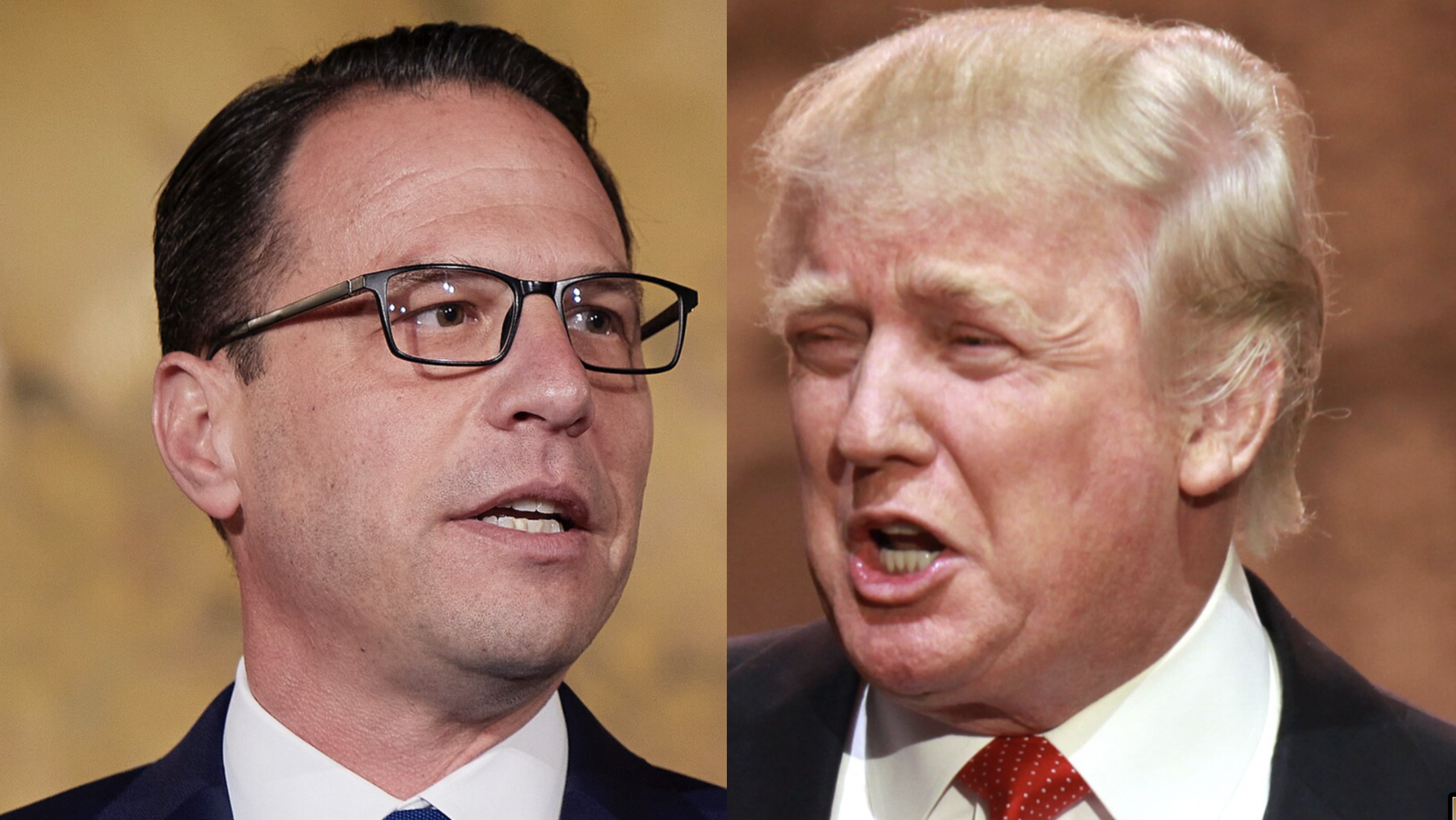
Pennsylvania Governor Josh Shapiro took direct aim at President Donald Trump on Monday in a pointed social media post, accusing the administration of driving up the cost of consumer goods through tariff policy and stripping more than 145,000 Pennsylvanians of healthcare coverage through skyrocketing insurance premiums. In language that amounted to both an indictment of current federal economic policy and a political promise, Shapiro closed his message with a midterm vow — telling his followers that come November, his state would hold Trump and those aligned with him accountable at the ballot box.
Shapiro’s Full Statement
Shapiro posted the remarks on X on May 26, 2026. The full text read:
“Donald Trump sent the price of literally everything soaring with his disastrous tariffs and reckless war of choice – and forced over 145,000 Pennsylvanians off their healthcare due to skyrocketing premiums. This November, Pennsylvanians will send a message to Donald Trump and his enablers and put a check on the chaos, cruelty, and corruption.”
The post was concise but deliberately sweeping in its accusations, tying three distinct policy grievances — tariff-driven inflation, healthcare access loss, and what Shapiro characterized as broader governmental misconduct — into a single pre-midterm rallying cry.
Tariffs and the Price of “Literally Everything”
Shapiro’s reference to tariffs driving up the price of “literally everything” tracks closely with data from the Federal Reserve. Researchers at the Federal Reserve found that tariffs implemented through November 2025 raised core goods PCE prices by 3.1 percent through February 2026, explaining the entirety of excess inflation in the core goods category relative to pre-pandemic inflation rates. The central bank’s analysis confirmed that the tariff effects on consumer prices gradually build over time, with full dollar-for-dollar pass-through to consumers emerging within roughly seven months of implementation.
Year-over-year core inflation hit 3.2 percent in March 2026 — the highest level recorded since 2023 — a surge largely attributable to tariff costs, according to Federal Reserve researchers, who estimated core inflation would have been 0.80 percentage points lower in the absence of tariffs. Earlier research from the New York Federal Reserve found that U.S. consumers and businesses were absorbing nearly 90 percent of total tariff costs, with Trump’s 2025 tariff regime amounting to a tax increase of approximately $1,000 for the average American household.
The Yale Budget Lab estimated the current tariff regime implies an increase in consumer prices of 1.1 percent in the short run — assuming full pass-through to consumers — equivalent to a loss of roughly $1,500 per household on average in 2025 dollars. Shapiro’s characterization of tariffs as a “reckless war of choice” signals his framing of the policy not as a calculated strategic tool, but as a self-inflicted economic wound with no compelling justification.
145,000 Pennsylvanians Off Healthcare
The governor’s claim that over 145,000 Pennsylvanians were forced off their healthcare due to skyrocketing premiums comes amid a well-documented surge in insurance costs across the state. The Pennsylvania Insurance Department released final Affordable Care Act health insurance rates for 2026, finding that the failure of Congress to extend enhanced premium tax credits before open enrollment — combined with new federal enrollment rules — resulted in significant price increases for Pennsylvanians, with an average aggregate weighted rate increase of 21.5 percent in the individual market.
The premium shock hit some Pennsylvania families with particular severity. For example, a 60-year-old married couple in York County with $82,000 in annual income would see their yearly premium increase from $7,032 to $35,712 per year. Pennsylvania Insurance Commissioner Michael Humphreys warned at the time that renewal letters would contain prices that would be “shocking” for families purchasing their own coverage.
States across the country were also seeing health insurance premiums rising roughly 18 percent on average — 11 percent higher than the prior year — while in Pennsylvania, without the enhanced tax credits, premiums would have risen by an average of 82 percent. Half a million Pennsylvanians were enrolled through Pennie, the state’s official health insurance marketplace, and three of every four enrollees had only ever experienced enrollment with the enhanced tax credits in effect.
A Broader Healthcare Crisis
Shapiro’s concerns about healthcare access in Pennsylvania extend beyond premium increases. The governor has separately warned that proposed Medicaid cuts moving through Congress represent an equally serious threat. Pennsylvania has approximately 3 million Medicaid enrollees — nearly one in four Pennsylvanians — with the program’s annual cost approaching $50 billion in the state alone.
Shapiro warned that if the cuts are made, the state would be unable to make up the lost federal funding. “I just need to stress: there is no back-filling at the state level,” Shapiro said. “There are no dollars available at the state level to make up for these cuts at the federal level. So if they cut someone off Medicaid, they’re off. We will not be able to fix that for them.”
When new Medicaid work requirements take effect, an additional 300,000 Pennsylvanians could lose their health coverage, according to the Shapiro administration — with those individuals primarily losing insurance due to bureaucratic requirements rather than ineligibility. The Pennsylvania Health Access Network has identified 47 hospitals in Pennsylvania that face closure following the Medicaid cuts. One of those hospitals, Bradford Regional Medical Center, ceased hospital operations in May 2026.
“Chaos, Cruelty, and Corruption” — A Midterm Threat
The closing line of Shapiro’s post — that Pennsylvanians would “put a check on the chaos, cruelty, and corruption” this November — was not subtle in its electoral intent. With the 2026 midterm elections approaching, Democrats across the country have been positioning the economic consequences of Trump’s second term as their central campaign argument.
The latest RealClearPolling generic Congressional voting polls show a 7.2-point margin in favor of Democrats — the most significant divide over the past year. The Economist’s prediction model, which conducts 25,001 simulations, estimates Democrats as heavy favorites to flip the House in the 2026 midterms. On the Polymarket prediction platform, the probability of Democrats winning the House stands at approximately 73 percent, with a Democratic sweep of both chambers sitting at 40 percent odds.
Democrats need to flip only a small number of seats to retake the House majority, and the Democratic Congressional Campaign Committee has unveiled an ambitious list of nearly three dozen GOP-held House seats it will attempt to flip in 2026, including 10 seats that Trump won by 10 percentage points or more in 2024.
Shapiro on the National Stage
While Shapiro’s post was directed at Pennsylvania voters, the governor has increasingly operated as a national Democratic voice on economic and healthcare issues. His record-breaking $30 million campaign war chest for his reelection bid has elevated his profile as a potential 2028 presidential contender. On the Polymarket prediction market for the 2028 presidential election, Shapiro’s odds currently sit at approximately 3 percent following his narrow reelection loss in Pennsylvania — a decline from the 7 percent he held earlier in the cycle. For context, that figure is remarkably close to the current Polymarket odds assigned to Donald Trump himself for the 2028 race, with the former and current president sitting at similarly marginal levels given constitutional and political constraints on a third term. JD Vance leads the overall 2028 field on Polymarket at 18 percent, followed by Gavin Newsom at 16 percent and Marco Rubio at 13%.
Whether Shapiro’s May 26th broadside translates into tangible midterm momentum for Democrats in Pennsylvania — a critical battleground state — will become clearer as November approaches. What is not in question is the governor’s intent: to make the economic costs of the Trump tariff regime and the deterioration of healthcare access the defining issues of the 2026 cycle, and to frame every vote in November as a direct referendum on what he called the “chaos, cruelty, and corruption” of the current administration.