
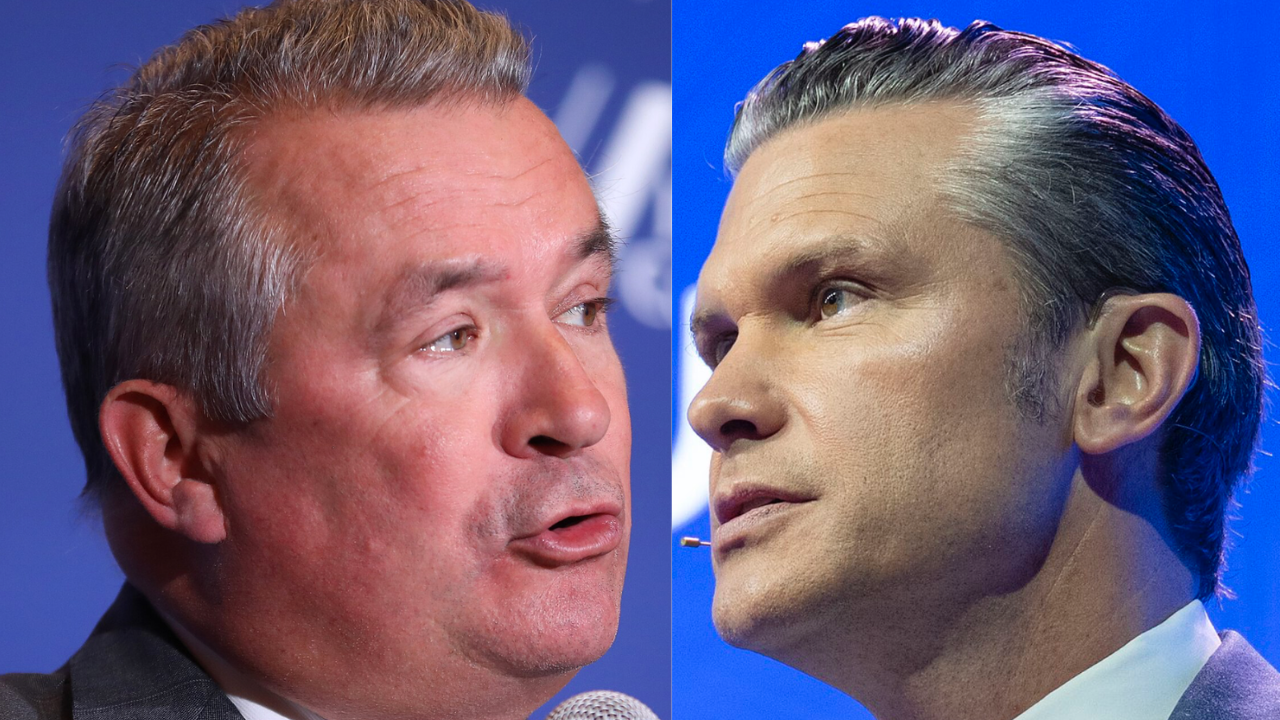
Rep. Don Bacon (R-Neb.) directed pointed criticism at Defense Secretary Pete Hegseth on June 23, 2026, saying the Pentagon has yet to explain how it intends to follow through on a presidential order to send troops to Poland. “Meanwhile, we are still waiting for SECDEF to explain how he’ll carry out the President’s order to deploy a brigade to Poland…” Bacon wrote on X, using the military shorthand for secretary of defense. The comment came at the end of a longer post in which Bacon credited Congress, not the Pentagon, with forcing through $400 million in Ukraine aid and $200 million for the Baltic Security Initiative. “Europe’s frontline defenses could no longer wait for mixed signals from the Pentagon,” Bacon wrote. “After much foot-dragging, Congress finally compelled the Pentagon to direct” the funding.
The Decision Bacon Is Referencing
Bacon’s criticism traces back to a Pentagon decision in May to cancel a long-planned rotation of an armored brigade combat team, roughly 4,000 troops, that had been expected to deploy to Poland. Speaking to RFE/RL shortly after the cancellation became public, Bacon said the move sent “a terrible message” to both Russia and Eastern European allies. He drew a direct comparison to an earlier incident in which the Pentagon withdrew a U.S. brigade from Romania without advance notice to Congress or the Romanian government. “They took the brigade out of Romania without telling Congress or Romania until after it was done,” Bacon said. “That’s not how you treat allies.”
Bacon’s Assessment of Hegseth’s Pentagon
Bacon’s criticism of the department’s decision-making under Hegseth has been unusually blunt for a fellow Republican. “It’s like the blind leading the blind over at the Pentagon,” Bacon told RFE/RL, describing what he characterized as a pattern of uncertainty in how the department was handling troop posture decisions across Europe. He argued the ambiguity carried real strategic costs: “Ambiguity is dangerous in this world,” he said, warning that mixed signals from Washington risked emboldening adversaries including Russia, China, and Iran simultaneously, given what he described as the increasingly interconnected nature of those threats.
Trump’s Reversal
Trump moved to reverse the Pentagon’s cancellation shortly after it drew public criticism, announcing the U.S. would in fact send additional troops to Poland, citing the country’s strong alliance status and its newly elected president, Karol Nawrocki. Bacon’s June 23 post suggests that, more than a month after that reversal, Hegseth’s department had still not laid out how or when the brigade deployment would actually be carried out.
How Hegseth Has Explained Troop Posture Changes Elsewhere
Hegseth has, at other points, offered direct explanations for related European troop decisions, even if the Poland brigade timeline remains unaddressed. The Department of War issued a statement in May attributed to the office of the assistant to the secretary of war for public affairs, framing reductions to the number of brigade combat teams assigned to Europe, from four to three, as part of a deliberate restructuring rather than a retreat from the continent. Army leadership echoed that framing in testimony before Congress; Gen. Christopher LaNeve, the Army’s acting chief of staff, told the Senate Appropriations Committee that “while one brigade is coming back, we still have a pretty big force presence from the United States Army in Europe,” and that forces remained “actively participating inside of Poland with our allies” even without the rotational brigade in place.
A Pattern Lawmakers Have Flagged Before
Bacon’s complaint fits a broader pattern other lawmakers have raised about delayed or unclear Pentagon follow-through under Hegseth on European security matters. Hegseth had personally promised lawmakers a spending plan for the $400 million in Ukraine funding, only for Army Secretary Dan Driscoll and LaNeve to tell the Senate Appropriations Committee a week later that no such plan had actually been provided to them. Sen. Chris Coons (D-Del.) used the same hearing to question Hegseth’s decision-making more broadly, linking the Poland brigade cancellation to Trump’s abrupt, separate decision to pull 5,000 troops out of Germany after German Chancellor Friedrich Merz criticized U.S. operations in Iran. “I’m concerned that the lesson our allies are learning is that Chancellor Merz criticized our operations in Iran, and the president, in a fit of pique, announced the withdrawal of 5,000 troops that had not previously been planned,” Coons said.
How the $400 Million Episode Played Out Under Hegseth
Hegseth’s handling of the Ukraine funding fight offers a useful point of comparison for how the Poland question might ultimately be resolved. Hegseth announced the release of the $400 million only after McConnell published a sharply critical op-ed accusing the Pentagon of sitting on the funds. Hegseth told Congress at the time, “The department recognizes that $400 million was allocated for European capacity building, and as of yesterday, it has been released.” Even then, Pentagon Comptroller Jules Hurst III acknowledged the money had not actually been placed under contract, telling Rep. Sarah Elfreth (D-Md.) that the timeline for the funds reaching Ukraine would depend on “what they buy with the money” — an answer that left the practical details unresolved even after Hegseth’s announcement.
The Pattern McConnell Identified
McConnell’s op-ed, which prompted Hegseth’s eventual release of the Ukraine funds, pointed to a specific Pentagon official, Elbridge Colby, the undersecretary of defense for policy, as the source of the earlier delays. McConnell wrote that Colby had previously been “behind the decision to suspend arms shipments to Kyiv” and had separately determined that security assistance to both Ukraine and NATO’s Baltic allies was “wasteful,” removing those programs from the department’s initial fiscal 2026 budget request before Congress restored the funding over Pentagon objections.
Whether Colby or another Pentagon official is similarly responsible for the lack of clarity on the Poland brigade deployment has not been publicly addressed by Hegseth’s office. Bacon’s post did not name any specific official within the department, directing his criticism at Hegseth in his capacity as secretary of defense rather than at any individual subordinate.
Where Things Stand
Neither Hegseth’s office nor the broader Department of Defense had publicly addressed Bacon’s specific June 23 question as of publication: how and when the Pentagon intends to execute Trump’s order to deploy a brigade to Poland. The gap between the president’s stated decision and the department’s public explanation of its implementation remains the central point of Bacon’s criticism, distinguishing it from his praise for Congress’s separate role in forcing the release of the Ukraine and Baltic funding.
Bacon has not indicated what action, if any, he intends to take beyond public statements to compel a more detailed Pentagon response on the Poland deployment, though his record on the Ukraine and Baltic funding fights suggests sustained public pressure has previously been his preferred approach to prompting department action. As Bacon put it in his own assessment of the Pentagon’s broader pattern of decision-making on European security: “It’s like the blind leading the blind over at the Pentagon.”
Bacon’s Standing Within His Party
Bacon’s willingness to publicly criticize Hegseth, a fellow Republican and Trump Cabinet official, reflects his longstanding position as one of the more independent voices within the House GOP on defense and foreign policy matters. A retired Air Force brigadier general who serves on the House Armed Services Committee and co-chairs the House Baltic Caucus, Bacon has continued to press the Pentagon publicly on European security issues even as he has not always aligned with the administration’s broader approach to troop posture and alliance management.