
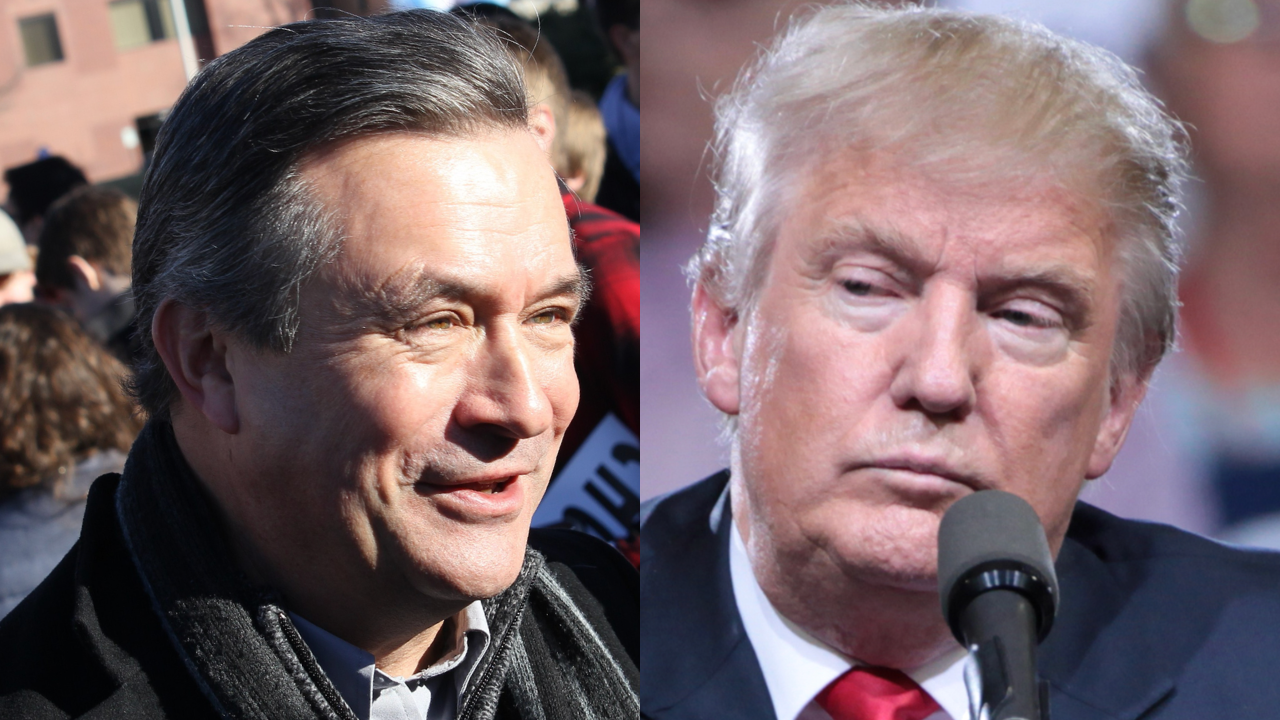
Rep. Don Bacon (R-NE), a retired Air Force brigadier general who has been one of the most persistent Republican critics of the Trump administration’s foreign policy, issued a stark historical warning on May 1, 2026, after conservative commentator and longtime journalist Geraldo Rivera accused Trump of “unraveling NATO.” “The history will be written,” Bacon posted on X. “Destroying NATO will be seen as a disgrace for centuries to come.” His words came the same day the Pentagon confirmed it was withdrawing approximately 5,000 U.S. troops from Germany — a move that blindsided NATO allies, was not coordinated with Congress, and was widely attributed to Trump’s anger at German Chancellor Friedrich Merz’s public criticism of the Iran war.
Rivera’s original post, which Bacon was responding to, read: “President Trump is unraveling NATO, the Alliance that has kept the world safe from malignant Communism since WWII. Slava Ukraini.” The alignment of Bacon — a sitting Republican congressman and veteran — with that warning signals how far the debate over NATO’s future has penetrated the Republican party’s national security wing, and how seriously some of Trump’s own allies view the current trajectory of U.S. alliance policy.
What NATO Is and Why It Was Built
To understand the weight of Bacon’s warning, it is necessary to understand what NATO represents and what its destruction would mean. The North Atlantic Treaty Organization was founded on April 4, 1949, when 12 nations — the United States, Canada, the United Kingdom, France, Belgium, the Netherlands, Luxembourg, Norway, Denmark, Iceland, Italy, and Portugal — signed the North Atlantic Treaty (the Washington Treaty) in Washington, D.C. As documented by the U.S. Department of State’s Office of the Historian, the alliance was formed in direct response to Soviet expansionism in postwar Europe — the 1948 communist coup in Czechoslovakia, the Soviet blockade of Berlin, and the growing threat that the USSR would extend its control westward across a continent still rebuilding from the devastation of World War II.
The treaty’s core promise is contained in Article 5: “An armed attack against one or more of them in Europe or North America shall be considered an attack against them all.” Article 5 has been invoked only once in NATO’s 77-year history — on September 12, 2001, the day after the attacks on the World Trade Center and Pentagon, when NATO’s European allies came to the defense of the United States. President Harry Truman, at the treaty’s signing, declared: “Men with courage and vision can still determine their own destiny. They can choose slavery or freedom — war or peace.” For the 76 years since, no full-scale war between NATO members and the Soviet Union or Russia has occurred — the alliance’s foundational purpose achieved through deterrence rather than combat.
The treaty also contains a legal constraint that directly applies to the current moment. Section 1250A of the National Defense Authorization Act for Fiscal Year 2024 explicitly states: “The President shall not suspend, terminate, denounce, or withdraw the United States from the North Atlantic Treaty, done at Washington, DC, April 4, 1949, except by and with the advice and consent of the Senate, provided that two-thirds of the Senators present concur, or pursuant to an Act of Congress.” Congress passed that provision by a wide bipartisan margin specifically to foreclose unilateral presidential withdrawal from NATO — a precaution taken in direct response to Trump’s first-term statements threatening to leave the alliance.
What Trump Has Done to the Alliance in 2026
The troop withdrawal Bacon is responding to is only the most recent in a series of actions that NATO allies and Republican defense hawks say are systematically undermining the alliance. On May 1, the Pentagon announced it was withdrawing 5,000 troops from Germany over the next six to twelve months — a decision made without consulting NATO allies, without coordinating with Congress, and without providing details about which units would be affected, which cited multiple NATO sources saying the announcement “took senior NATO command by surprise.” Former U.S. Ambassador to NATO Ivo Daalder told Euronews: “We don’t know what these forces are — is it the core of a brigade? An air squadron?” Trump added on Saturday that troop reductions in Germany would go “a lot further” than 5,000, without specifying when or by how much.
According to TIME, the Pentagon is also reviewing potential troop reductions in Spain and Italy, has threatened to suspend Spain from NATO entirely in internal documents, and has told European allies to expect delays in weapons deliveries as the U.S. works to replenish munitions used in the Iran war. Those weapons delays directly affect Ukraine — specifically HIMARS rocket systems, Patriot air defense munitions, and NASAMS missile systems — at a moment when European Union Defense Commissioner Andrius Kubilius has described Ukraine’s outlook as “critical.” Trump has also publicly called NATO “useless” and its European members “cowards” for refusing to join the U.S.-Israel war against Iran, and described the alliance as a “paper tiger,” according to Euronews sourcing from NATO capitals.
The specific trigger for the Germany withdrawal was Chancellor Merz’s statement that the United States was being “humiliated” by Iran’s leadership and had entered the war without a clear strategy. NATO officials drew direct conclusions from the timeline: “Let’s just say it was a very short space of time between Trump’s first post saying he was ‘studying’ how to draw down troops after the feud with Merz, and then the sudden announcement,” one NATO source told Euronews. The view from NATO capitals, PBS reported, was that allies had expected “an orderly, collaborative disengagement” if any drawdown occurred — not a punitive, unannounced withdrawal driven by a diplomatic feud.
Bacon’s Record: A Reagan Republican in the Trump Era
Bacon’s warning about NATO carries particular weight because of his biography and his record. A retired Air Force brigadier general with 30 years of military service, he has consistently framed his foreign policy positions as rooted in Reagan-era Republican principles — robust NATO commitment, strong support for Ukraine, and firm deterrence of Russian aggression — as documented in his official House biography. He received the Honorary Diploma of the Verkhovna Rada — Ukraine’s parliament — for his support of Ukrainian security, as well as high honors from Estonia and Lithuania for his commitment to Baltic defense. He has been one of the most consistent Republican voices warning that weakening NATO rewards Russian President Vladimir Putin’s strategic goals.
Bacon’s May 1 post is consistent with a warning he issued in December 2025, when he called Trump “the new Chamberlain” — invoking British Prime Minister Neville Chamberlain’s 1938 appeasement of Hitler — over the administration’s approach to Ukraine and Russia. He has also warned repeatedly that proposals to cede Ukrainian territory to Russia in exchange for a ceasefire are reminiscent of Munich 1938, and that any territorial concession to an aggressor emboldens rather than satisfies them. His “disgrace for centuries” framing on NATO is the natural extension of that historical lens — a view that decisions made now about the transatlantic alliance will be judged the way appeasement in the 1930s is judged today.
Bipartisan Republican Concern — and European Reaction
Bacon is not alone among Republicans. Sen. Roger Wicker (R-MS) and Rep. Mike Rogers (R-AL) — the Republican chairs of the Senate and House Armed Services Committees — issued a joint statement saying they were “very concerned” by the Germany withdrawal and urged the Pentagon to redeploy troops eastward to Poland and the Baltic states rather than withdrawing them from Europe entirely. Former National Security Advisor John Bolton, appearing on CNN the same week, called the withdrawal “childish” if it was motivated by punishment of Merz for his public statements, while also criticizing the European allies for responding to the Iran war with playground-level political maneuvering rather than strategic thinking. Sen. Susan Collins (R-ME) said Trump’s authority as commander in chief over troop deployments “is not without limits.”
European leaders, gathering at the European Political Community summit in Yerevan, Armenia — notably without Merz, who did not attend — offered a range of reactions. NATO Secretary General Mark Rutte said allies had “heard a message” and were ensuring “all bilateral basing agreements are being implemented.” French President Emmanuel Macron said Europeans are “not ready to get involved in any operation that does not seem clear,” while British Prime Minister Keir Starmer acknowledged “more tension” in international alliances “than there should be.” German Chancellor Merz’s spokesman Stefan Kornelius insisted Germany-U.S. relations remain “resilient and broad,” and that Germany absolutely can still rely on the U.S. as a military partner — while acknowledging that Berlin had no explanation from Washington for what Trump’s “a lot further” promise about troop cuts actually means in practice.
“The History Will Be Written”
Bacon’s warning — “The history will be written. Destroying NATO will be seen as a disgrace for centuries to come” — is a deliberate echo of language he has used before. In November 2025, he posted “History will not look kindly at how he treated people” about Defense Secretary Pete Hegseth’s dismissal of senior military officers. In May 2026, responding to the exclusion of Ukraine from the 2027 defense budget, he posted “Again… history won’t look kindly on this.” Across all three statements, the word “history” carries the same weight: a judgment that transcends the political moment, rendered by future generations looking back at decisions made under pressure. Whether Trump’s approach to NATO — threatening it, publicly demeaning it, withdrawing troops from it without consultation, and calling its members cowards — ultimately destroys the alliance or merely weakens it will be determined in the years ahead. Bacon’s argument is that those years will eventually become history, and that history will not be kind.