
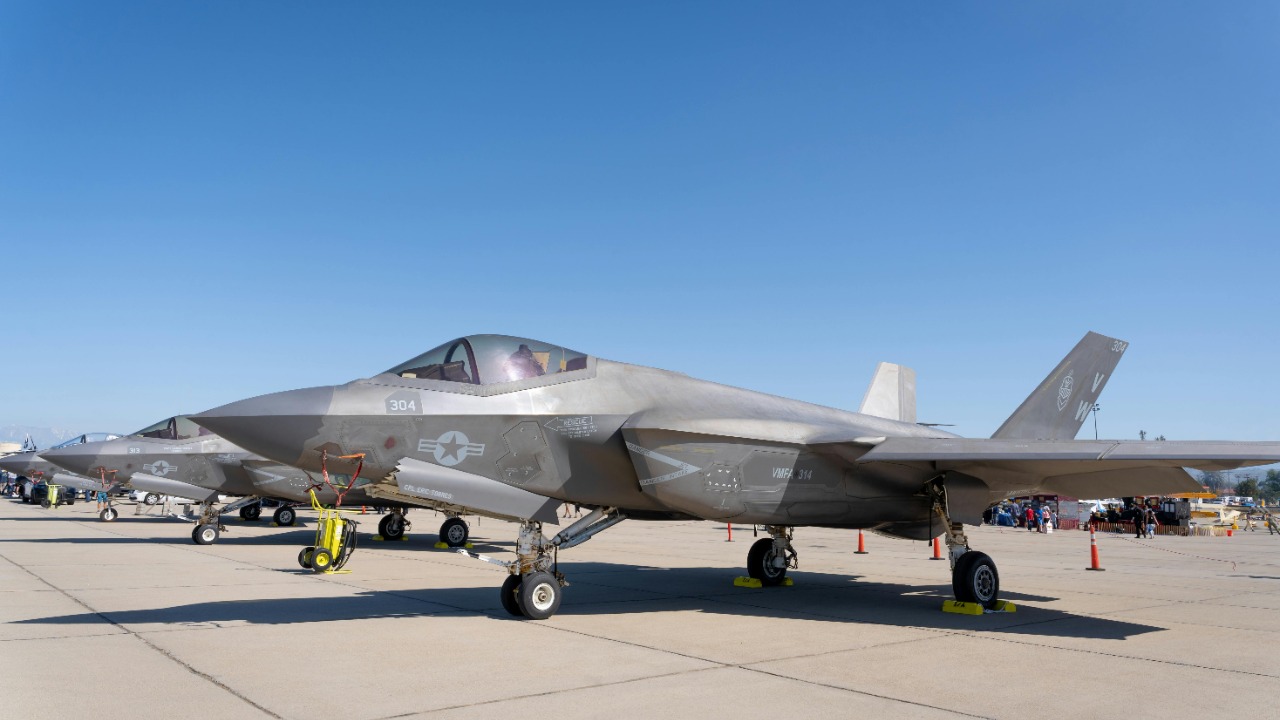
Denmark is sending four F 35 fighter jets to strengthen NATO’s air defenses over the Arctic and the North Atlantic, marking a significant escalation of allied activity in the High North. The deployment puts one of the alliance’s newest stealth aircraft at the center of a region where climate change, shifting trade routes, and renewed great‑power rivalry are converging. It also signals that Copenhagen intends to play a more visible role in Arctic security, including over the vast territory of Greenland.
The contribution is part of NATO’s new Arctic Sentry activity, designed to tighten coordination of air, sea, and cyber operations across the northern flank. By committing some of its most advanced combat aircraft to this mission, Denmark is tying its national defense priorities directly to the alliance’s evolving strategy for the Arctic and the High North.
Denmark’s first F 35 contribution to Arctic Sentry
Denmark’s decision to provide four F 35 jets is its first operational use of the aircraft in a NATO framework focused explicitly on the High North. Defence Minister Troels Lund Poulsen confirmed that Denmark will send four F 35 fighter jets to NATO’s Arctic Sentry mission, describing the move as a response to the country’s significant security concerns in the Arctic and North Atlantic. The deployment reflects a broader Danish effort to match political rhetoric about Arctic responsibility with tangible military assets, placing a premium on rapid reaction and persistent surveillance over remote sea lanes and airspace.
The jets will join a wider allied effort under the Arctic Sentry banner, which NATO has described as a multi‑domain activity intended to enhance deterrence and defense in the Arctic and the High North. According to NATO, the activity is directed at the strategic level by Allied Command Operations, while Joint Force Command Norfolk leads operational planning and coordination for the northern Atlantic area. Within that structure, Denmark’s four F 35 aircraft will serve as an early and highly visible national contribution, integrating with allied air forces already accustomed to operating in harsh polar conditions and contested electromagnetic environments.
Why the High North matters for NATO
The Arctic has moved from a peripheral theater to a central concern for NATO planners, who see the region as a junction between North America and Europe and a potential route for both military and commercial traffic. Melting sea ice is opening new passages that shorten shipping times between Asia and Europe, while also exposing undersea cables and critical infrastructure to new vulnerabilities. NATO has framed Arctic Sentry as a way to improve allied awareness and readiness across this area, treating the High North as a single strategic space that connects the Arctic Ocean, the North Atlantic, and northern Europe. Within that picture, Denmark’s geography, which includes Greenland and the Faroe Islands, gives it a front‑row seat to any tension in the region.
Allied leaders are also responding to political friction tied to Greenland, which has become a symbol of wider competition over Arctic resources and basing rights. Reports on the launch of Arctic Sentry state that the initiative is intended to address tensions over Greenland while acknowledging its strategic value. By contributing four F 35 jets at this early stage, Denmark is signaling that it wants to be seen as a responsible steward of that territory within the alliance, and not merely as a gatekeeper for outside interest in its Arctic lands.
Capabilities the F 35 brings to Arctic Sentry
The F 35 is far more than a traditional fighter jet, and its deployment to the Arctic Sentry activity is as much about sensors and data as it is about missiles and bombs. The aircraft’s stealth design, advanced radar, and sensor fusion allow pilots to detect and track targets across long distances, even in cluttered or contested airspace. In the Arctic, where weather, darkness, and remoteness complicate surveillance, that combination of stealth and advanced sensors improves NATO’s ability to monitor activity over the Arctic and North Atlantic compared with older aircraft. Denmark’s four jets will plug into a wider network of allied platforms, feeding information to ships, ground stations, and other aircraft in real time.
Reporting on the Danish deployment notes that the four F 35 fighters will take part in scheduled training and air policing tasks under the Arctic Sentry umbrella, rather than operating as a standalone national mission. That integration is central to the concept of a multi‑domain activity, in which air, maritime, and other assets are coordinated under a single operational design. Denmark is in the process of fielding a total fleet of F 35A aircraft, and sending four of them to this mission gives Danish pilots early experience in complex multinational operations in harsh northern conditions. It also demonstrates that Copenhagen is willing to deploy some of its newest equipment to operate in Arctic conditions, including extreme cold and limited diversion airfields.
Domestic politics and alliance expectations
Domestically, the decision to send four F 35 jets reflects a political consensus in Copenhagen that Denmark’s security is directly tied to stability in the Arctic and North Atlantic. Defence Minister Troels Lund Poulsen has argued that Denmark faces significant security concerns because of its geography, which stretches from continental Europe to the Arctic. That logic has been echoed in local coverage that stresses how the F 35 deployment is a concrete response to those concerns, rather than a symbolic gesture. As Denmark’s first operational contribution of this type, the deployment carries added significance in national debates over defense spending and military readiness.