
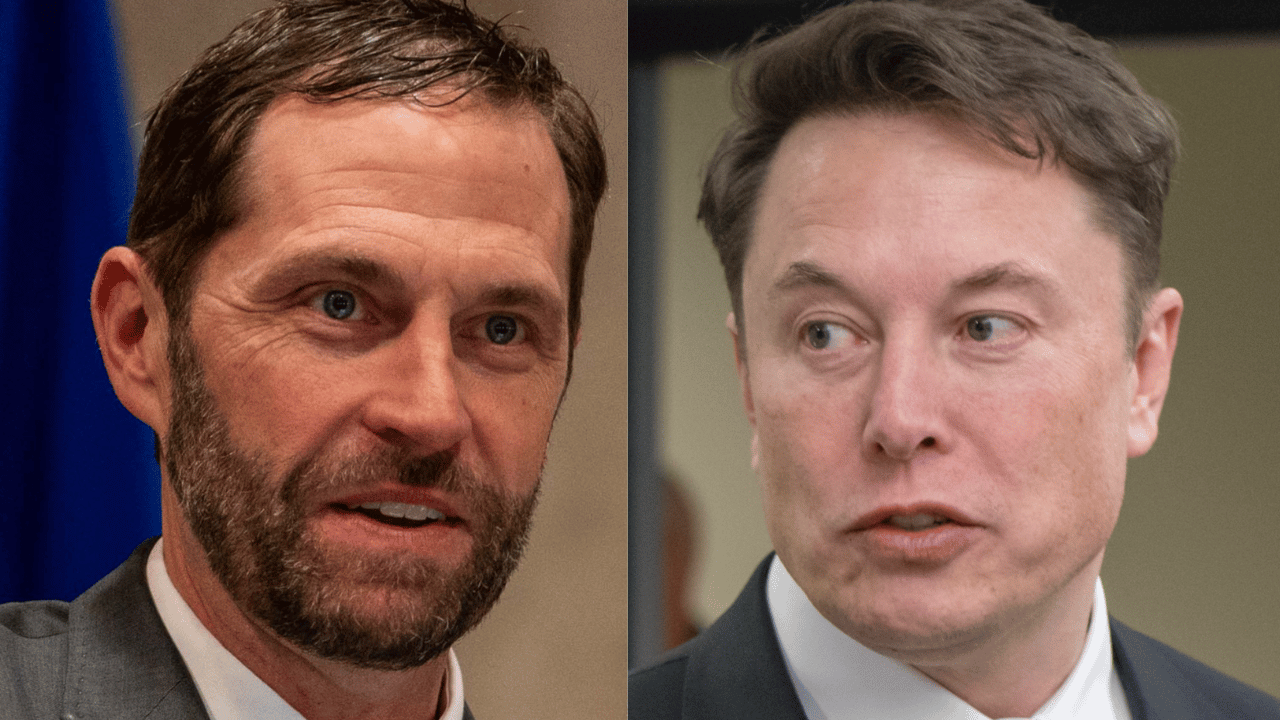
U.S. Representative Jason Crow, a Colorado Democrat, said Tuesday that “A single unelected tech oligarch shouldn’t be able to make life-and-death decisions about America’s national security,” amplifying remarks he made on CBS News’ “Face the Nation” about SpaceX’s Starlink service in Ukraine.
“A single unelected tech oligarch shouldn’t be able to make life-and-death decisions about America’s national security,” Crow wrote in a post on X, quoting a Face the Nation clip of his Sunday interview.
Moderator Margaret Brennan asked whether “one man and his whim, an unelected official, can have such unilateral influence over our national security policy,” after noting that Elon Musk owns SpaceX and that Ukraine had said satellite services were restored. Crow answered, “Yeah, it appears to be the case, and it’s beyond disturbing to me,” according to the CBS interview transcript.
Crow said on the program that he had written to President Donald Trump with Representatives Adam Smith and Jim Himes. “It cannot and should not be the case that a tech oligarch, a private citizen, who has that much control over our national security, who is unaccountable, who is unelected, with zero transparency, is making life and death decisions on the battlefield in systems that our service members and our partners and allies rely upon,” he said. “It should not be the case. And under this administration, they are allowing it to happen. And we’re going to try to stop it because Americans deserve accountability and they deserve leadership.”
The Oct. 16 letter, signed by Crow, Smith, Himes and Representative George Whitesides, asked Trump who authorized speed restrictions on Starshield services provided to Ukraine, whether the decision was an independent SpaceX choice or a U.S. government directive, what communications occurred with SpaceX or Russia, whether operational consequences were assessed, and why Ukrainian forces were not given advance notice, with answers requested by Oct. 30. “If a private company can unilaterally restrict a critical operational service governed by a signed contract with the Department of Defense during an active conflict, it raises serious concerns about public accountability and the outsized influence of private actors over U.S. national security matters,” the letter said. “If, on the other hand, the direction was given by your Administration, it raises serious questions about U.S. defense policy regarding Russia and Ukraine.”
Musk has offered a different account. “Ukraine military violated Starlink terms of service and used it for offensive drone strikes to kill people. That loophole was closed last week,” he wrote in an Oct. 24 post on X. In the same post he said using Starlink, “a civilian commercial service, for offensive drone strikes to kill people has never been allowed,” that “Starshield, a different system, is controlled by the US government,” and that Starlink “remains critical to the defense of Ukraine.” In a follow-up post the same day, he wrote: “Starshield use is a decision of the US government. End of story.” SpaceX describes Starshield on its Starshield product page as its government-focused satellite network. Neither SpaceX nor the Defense Department has issued a public statement saying who ordered the October speed limits.
Serhii Beskrestnov, an adviser to Ukrainian President Volodymyr Zelenskyy on defense technology, wrote in a Telegram post that commercial Starlink terminals over Ukraine had been limited to movement speeds of 70 to 90 kilometers per hour since winter 2026, that Starlink does not work over Russia, and that Ukraine therefore “PHYSICALLY CANNOT USE COMMERCIAL STARLINK” for deep or mid-range strikes. Serhii Sternenko, a former Ukrainian defense ministry adviser, wrote in an Oct. 24 post on X that drone missions requiring satellite links could only use Starshield and that “Ukraine did not violate the terms of use.” Ukraine’s Defense Ministry said in an Oct. 24 statement that monitoring systems were recording the restoration of Starlink and Starshield operating speeds, with connectivity stable at movement speeds of more than 400 kilometers per hour. Defense Minister Evgeniy Khmara said the restored speeds mattered “for our front line, for service members, for drone operations, logistics, and communications.”
Crow’s “tech oligarch” framing is his characterization of Musk’s role. The record shows Musk publicly attributed the limits to a terms-of-service dispute over offensive drone use and said Starshield decisions belong to the U.S. government; that Beskrestnov and Sternenko disputed that commercial Starlink could be used for deep or mid-range offensive strikes; that Crow, Smith, Himes and Whitesides pressed Trump in writing for answers by Oct. 30; and that Ukraine’s Defense Ministry later reported the speeds restored. As of Tuesday, Musk and the White House had not responded publicly to Crow’s post.