
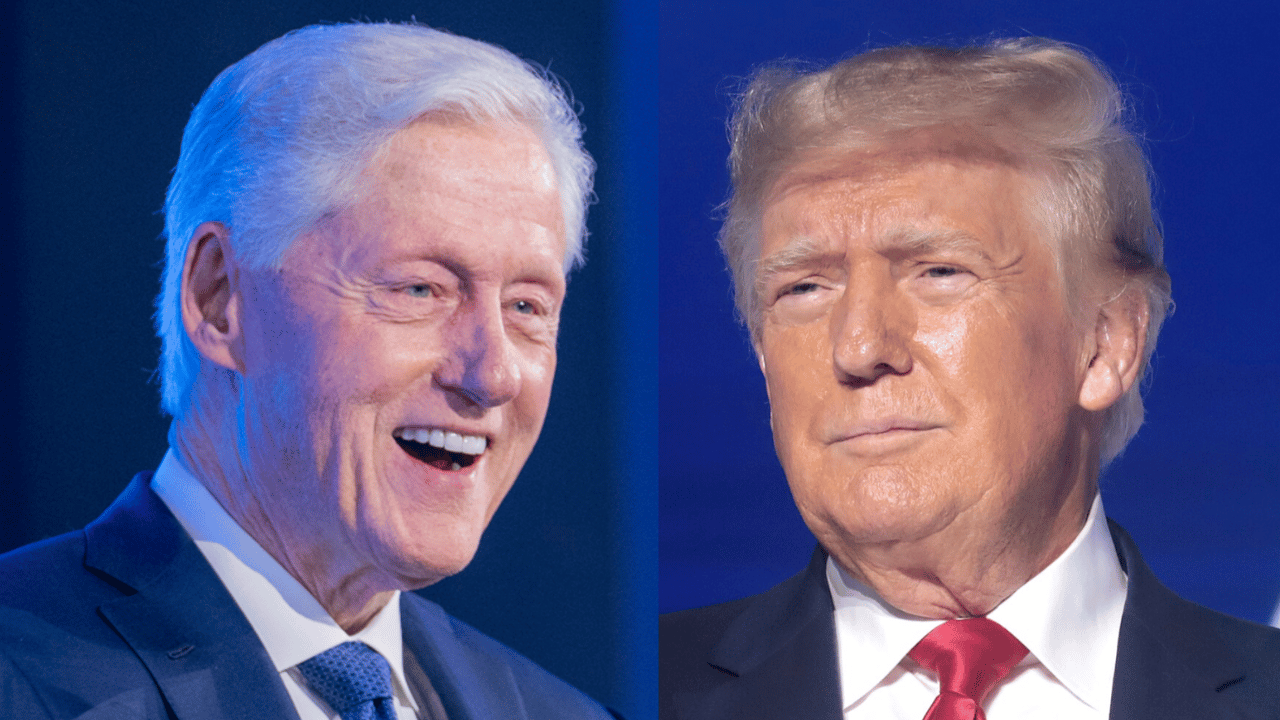
Former President Bill Clinton said “President Trump thinks mostly about himself” and asked who wants “to rename the Kennedy Center just because you do repair work on it” while campaigning for Democratic Senate nominee Scott Colom in Tupelo.
“So, much as I hate to say it, President Trump thinks mostly about himself,” Clinton said Friday, Oct. 30, at the Link Centre in Tupelo. “I mean, who wants to rename the Kennedy Center just because you do repair work on it? There’s something not right about this. You know it, I know it, even they know it.” The lines appear in WTVA’s full-speech video of the Colom rally. He continued that “Scott’s opponent and plenty of others in Washington are looking after his feelings and his naming rights” and that “somebody’s got to look after your future,” before saying Colom “will be 100% for Mississippi.”
Mississippi Today covered the Link Centre stop the same day as a Colom rally of roughly 400 people, with Clinton, James Carville, and Mitch Landrieu on the program. WAPT’s report put the crowd at about 500 and quoted Clinton’s tariff and gas-price passages from the same speech. “The reason I wanted to bring President Clinton to Tupelo is because I understand what tariffs have done to the furniture industry,” Colom told that audience, according to WAPT.
The Kennedy Center fight Clinton referenced has been in federal court for months. In Beatty v. Trump, U.S. District Judge Christopher R. Cooper of the District of Columbia blocked efforts to add Trump’s name to the John F. Kennedy Center for the Performing Arts and related plaza branding, holding that the board’s renaming steps conflicted with the federal statute that memorializes President Kennedy and with prior injunctive relief. Roll Call reported that Cooper again blocked adding Trump’s name and related inscriptions.
Trump described the project in a Feb. 1 Truth Social post preserved on Trump’s Truth, writing that a temporary closure for “Construction, Revitalization, and Complete Rebuilding” would take “a tired, broken, and dilapidated Center, one that has been in bad condition, both financially and structurally for many years, and turn it into a World Class Bastion of Arts, Music, and Entertainment.” He said the facility would close on July 4, 2026, “totally subject to Board approval,” with financing “completed, and fully in place,” and that the temporary closure would produce “a much faster and higher quality result.” Clinton’s “just because you do repair work” line answers that board-backed rebuild rationale by casting the rename as self-regard rather than structural necessity.
The federal statute creating the John F. Kennedy Center for the Performing Arts as a living memorial to President Kennedy is the legal backdrop Cooper applied in Beatty. Plaintiffs argued that adding “Trump” to the building or grounds violated that memorial scheme and prior court orders; the government and board defendants argued the trustees had authority to recognize renovations and donors. Cooper’s written decisions on the CourtListener docket for case 1:25-cv-04480 are the primary judicial record of those injunctions.
The Tupelo stop was part of Colom’s challenge to Republican Sen. Cindy Hyde-Smith. Four days earlier in Corinth, Trump stumped for Hyde-Smith and cast Colom as a “Marxist radical left Soros district attorney.” Hyde-Smith, in a WLOX interview, said gas and food prices are the issues she hears about most. Clinton’s Kennedy Center passage came late in the same Tupelo speech that also blamed “that war in the Gulf” and the Iran war and Strait of Hormuz for higher gasoline prices, lines covered separately from this naming critique.
Earlier in the Tupelo speech, Clinton also discussed tariffs hitting furniture plants, beef prices, and gas, telling Mississippians there “isn’t a button in the Oval Office that makes all that go away” and that “public service has to be more than telling people to get used to less,” in the same WTVA recording. He presented Colom as the candidate who would “look after your future” while Washington looked after “naming rights.” Immediately after the Kennedy Center passage, Clinton said “President Trump told the truth when he said she was for MAGA a hundred percent of the time,” adding that “when he’s right we ought to acknowledge it” and that “it’s something he won’t do for us,” before contrasting that Hyde-Smith record with Colom being “100% for Mississippi.”
WAPT noted that former Vice President Kamala Harris had appeared with Colom the prior week, another national surrogate stop in the same race. Mississippi Today’s account of the Link Centre program listed Carville and Landrieu on stage with Clinton. Colom’s furniture-tariff pitch and Hyde-Smith’s WLOX focus on gas and food prices are the kitchen-table arguments in the same Senate contest where Clinton raised the Kennedy Center rename.
Clinton told Tupelo that Trump “thinks mostly about himself” and mocked renaming the Kennedy Center “just because you do repair work on it,” saying “Scott’s opponent” and others in Washington were looking after “his feelings and his naming rights.” Trump’s Truth Social post called for closing and rebuilding what he labeled a “tired, broken, and dilapidated” center. Cooper’s orders in Beatty blocked Trump name additions under the Kennedy memorial statute. Mississippi voters on Nov. 3 choose between Colom and Hyde-Smith; those court orders and the Senate contest are the concrete records around Clinton’s argument.