
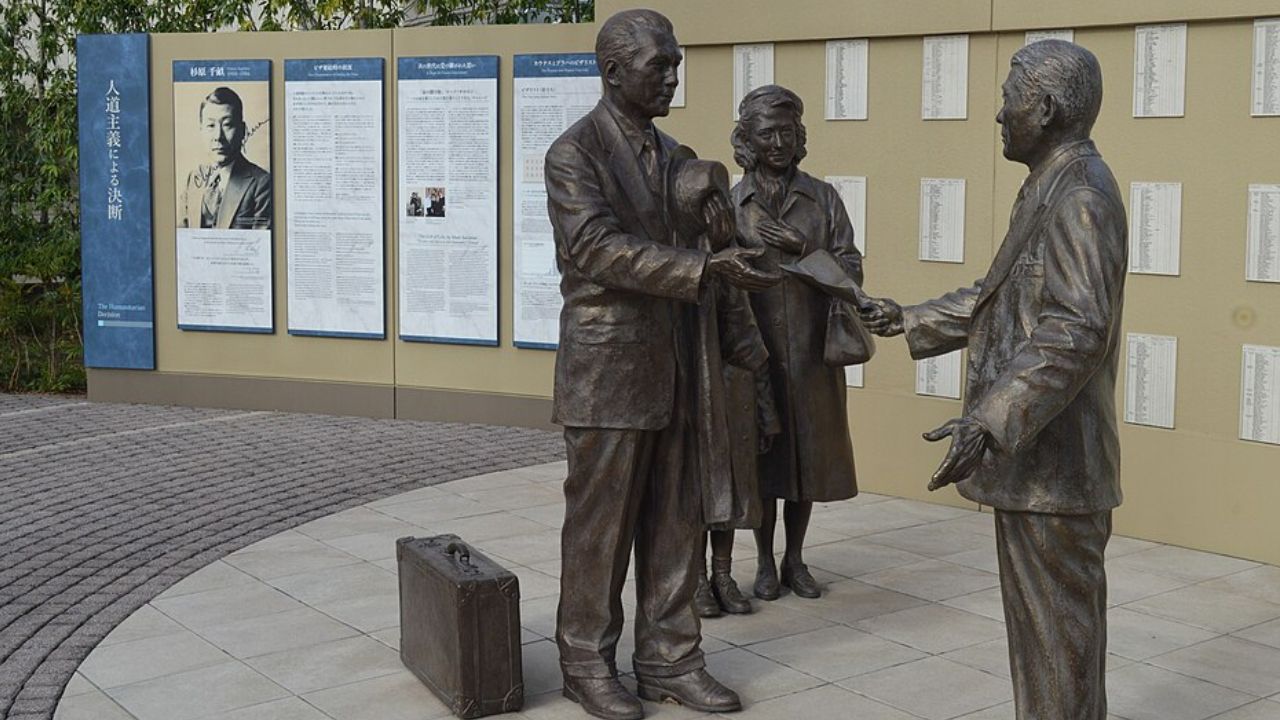
Chiune Sugihara was a man who dared to defy the odds and make an indelible mark on history. Stationed in Lithuania during the chaos of World War II, this Japanese diplomat took a courageous stand against his government’s orders. By issuing transit visas to Jewish refugees, Sugihara saved thousands from the horrors of the Holocaust. His brave actions earned him the nickname “Japan’s Schindler,” a testament to his unwavering humanitarian spirit.
The Man Behind the Mission
Chiune Sugihara’s journey to becoming a beacon of hope began in his early years in Japan. Born in 1900 in the small town of Yaotsu, he was the second son of a family with moderate means. From a young age, Sugihara was encouraged to pursue education. He excelled academically, showing a keen interest in foreign languages and cultures. His pursuit of higher education led him to Waseda University, where he studied English, and later to Harbin Gakuin in China, where he honed his skills in Russian. These experiences set the stage for his future diplomatic career.
Sugihara’s personal values and motivations were deeply rooted in compassion and empathy. Influenced by his Christian upbringing and the teachings of his mentors, he developed a strong sense of duty towards helping others. This sense of moral responsibility was further reinforced by his experiences in Manchuria, where he witnessed the harsh realities of imperial politics and human suffering firsthand. Sugihara’s wife, Yukiko, played a crucial role in supporting his humanitarian efforts. Together, they shared a mutual understanding of the importance of helping those in dire need, even when it meant risking their own safety.
The Situation in Lithuania
During World War II, the geopolitical landscape in Lithuania was fraught with tension and uncertainty. The country found itself caught between the advancing Nazi forces and the Soviet Union’s looming threat. For Jewish refugees, Lithuania became a temporary haven, albeit a precarious one. The outbreak of war had forced many Jews to flee their homes in Poland and other parts of Europe, seeking refuge wherever they could. As the Nazi occupation spread, these refugees faced desperate circumstances, having to navigate an increasingly hostile environment while searching for a way to safety.
The plight of Jewish refugees in Lithuania was dire. With the Nazis tightening their grip on Europe, thousands of Jews sought to escape the horrors of persecution by any means possible. Many arrived in Lithuania with little more than the clothes on their backs, hoping to find a way out before the doors to freedom closed forever. The diplomatic community in Lithuania, including Sugihara, faced a dilemma: should they adhere strictly to their government’s policies, or should they heed the call of humanity and help those in need? For Sugihara, the choice was clear, but it was not without significant challenges and risks.
Defying Orders
In a move that would define his legacy, Chiune Sugihara decided to issue transit visas to Jewish refugees, allowing them to escape through Japan to other countries. Despite explicit orders from the Japanese government to refrain from issuing such visas, Sugihara took matters into his own hands. Over a period of several weeks in 1940, he worked tirelessly, writing visas day and night, often until his hand cramped from exhaustion. In total, he issued over 2,000 visas, which allowed approximately 6,000 Jews to escape the impending doom of the Holocaust.
The risks Sugihara faced were immense. By defying his government’s directives, he put his career and his family’s safety in jeopardy. There was a very real possibility that he could have faced severe repercussions from Japanese authorities, including dismissal from his post or even imprisonment. Despite these dangers, Sugihara was unwavering in his commitment to save as many lives as possible. He was not alone in his efforts; he received encouragement and support from other diplomats, most notably Jan Zwartendijk, the Dutch consul in Lithuania. Zwartendijk issued visas to Curaçao, which paired with Sugihara’s transit visas, provided a pathway to freedom for many refugees.
The Human Impact
The impact of Sugihara’s actions was monumental. For the thousands of Jews who received his visas, it meant the difference between life and death. Countless personal accounts and testimonies have emerged, detailing the harrowing journeys and narrow escapes made possible by Sugihara’s intervention. These stories of survival are a testament to the profound effect one man’s courage can have on the lives of many. The ripple effect of his actions is still felt today, as the descendants of those he saved continue to honor his legacy by sharing their stories and contributing to a more compassionate world.
Sugihara’s legacy is remembered and celebrated in various ways. Memorials and educational initiatives have been established to honor his bravery and humanitarian spirit. In 1985, he was recognized as “Righteous Among the Nations” by Yad Vashem, Israel’s official memorial to the victims of the Holocaust. His story has been retold in numerous books, documentaries, and articles, ensuring that his actions continue to inspire future generations. Sugihara’s life serves as a powerful reminder of the impact one individual can have in the face of overwhelming adversity.
Legacy of Courage
Chiune Sugihara’s life after the war was not without its struggles. Initially, his actions were not immediately recognized by the Japanese government. He faced a difficult path, working in various low-profile positions and enduring financial hardships. It wasn’t until the 1960s that his heroic deeds began to gain widespread recognition. Despite the challenges he faced, Sugihara remained a humble and resilient figure, committed to the values that had guided him throughout his life.
Sugihara’s story is a powerful example of moral courage and the importance of standing up for what is right, even when the risks are high. His actions challenge us to reflect on the role of diplomacy in times of crisis and the moral responsibilities of individuals in positions of power. Sugihara’s decision to prioritize humanity over orders serves as an enduring lesson in compassion and ethical decision-making. His legacy continues to inspire acts of courage and humanitarianism around the world, reminding us that even in the darkest times, there are those who will stand up and make a difference.