
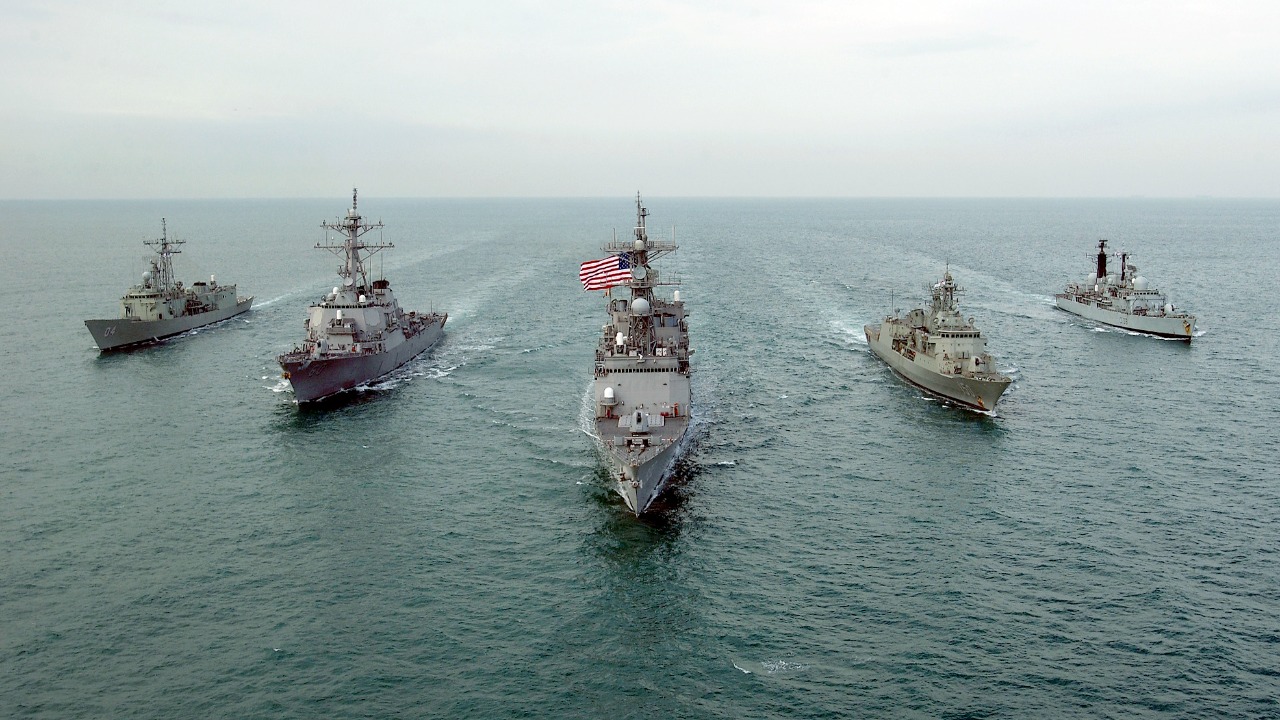
China and the United States are testing each other’s resolve in the narrow waters that separate Taiwan from the mainland. As two American warships crossed the Taiwan Strait in the first such passage of the year, China’s military publicly announced that it had tracked and monitored the transit, framing the move as a challenge to its security interests. The episode highlights how even routine naval movements now unfold under intense scrutiny, with both sides signaling that they are prepared to defend their positions.
PLA shadowing of US transit raises the temperature
Chinese authorities moved quickly to frame the latest passage as a controlled encounter rather than a surprise. The Ministry of National Defense said the PLA had monitored and tracked the transit of US military vessels through the Taiwan Strait, stressing that its forces remained on high alert to safeguard what Beijing calls national sovereignty and regional peace and stability. A related statement from PLA channels, issued from BEIJING, described the strait as a highly sensitive waterway and underlined that the operation was handled by designated units that followed the ships throughout their passage.
Chinese messaging also sought to portray the US move as a test of Beijing’s patience. Officials described the Taiwan Strait as a core security concern and warned that any external interference would be met with firm countermeasures, language that has become standard in PLA references to the area. The Spokesperson emphasized that from January, the PLA had strengthened its posture around the strait, while the News To notice reiterated that monitoring and tracking of foreign vessels was now a standing task rather than an ad hoc response.
First US transit of 2026 tests “routine” narrative
For Washington, the passage was presented as a standard assertion of navigational rights. A detailed account of the operation noted that the destroyer USS John Finn, designated DDG-113, and a US survey vessel conducted what American officials described as a routine Taiwan Strait transit in Jan. The same report, by Aaron Matthew Lariosa, highlighted that the mission was characterized as a lawful passage through international waters, with the US side stressing that such operations would continue as long as ships and aircraft are able to operate wherever international law allows, even as Chinese officials publicized their tracking of the vessels.
Chinese sources, however, underscored that this was the first time in 2026 that two US Navy ships had crossed the strait, giving the event added symbolic weight. A broadcast segment on the transit stated that Two US Navy vessels passed through the Taiwan Strait on Thursday and Friday in the first crossings since President Donald Trump took office, a framing that linked the operation directly to the new administration’s approach to China policy. The same coverage stressed that the timing, early in the year and soon after the inauguration, would be read in Beijing as a deliberate signal that the United States intends to keep a visible presence in the strait.
Air and naval drills tighten the ring around Taiwan
The maritime encounter unfolded against a backdrop of expanding Chinese military activity around Taiwan. Taipei reported that Chinese aerial operations near the island had coincided with the transit of the USS John Finn, noting that the flights took place between Friday and Saturday and involved multiple sorties that crossed into Taiwan’s air defense identification zone. According to Taipei, these Chinese activities were part of a pattern in which air and sea maneuvers are increasingly synchronized with politically sensitive events, including high-profile US transits.
Chinese forces have also staged more complex drills that go beyond simple shadowing. Taiwan’s defense ministry said that China dispatched air, navy, and missile units on a Monday to conduct joint live fire exercises around the island of Taiwan, describing the event as a coordinated show of force. That account indicated that the drills encircled the island and involved multiple branches of the PLA, suggesting a rehearsal for blockade or coercive scenarios rather than routine training. Taken together with the tracking of US ships in the Taiwan Strait, these moves point to a strategy in which Beijing uses every transit and exercise to normalize a higher tempo of operations around Taiwan.
Strategic messaging and risks for regional stability
Both sides are using the latest encounter to send calibrated messages to regional audiences. Chinese statements from SHANGHAI, carried in a Reuters dispatch, stressed that China had “monitored” the US vessels transiting the Taiwan Strait and accused Washington of undermining peace and stability. At the same time, the PLA’s formal notices from BEIJING framed the response as professional and restrained, a way to reassure neighboring states that China is not seeking open conflict even as it contests US presence. For its part, the United States has highlighted the legal basis for the passage and the routine nature of such operations, signaling to allies like Japan and the Philippines that it will continue to operate in contested waters despite Chinese objections.
The risk is that what each side views as routine signaling can collide in unpredictable ways. The PLA’s decision to track and sometimes surround foreign ships in the Taiwan Strait, combined with live fire drills that bring air, naval, and missile units into close proximity with Taiwan’s own forces, increases the chance of miscalculation or accident. At the same time, the US choice to send a front-line destroyer like the USS John Finn, with its DDG-113 designation and advanced sensors, alongside a survey vessel through such a narrow and politically charged waterway, underscores how much is now at stake in every transit. With President Donald Trump in office and both Beijing and Washington tying these movements to questions of sovereignty and credibility, the Taiwan Strait is set to remain one of the most volatile flashpoints in the Indo-Pacific, where even a single crossing can reverberate far beyond its 33 to 35 nautical miles of width at its narrowest points.