

China has quietly crossed a threshold that U.S. planners have long feared, fielding anti-ship ballistic missiles with intercontinental reach that could hold American aircraft carriers at risk as far away as the waters off Alaska. The new capability, centered on the DF-27 missile family, extends Beijing’s strike envelope deep into the Pacific and up to the northwest continental United States, reshaping assumptions about where U.S. naval forces can safely operate in a crisis.
For the Pentagon, the development is not just about range on a map, but about how a faster, more maneuverable generation of “carrier killers” could complicate any fight near Alaska, Hawaii, or even the U.S. West Coast. The emerging picture is of a People’s Liberation Army that can threaten U.S. carriers from launch sites inside China, without relying on forward bases or vulnerable ships of its own.
From regional “carrier killers” to intercontinental reach
For more than a decade, U.S. officials treated China’s anti-ship ballistic missiles as a regional problem, focused on systems like the DF-21D and DF-26 that could reach targets across the Western Pacific. That logic no longer holds. The Pentagon’s latest China Military Power Report describes Chinese forces fielding intercontinental anti-ship ballistic missiles capable of reaching the U.S. West Coast, a leap that turns what was once a theater weapon into a tool of global sea denial. In that assessment, the DF-27 stands out as a conventionally armed system designed to hit moving naval targets at distances up to roughly 8,000 kilometers, a span that covers much of the Pacific and the approaches to Alaska.
Analysts note that the DF-27 is not just another long-range rocket, but a missile that can travel at least five times the speed of sound and maneuver in flight, making it difficult for traditional missile defenses to track and intercept. Pentagon reporting describes the DF-27 as part of a broader family of conventionally armed missiles whose maximum ranges are now plotted on internal maps that extend from East Asia to Hawaii, Alaska, and the northwest continental USA. Those same assessments warn that China’s anti-ship ballistic missiles, now potentially extending to intercontinental ranges, are intended to threaten U.S. naval forces as well as enable conventional and nuclear strikes against distant targets.
Why Alaska suddenly sits on the front line
Alaska has long been a strategic outpost, but the combination of Chinese and Russian capabilities is pushing it back to the center of U.S. defense planning. Military officials now describe Alaska as a key hub in any Pacific conflict, with its airfields, radar sites, and deep-water ports offering a launchpad for operations across the Arctic and into the North Pacific. Reporting on the Pentagon’s posture reviews notes that Alaska’s infrastructure would carry strategic weight in a Pacific fight in a way that rivals, or even exceeds, some closer-in bases that sit directly under Chinese missile arcs.
That renewed focus is driven in part by the recognition that Chinese missiles can now reach far beyond the first island chain. As the DF-27 and related systems come online, the waters south and west of Alaska, once considered relatively secure for carrier strike groups, fall within potential engagement zones. U.S. commanders have begun to treat Alaska not only as a sanctuary for bombers and fighters, but as a region whose ports and sea lanes could be targeted by long-range Chinese missiles in the opening hours of a conflict. The twin pressures from Russia and China, both operating in the broader Arctic and North Pacific, are pushing the Pentagon to harden bases, disperse assets, and rehearse operations that assume Alaska itself could be contested.
How the DF-27 changes the risk calculus for U.S. carriers
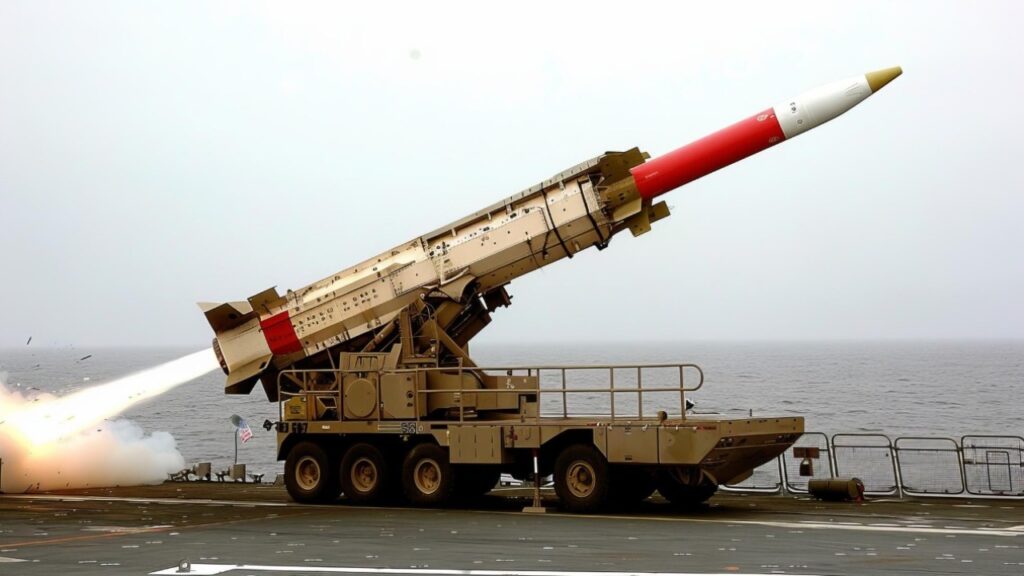
The DF-27 is emerging as the centerpiece of China’s effort to hold U.S. carriers at risk far from its shores. Pentagon analysis cited in recent reporting describes the DF-27 as a “World’s 1st Conventional ICBM That Threatens To Cripple” the U.S. Navy and “Hit Mainland USA,” language that underscores how unusual it is to see intercontinental range paired with a conventional, anti-ship mission. With an estimated reach of up to 8,000 kilometers, the DF-27 can theoretically strike targets in the northwest continental USA and across large swaths of the central and eastern Pacific, including waters where U.S. carriers might operate near Alaska or Hawaii.
That range is not just theoretical. The Pentagon’s China Military Power Report, summarized in multiple analyses, concludes that Beijing has already fielded the DF-27 and integrated it into the People’s Liberation Army Rocket Force. One assessment notes that China’s missile forces can now hit the U.S. Navy almost anywhere in the Pacific, combining short-range, medium-range, and intercontinental systems into a layered threat. Another points out that, in theory, the DF-27 could sink a U.S. Navy aircraft carrier docked at Pearl Harbor, a stark illustration of how port facilities and fixed infrastructure are now as vulnerable as ships at sea. Taken together, these findings suggest that carriers operating near Alaska would have to assume they are within reach of Chinese launchers located thousands of kilometers away on the Chinese mainland.
Speed, maneuverability, and the challenge for missile defenses
Range alone does not make a missile a carrier killer. What worries U.S. planners is the combination of distance, speed, and maneuverability that defines China’s newest systems. Reporting on the DF-27 and related missiles notes that they can travel at least five times the speed of sound and execute maneuvers during flight, characteristics associated with hypersonic glide vehicles. Such profiles compress decision times for defenders and complicate the tracking solutions needed for interceptors to succeed. Traditional ballistic missile defenses are optimized for more predictable trajectories, not for weapons that can shift course in the terminal phase to home in on moving ships.
The Pentagon’s own assessments emphasize that China’s anti-ship ballistic missiles are designed to defeat layered defenses and overwhelm carrier strike groups. A map included in the China Military Power Report, described in recent coverage, shows the maximum ranges of conventionally armed Chinese missiles, with the DF-27’s arc sweeping across the Pacific and touching U.S. bases that together host multiple aircraft carriers. Analysts warn that if China can coordinate salvos of such missiles, supported by space-based sensors and over-the-horizon targeting, it could challenge even the most advanced U.S. naval air defenses. That is the context for a stark warning from the U.S. defense leadership that China could, in a worst-case scenario, sink an entire U.S. carrier fleet in as little as 20 minutes, a scenario that assumes concentrated missile fire against a limited number of high-value ships.
U.S. responses: dispersal, hardening, and new deterrence math
The emerging missile threat is already reshaping U.S. posture and planning. In Alaska, commanders are investing in infrastructure that can support more frequent deployments of fighters, bombers, and naval forces, while also improving resilience against long-range strikes. Reports on the new focus on Alaska describe efforts to expand training ranges, upgrade air defense systems, and integrate the state more tightly into Pacific war plans. The logic is straightforward: if Chinese missiles can reach farther, U.S. forces must be able to operate from a wider set of locations, complicating Beijing’s targeting and reducing the payoff of any single strike.
At sea, the U.S. Navy is experimenting with new concepts that assume carriers may have to operate at greater distances from contested zones, relying more heavily on long-range aircraft, unmanned systems, and distributed surface groups. Analysts point out that dispersal, deception, and rapid maneuver will be essential to surviving in an environment where intercontinental anti-ship missiles can reach deep into the Pacific. At the strategic level, the Pentagon’s warnings about China’s growing missile inventory, including projections that Beijing could field around 1,000 nuclear warheads by 2030, are feeding a broader debate about deterrence. The ability of China’s missile forces to threaten U.S. carriers near Alaska, Hawaii, and the West Coast is no longer a hypothetical, but a factor that must be baked into every serious discussion of crisis stability and escalation in the Pacific.